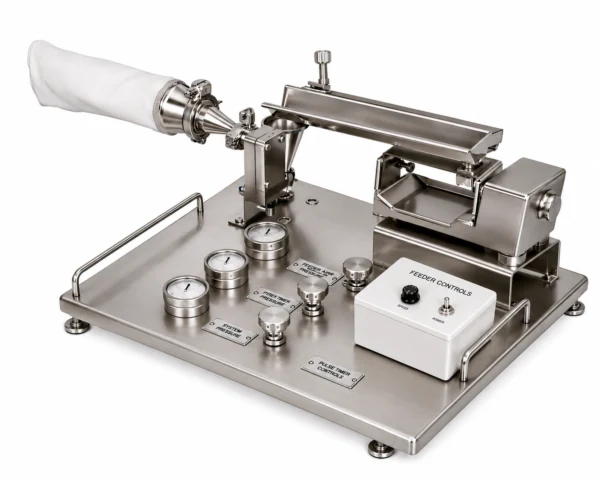
Fluid Energy Model 00 JET-O-MIZER
Dry fracture or deagglomeration when justified by the powder
Confirm: Feed behavior, gas compatibility, collection and particle damage.
View Fluid Energy Model 00 JET-O-MIZER
JET-MILLING SUITABILITY
Choose a mechanism around the powder change you need: precursor activation, particle fracture, loose-agglomerate separation or ingredient distribution.
Jet mills use gas-driven particle collisions; ball mills transfer energy through grinding media. For cathode powders, the right choice depends on the processing stage and acceptable changes in structure, surface and contamination. Blending may be sufficient when the particles already have the required properties.
| Route and feed | Purpose to evaluate | Limits and checks |
|---|---|---|
| Dry compressed-gas jet milling | Particle collisions for a justified dry fracture or deagglomeration task. | Feed/collection behavior, gas compatibility, contact-surface wear and particle damage. Not a wet-slurry process. |
| Planetary or mixer ball milling | Media/vessel contact for precursor activation, homogenization or a defined mechanical experiment. | Approved wet or dry method, compatible jar/media, wear, temperature and structural change. |
| Closed-container powder blending | Distribution of compatible ingredients without intentional fracture. | Sampling, segregation and retained morphology. Blending alone does not establish a coating or host infiltration. |
No. The laboratory Fluid Energy candidate shown here uses compressed gas to process dry powder. Wet jet milling describes a liquid-suspension process. A slurry-dispersion result does not establish performance or compatibility for a dry gas jet mill, and the reverse also applies.
Fraunhofer IPA reports wet jet milling in water-based LFP electrode-slurry preparation. That is useful terminology and process-stage context, not a claim that the dry equipment pictured on these pages can reproduce the study. Review slurry mixing and dispersion as a separate equipment-selection question.
Precursor preparation aims to distribute reactants, reduce selected starting particles or mechanically activate a planned reaction. The result may still require thermal or other synthesis steps. A finished cathode powder already has a phase, morphology and surface condition that may need to be retained.
Write the intended transformation in one sentence before comparing machines. “Distribute carbon without changing active-particle shape” leads to a different trial from “activate precursors before a solid-state reaction.” Neither objective is adequately described by “make it finer.”
A jet mill accelerates a dry feed using compressed gas. Particle collisions and, depending on the system, classification determine the collected powder. There are no grinding balls, but feed equipment, liners and collection surfaces remain potential sources of wear or contamination.
A planetary or mixer mill uses contact with grinding media and a vessel to transfer impact and frictional energy. Jar material, media, loading, cycle history and chemistry all affect the outcome. Equal run times across two mills do not imply equal treatment.
If the active powder already meets its size and morphology requirements, ingredient distribution may be the remaining task. Closed-container powder blending is worth comparing before introducing deliberate fracture. Check uniformity through representative sampling and verify that transfer does not undo the blend through segregation.
Blending is not automatically equivalent to carbon coating or infiltration into a porous host. Those claims require evidence of the actual composite structure. Sulfur-carbon preparation is a useful example of why appearance alone cannot establish intimate component contact.
Start with one characterized feed and retain an untreated control. Define the desired change, the unacceptable changes and the methods used to distinguish them. Use a blend-only reference where the question is whether grinding adds value beyond homogenization.
Compare recovered mass, the complete size distribution, microscopy, relevant phase analysis and contaminant uptake. When electrode behavior is the endpoint, keep electrode fabrication and cell testing consistent. Changing several downstream variables at once obscures what the mill contributed.
Gas demand, feeding, collection and residence behavior matter in jet-milling scale-up. Mechanical energy transfer, cooling, tool wear and handling differ between laboratory ball mills and larger systems. A small-batch result does not establish production throughput.
Ask Glen Mills to review the material, working quantity, target result and restrictions before recommending a configuration. A feasibility test can define useful next steps; it is not a substitute for validation in the intended production process.
Dry fracture or deagglomeration when justified by the powder
Confirm: Feed behavior, gas compatibility, collection and particle damage.
View Fluid Energy Model 00 JET-O-MIZER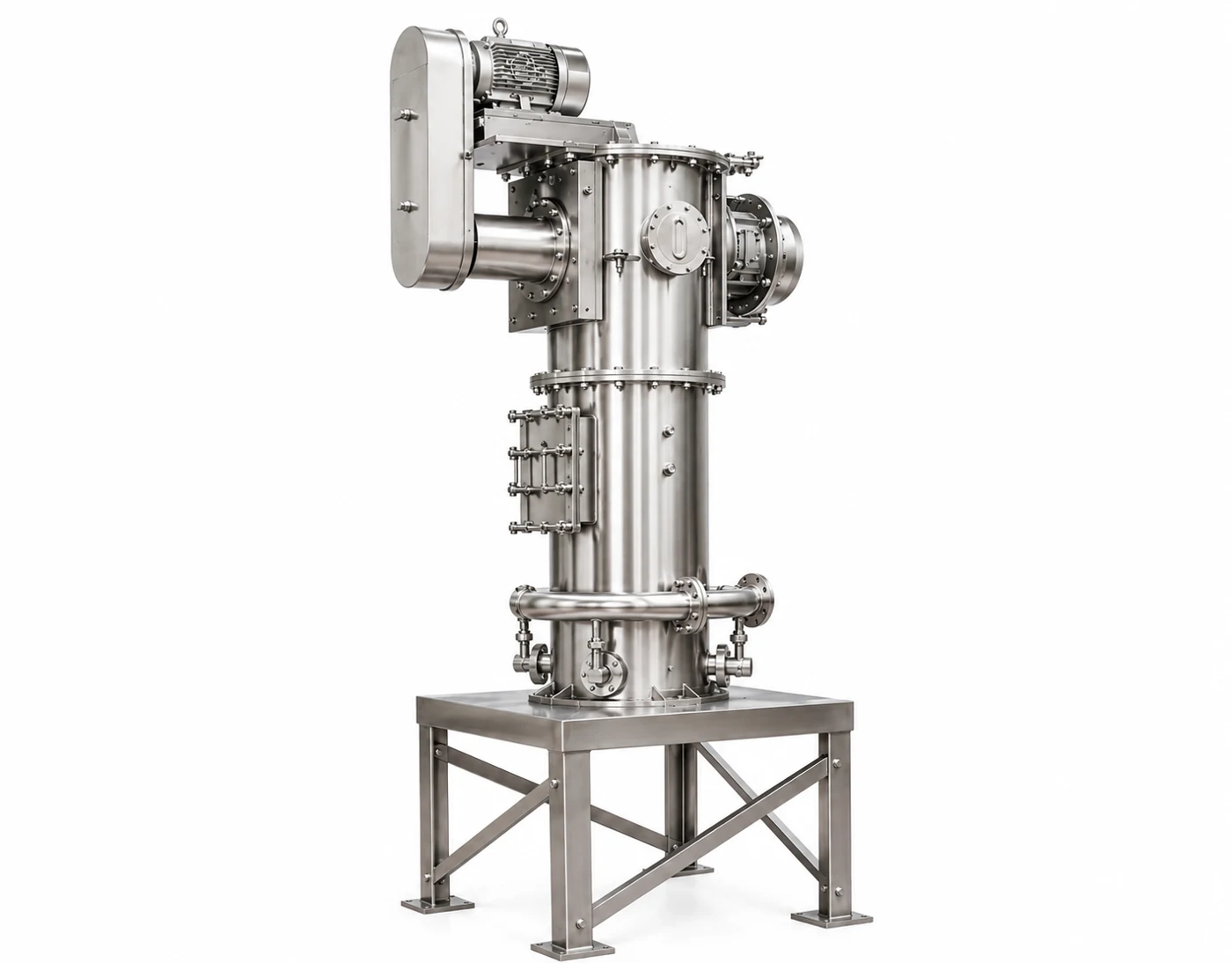
Jet-milling scale-up and active-classification review
Confirm: Material suitability, feed/collection configuration, capacity and scale-up validation.
View Fluid Energy ROTO-JET Jet MillThese are candidates for application review. Equipment listings do not establish cathode-specific performance, inert-gas capability or containment. Confirm the exact configuration with Glen Mills.
Precursor activation or ingredient blending is a different task from dry jet milling. These alternatives support a material-specific choice.
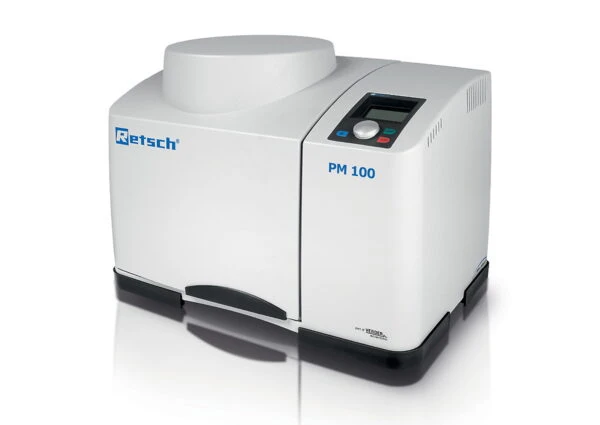
Precursor activation and defined mechanical research
Confirm: Jar and media compatibility, wear, temperature and retained phase.
View RETSCH PM 100 Planetary Ball Mill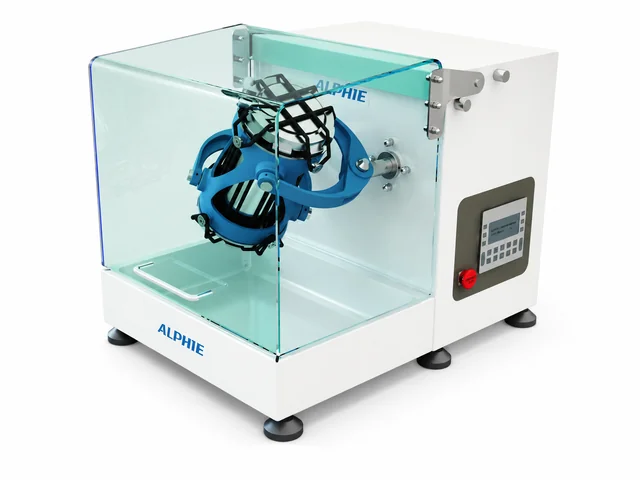
Closed-container blending without intentional grinding
Confirm: Blend uniformity, segregation and required handling configuration.
View Hexagon Product Development Alphie 3These are candidates for application review. Equipment listings do not establish cathode-specific performance, inert-gas capability or containment. Confirm the exact configuration with Glen Mills.
No. Eliminating grinding balls removes one possible wear source, but contact surfaces and feed/collection equipment still need to be assessed.
No. It can be useful in precursor activation and deliberate research modifications. Finished active powders need a justified objective and checks for unwanted change.
No. Composition, morphology, coating, additives and process stage must be evaluated for each material.
Prepared . Literature and manufacturer references support the discussion; they do not establish a tested Glen Mills recipe for your powder.
Share the chemistry, processing stage, working quantity and acceptance measures. Glen Mills can review equipment candidates and whether a feasibility test is an appropriate next step.