Particles and process stage
Removing water can itself alter structure. A change after processing may arise from drying or exposure as well as mechanical treatment. Record feed conditioning and keep an untreated sample with the same storage history.

JET-MILLING SUITABILITY
Start Prussian White trials with gentle blending, agglomerate assessment and a defined water-content specification. Preserve the framework and document the drying history.
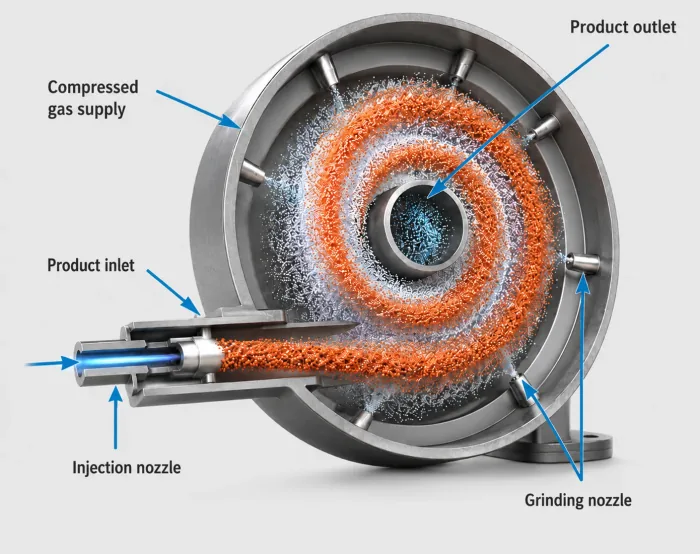
Prussian White is a sodium-rich Prussian blue analogue studied for sodium-ion cathodes. Its framework, vacancies, sodium content and water content distinguish a particular grade; it is not one invariant powder specification.
Removing water can itself alter structure. A change after processing may arise from drying or exposure as well as mechanical treatment. Record feed conditioning and keep an untreated sample with the same storage history.
Agree on water-content measurement, conditioning and storage with the material owner. Avoid specifying a generic drying temperature. Review the exact SDS and chemical compatibility before introducing cleaning agents or a new handling route.
Technical background: Local structure of hydrated and dehydrated Prussian White. See the source limits below before applying a published method to this powder.
Jet milling is not the default recommendation. Start by determining whether the size issue is loose aggregation and whether the required separation can be achieved gently. Any proposed high-energy treatment needs evidence of retained framework and function.
Do not select intensive ball milling merely to obtain a finer number. A mechanochemical research study would need a separate rationale and structural controls; this draft prioritizes gentler handling of finished Prussian White.
Evaluate closed-container blending for compatible additions and analytical sieving for appropriate agglomerate assessment. Sieving is not a substitute for measuring fine primary particles, and it must not be assumed to preserve every fragile aggregate.
A proposed evaluation brief, not a validated processing recipe.
Start by checking whether the intended powder change calls for dry jet milling. Jet milling is not the first route proposed for this preparation task; review the material-specific method discussion before requesting a configuration.
Explore laboratory jet mills Explore pilot and production jet mills
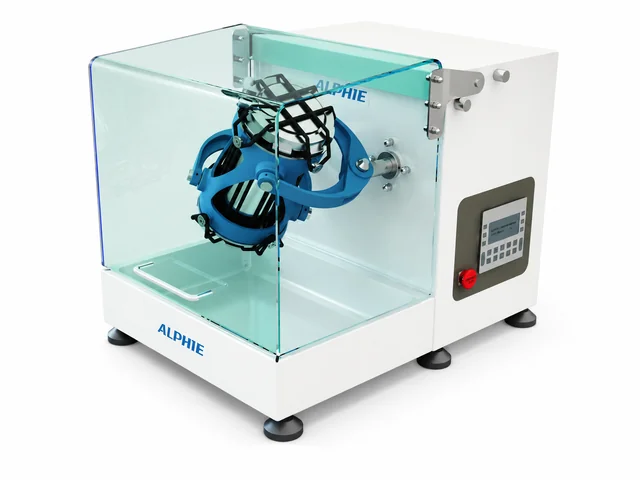
Closed-container blending without intentional grinding
Confirm: Blend uniformity, segregation and required handling configuration.
View Hexagon Product Development Alphie 3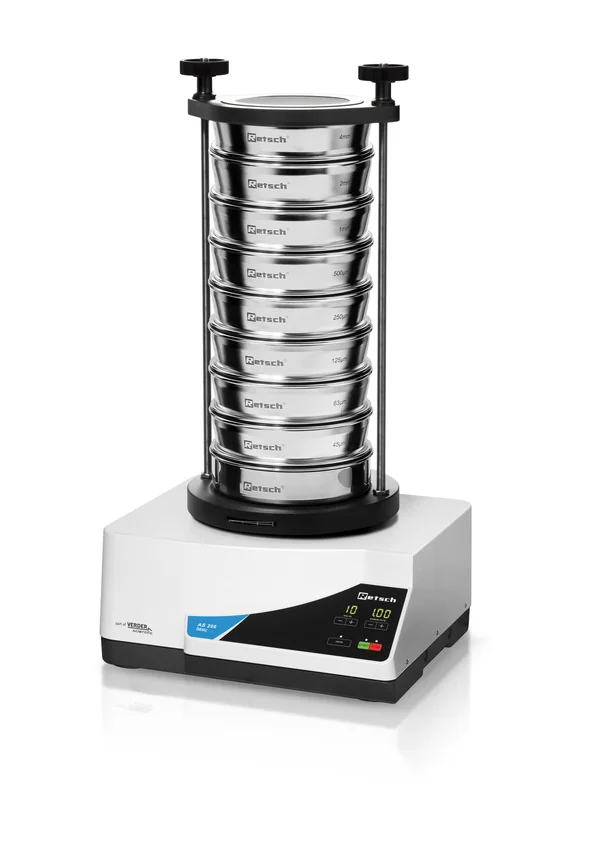
Suitable sieve-fraction and agglomerate assessment
Confirm: Mesh selection, sample behavior and suitability for the fraction of interest.
View RETSCH AS 200 Basic Sieve ShakerThese are candidates for application review. Equipment listings do not establish cathode-specific performance, inert-gas capability or containment. Confirm the exact configuration with Glen Mills.
Compare framework characterization, water content, microscopy and the relevant powder distribution. Assess the result with a hydration-matched control so gentler processing is not credited for a separate drying effect.
Percentiles depend on the measurement and weighting basis. Report the method, dispersion conditions and complete curve. These labels are definitions, not target sizes or equipment guarantees.
Share the chemistry, processing stage, quantity and current condition.
Confirm suitability, safety information, scope and acceptance measures before shipping.
Evaluate the intended change against morphology, contamination and retained function.
Review feeding, recovery, handling and the additional validation needed.
Free feasibility testing depends on material suitability and an agreed scope. Ask which measurements are available, how much sample is required and which handling arrangements are needed. Do not ship powder before written instructions.
Moving from a laboratory trial to pilot or production work requires review of feeding, collection, cleaning, thermal behavior and throughput. A laboratory result does not establish performance at a larger scale.
Get an equipment recommendationJet milling is not the starting recommendation for finished Prussian White. Determine whether gentle separation of loose clumps can address the problem, and check framework and water-content changes before considering intensive treatment.
Specify composition, processing stage, primary and secondary morphology where applicable, and the full particle-size distribution. For Prussian White, the first decision is: separate loose agglomerate management from framework modification and from controlled dehydration.
Agree on conditioning with the material owner first. Drying can itself change the framework. Use a hydration-matched reference when evaluating mechanical effects; no generic drying temperature is recommended here.
Only for a separately justified mechanical-research question with framework and hydration controls. Gentle blending and appropriate agglomerate assessment are the first comparisons in this draft.
Not by itself. Appropriate sieving can help assess a selected coarse fraction or agglomerates, but fine primary-particle measurement requires a suitable characterization method.
Share the exact composition or a nonconfidential description, SDS, processing stage, starting condition, desired result and quantity. Include atmosphere and impurity limits. Glen Mills must agree on suitability, scope and shipping before receiving the sample.
Primary structural research shows water-related changes and strain in hydrated/dehydrated Prussian White. The recommendation to begin gently is a conservative trial approach, not an established universal process.
Prepared . Literature and manufacturer references support the discussion; they do not establish a tested Glen Mills recipe for your powder.
Application-selection guidance for discussion with Glen Mills. Equipment and application support since 1980
YOUR MATERIAL. YOUR NEXT STEP.
Tell us which powder you have, what needs to change and what must remain intact.
Start with a jet-milling suitability review. Request free feasibility testing or an equipment recommendation; the team will confirm whether dry jet milling fits the material and agree on scope before arranging a test.
Start with a nonconfidential description. Contact us before sharing proprietary formulations, and wait for written shipping instructions before sending material.