
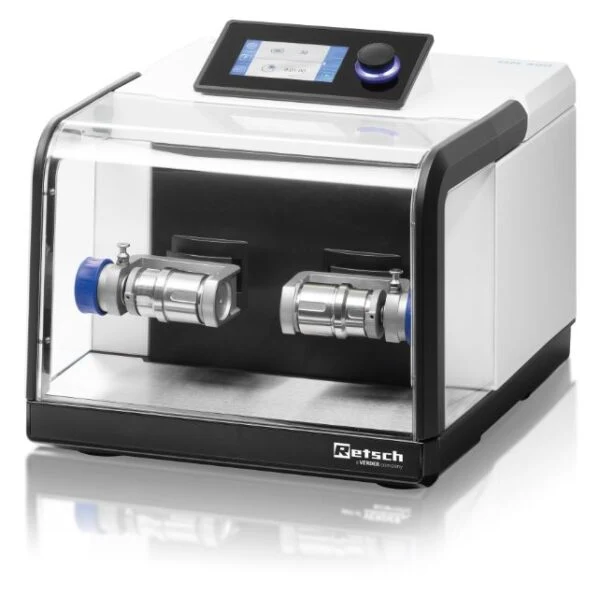
Can one cannabis homogenization method cover every product?
Not without evaluation. Product composition and the downstream analysis determine whether the same tools and preparation conditions remain appropriate.
Possession of cannabis was prohibited worldwide in 1925 but today, limited consumption is legal in a growing number of countries, for example Canada, the Czech Republic or Israel. Many countries have started the process of legalising the use of cannabis under strictly regimented conditions for medical treatment, among them Germany.
The concentrations of cannabinoids and terpenoids are the main points of interest in the quality control of cannabis and related products. To ensure reliable analytical results, the sample preparation process for cannabis needs to be adaptable to the considerable complexity of the various plant matrices. There are some challenges to overcome: samples can be sticky (especially in the flower buds) and the sample amount may vary greatly. Furthermore, residues leading to sample loss are not acceptable for many testing labs. Retsch offers a range of different laboratory mills to cover the various requirements, including a cutting mill for grinding large sample quantities prior to CBD oil extraction.
Sample homogenisation and small-scale production of ground cannabis The SM 300 cutting mill is perfect for small scale grinding of dried plant materials such as cannabis (whole plants, flower buds, trim leaves), herbs or leaves. The degree of product fineness can be influenced by the speed and by choosing a suitable bottom sieve. Specific particle size ranges required for different extraction methods (ethanol, supercritical CO2) can be obtained. Usually, for cannabis CBD oil extraction processes, particle sizes around 2 mm (extraction with supercritical CO2) or 5-15 mm (extraction with ethanol) particles are required. Retsch offers a 316L foodGrade version of the SM 300 . All parts in contact with the sample are made of 316L steel, including the long stock hopper, the parallel section rotor and the bottom sieve. For cutting hard and rather compact samples, it is recommended to use the optional 316L rotor with blades made of FDA-certified stainless steel. An optional sample outlet and cyclone unit with 30 l receptacle are also available in 316L steel.
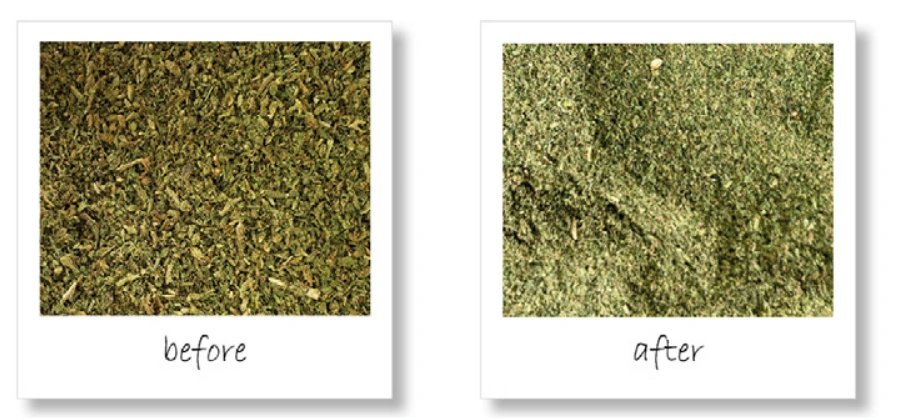
Cutting Mill SM 300 316L foodGrade.
In the SM 300 >40 kg/h dried flower buds of medical cannabis of approximately 50 mm size can be pulverised at 700 rpm to a fineness mostly below 2 mm when using a 4 mm bottom sieve . Sample loss is negligible, some dust remains in the grinding chamber and on the sieves or the surfaces of the cyclone and receptacle, usually <0.05%. The low grinding speed ensures good homogenisation results and minimises warming effects.
The fold-back hopper of the SM 300 is perfectly suited for easy cleaning, just like the bottom sieves without cassette or edges, where sample material might get trapped. Cleaning of the cyclone and the 30-l receptacle is also quickly done.
Sample homogenisation in the Ultra Centrifugal Mill ZM 300 The Ultra Centrifugal Mill ZM 300 is the ideal mill for pulverising fibrous samples like hemp plants. It achieves a maximum speed of 23,000 rpm and can be equipped with a large range of accessories, allowing for adaption to the sample´s requirements. Cannabis contains oil which makes it a temperature-sensitive material; to reduce heat build-up during grinding, it is recommended to use a distance sieve. Thanks to a small gap between the sieve and the rotor, the shearing forces and the formation of heat are reduced. 20 g of a pre-cut hemp flowers can be ground to a particle size smaller than 0.5 mm by using a 0.5 mm distance sieve at a speed of 23,000 rpm . The use of a cyclone has a cooling effect on the sample and helps to efficiently discharge the material from the grinding chamber. The pulverised sample is now ready for, e. g. extraction of pesticides with the QuEChERS method.
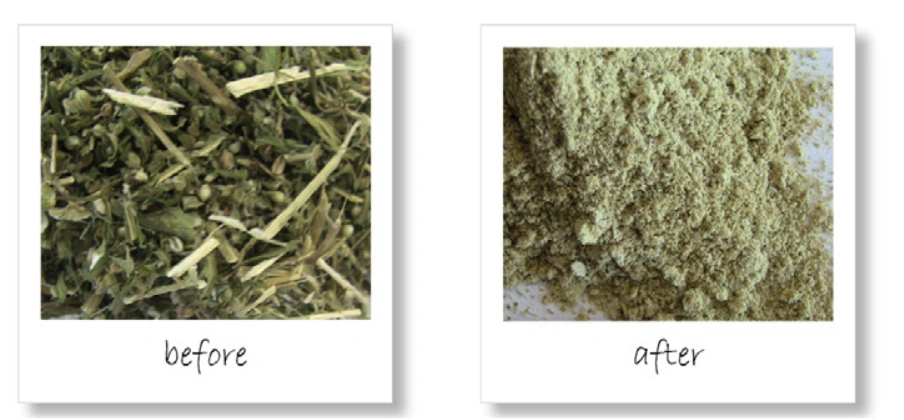
Pulverisation of dried cannabis flowers in the CryoMill for subsequent pesticide analysis The extraction via QuEChERS can be improved by reducing the particle size to <0.5 mm. Due to the oily and sticky sample properties, the Ultra Centrifugal Mill is not suitable to achieve this. Embrittlement of the sample, e. g. with liquid nitrogen, is a very effective way of making oily materials break easily. Cryogenic grinders like RETSCH CryoMill or the Mixer Mill MM 500 control are specially designed for these applications, as they continuously cool the grinding jar, and thus the sample, with LN2. The CryoMill produces grind sizes <0.1 mm, which means for the cannabis sample that higher pesticide amounts are detected after extraction than, for example, after grinding in a rotor mill. Application example: 5 g pre-cut cannabis sample are ground in a 50 ml stainless steel grinding jar with one 25 mm stainless steel grinding ball. Sample and ball are filled into the jar, the lid is tightly closed, and the jar is clamped into the CryoMill. An automatic pre-cooling function ensures that the grinding process does not start before a temperature of -196°C is reached and maintained. The pre-cooling time is set to 3 min at 5 Hz. Grinding is done at a frequency of 30 Hz for 3 min. Thanks to the autofill system of the CryoMill, the user never comes into contact with liquid nitrogen. The embrittled sample can be pulverised to much smaller particle sizes than in the ZM 300 . Still, for larger sample quantities, the ZM 300 is a suitable choice.
Contract lab increases sample throughput with Mixer Mill MM 400 QSI, a German contract laboratory with a focus on pharmaceutical products and cannabis, successfully uses the Mixer Mill MM 400 to quickly homogenise cannabis samples for subsequent extraction. They were facing the challenge of homogenising around 30 g of flower buds, which can be quite sticky, with minimum sample residues after grinding to avoid cross contamination and due to specific legal rules in handling cannabis samples. Cannabis samples were usually ground in common grinder systems. It took them about 15 to 30 min to homogenise 30 g of sample, plus 5 min cleaning. Retsch introduced the Mixer Mill MM 400 including an adapter for 8 x 50 ml Falcon tubes and a series of tests started to ascertain optimum sample filling, grinding time, homogenisation grade, reproducibility of the ground samples and sample residues. QSI also wanted to learn about general processes like freezing the sample before grinding. The following procedure has been established: each tube is filled with around 4 g flower buds, thus 32 g is pulverised in one run. This is ideal if larger sample amounts are required, or if up to 8 different samples need to be processed. Grinding balls and sample material are frozen at -22°C before grinding.
Drug Discovery, Pharmaceuticals & Cannabis Testing
Two 15 mm grinding balls of stainless steel are added to each tube, grinding is then performed at 25 Hz for only 2 min . Cleaning of the grinding balls is very easy – rinsing with acetone is sufficient. The tubes are disposed after use. The new method requires about 3 minutes in total, whereas the former method took up to 35 minutes. Especially for testing labs with large sample throughput, the method involving the MM 400 is a great alternative. In addition to the time factor, the MM 400 offers another advantage over a conventional grinder: The sample loss lies in a tolerable range of 4-5%. Furthermore, the relative standard deviation is usually less in samples homogenised in the MM 400, for example from 5% to 2% in the case of d9-THC for one sample.
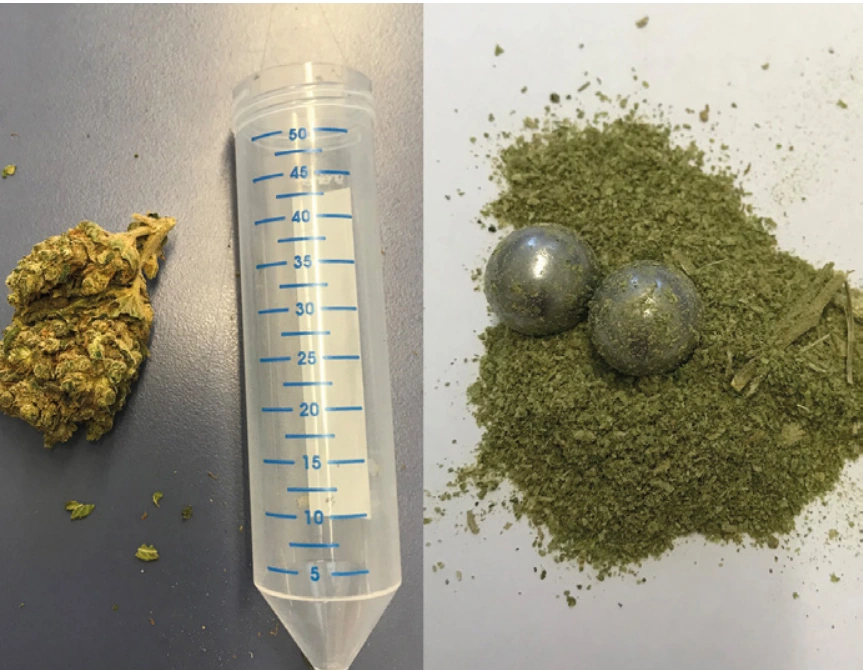
Mixer Mill MM 400.
Plan the configuration for your material.
Identify which constituents need to remain represented through grinding and recovery. A dried plant part and an oil-rich preparation may need different tools or thermal handling. Assess the prepared portion with the selected extraction method, including any transfer losses that change what reaches the assay.
| Consideration | Information to provide |
|---|---|
| Matrix variation | Plant parts and product form |
| Target preservation | Heat-sensitive or volatile components |
| Assay compatibility | Extraction and recovered sample |
How should the application examples be used?
The results describe the materials and configurations discussed here. Confirm equipment options, contact materials and operating conditions for your own sample before adopting a method. A demonstrated endpoint does not guarantee the same outcome for a different material.
Discuss material testing with Glen Mills or request further information or a quote.
Explore the equipment discussed
- RETSCH MM 400 Mixer Mill
- RETSCH SM 300 Cutting Mill
- RETSCH CryoMill Cryogenic Mixer Mill
- RETSCH ZM 300 Ultra Centrifugal Mill