

Can a production cut be used directly as an analytical sample?
Only after assessing representativeness and assay suitability. A process-sized material is not automatically homogeneous enough for a small analytical portion.
In the rapidly expanding world of cannabis legalization and consumption, ensuring the highest standards of quality control is paramount for safeguarding public health and safety. As cannabis products become increasingly available to a growing global market, comprehensive quality control measures are indispensable to guarantee consistent potency, purity, and safety. In this article, we explore the role of laboratory mills in quality control and small scale production of cannabis and related products.
The concentrations of cannabinoids and terpenoids are the main points of interest in the quality control of cannabis-related products. These are usually detected by HPLC analysis. The pesticide contents is also of interest. Cannabis occurs in a variety of edible forms, e. g. ground leaves, concentrate or related products like jelly bears or cookies. To ensure reliable analytical results, the sample preparation process for cannabis needs to be adaptable to the considerable complexity of the various matrices. There are some challenges to overcome: samples may be sticky, fibrous or fatty and the sample amount may vary greatly.
Although Cannabis is increasingly used for medical treatment, in many countries it is still an illegal drug and the possession and sales is a criminal offence. Therefore, not only the quality control for medical applications is relevant but also analysis of the active components in a penal context. In trials of drug offences, the expertise on the active components of the
drug has substantial influence on the penalty. For cannabis, for example, a content of more than 7.5 g tetrahydrocannabinol (THC) is already considered critical. The expertise is usually given by the local Office of Criminal Investigation.
Small-scale production of ground cannabis in the SM 300 316L foodGrade
Cutting mills are widely used for grinding of soft, medium-hard, tough, elastic, fibrous samples, and heterogeneous material mixes.
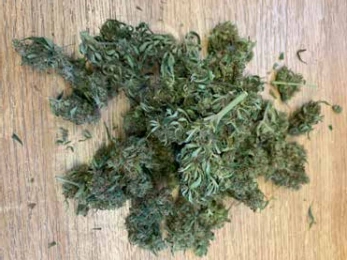
RETSCH’s Cutting Mill SM 300 is avaiable as a 316L foodGrade version where all parts in contact with the sample are made of 316L steel or FDA-certified stainless steel, including the hopper, rotor and bottom sieve.
The mill is perfect for small-scale grinding of dried plant materials such as cannabis (whole plants, flower buds, sugar leaves), herbs or leaves. The degree of product fineness can be influenced by the speed and by choosing a suitable bottom sieve. Specific particle size ranges required for different extraction methods (ethanol, supercritical CO2) can be obtained. Usually, for cannabis CBD oil extraction processes, particle sizes around 2 mm (extraction with supercritical CO2) or 5-15 mm (extraction with ethanol) particles are required.
In the SM 300, up to 25-30 kg/h dried flower buds of medical cannabis of approximately 50 mm size can be pulverized at 3000 rpm to a fineness mostly below 2 mm when using a 4 mm bottom sieve (material supplied by the University Hohenheim, Germany). This rotor can also be used if smaller particle sizes need to be obtained by using a bottom sieve with aperture sizes of 1-2 mm. The reduction of the speed to 2000 rpm helps to avoid sample warming and thus blockages of the sieve apertures. The exchange of the 30 l receptacle on the cyclone is easy and sample recovery is also facilitated by the smooth surfaces of the 316L material.
If larger sample particles 5-15 mm are required, e. g. for ethanol extraction, simply select a bottom sieve with larger apertures, e.g. 10 mm, and select a lower speed, e.g. 700 rpm. This results in larger particles, and less warming effects. The sample throughput was the same as mentioned above when using a 4 mm bottom sieve at 3000 rpm.
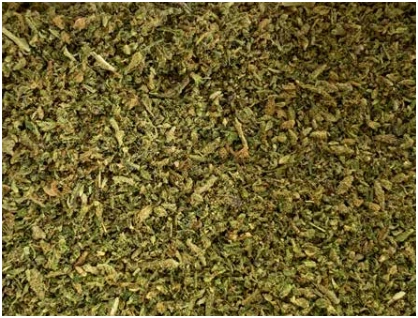
Cannabis after grinding in the SM 300 foodGrade, left: using a 4 mm bottom sieve and grinding at 3000 rpm, right, using a 10 mm bottom sieve and grinding at 700 rpm
Cutting Mill SM 300 foodGrade
Sample homogenization in the Ultra Centrifugal Mill ZM 300
The Ultra Centrifugal Mill ZM 200 is the ideal mill for pulverizing granules like grains or fibrous samples like hemp plants. It achieves a maximum speed of 18,000 min-1 and can be equipped with a large range of accessories, allowing for adaption to the sample´s requirements. The shearing forces between rotor and ring sieve facilitate successful size reduction of fibrous materials. Hemp contains oil which makes it a temperature-sensitive material; to reduce heat build-up during grinding, it is recommended to use a distance sieve. Thanks to a small gap between the sieve and the rotor, the shearing forces and the formation of heat are reduced. 20 g of the pre-cut hemp flowers can be ground to a particle size smaller than 0.5 mm by using a 0.5 mm distance sieve at a speed of 18,000 min-1. The use of a cyclone has a cooling effect on the sample and helps to efficiently discharge the material from the grinding chamber. The pulverized sample is now ready for, e. g. extraction of pesticides with the QuEChERS method.
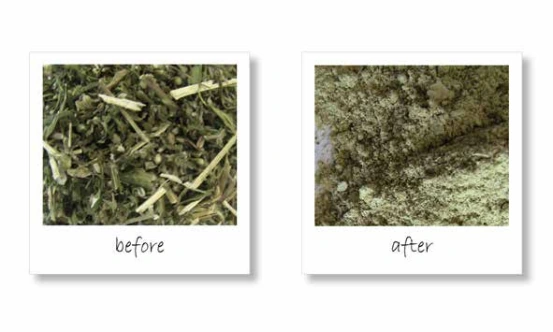
Pesticide extraction with the Mixer Mill MM 400 (QuEChERS method)
The so-called QuEChERS method (“quick, easy, cheap, effective, rugged and safe”) was developed to make sample preparation to pesticide residue analysis more efficient. It basically consists of three steps: Homogenization – Extraction – Analysis. During the homogenization process, care must be taken that the sample does not get too warm as some pesticides are volatile. After the homogenization, 10 g of the pulverized hemp sample are extracted with 10 ml acetonitrile. In the next step, the organic phase is dried and tested for pesticides with chromatographic analysis. To avoid ghost peaks in the chromatograms, the sample is extracted in the presence of a salt mixture (e. g. sodium chloride and magnesium sulphate in a 1:2 ratio). To transfer the pesticides from the sample into the organic phase, the mixture is agitated for 1 to 3 minutes with acetonitrile and salt. The mixture can be agitated in a laboratory mill like RETSCH’s Mixer Mill MM 400. It shakes the sample in a 50 mL Falcon tube with a frequency of up to 30 Hz, thus ensuring thorough mixing of the sample to improve subsequent extraction.
Pulverization of hemp in the CryoMill or the MM 500 vario for subsequent pesticide analysis
The extraction via QuEChERS can be improved by reducing the particle size to <0.5 mm. Due to the oily and sticky sample properties, the Ultra Centrifugal Mill is not suitable to achieve this. Embrittlement of the sample, e. g. with liquid nitrogen, is a very effective way of making oily materials break easily. Cryogenic grinders like RETSCH’s CryoMill are specially designed for these applications, as they continuously cool the grinding jar, and thus the sample, with LN2. The CryoMill produces grind sizes <0.1 mm, which means for the hemp sample that higher pesticide amounts are detected after extraction than, for example, in the ZM 200. 5 g pre-cut hemp sample were ground in a 50 ml stainless steel grinding jar with one 25 mm stainless steel grinding ball. Sample and ball were filled in the grinding jar, the lid was tightly closed, and the jar was clamped into the CryoMill. An
Ultra Centrifugal Mill ZM 300
Mixer Mill MM 400
automatic pre-cooling function ensures that the grinding process does not start before a temperature of -196°C is reached and maintained. The pre-cooling time was set to 3 min at 5 Hz. Grinding was done at 30 Hz for 3 min. Thanks to the autofill system of the CryoMill, the user never comes into contact to liquid nitrogen, the machine keeps the temperature at -196°C during grinding. The embrittled sample can now be ground to much smaller particle sizes than in the ZM 200. Still, for larger sample quantities, the ZM 200 is a suitable choice.
Another option for cryogenic grinding is using the Mixer Mill MM 500 vario – which accommodates 6 grinding jars with a maximum volume of 50 ml. The procedure is comparable to that in the CryoMill, except that the embrittling of the sample takes place in a bath with liquid nitrogen. After about 3-5 min, the LN2 stops boiling and the 6 grinding jars with sample can be placed in the MM 500 vario and pulverized for 2 min at 35 Hz.
Quick pulverization of 8 samples of flower buds with almost no residues for extraction of THC/CBDs
Testing labs need reliable solutions for grinding several Cannabis samples each day, the sample amount to be ground varies from 4 to about 30 g per sample. Often they are facing difficulties because of sample residues, as flower buds are sticky due to their oily content. Thus, cleaning effort is a time factor for testing labs. A classic grinder is often used, as the residues are in a tolerable range. Grinding 30 g flower buds needs approximately 15-30 min, depending on the sample´s properties, and cleaning another 5-10 min. The Mixer Mill MM 400, which can be equipped with 8 x 50 ml Falcon tubes, offers a very comfortable and fast solution. Per tube, around 4 g flower buds can be ground, thus 32 g in one run, if larger sample amounts are required, or up to 8 different samples. Grinding balls and sample material is frozen at -22°C before grinding. In each tube 2 x 15 mm grinding balls stainless steel are added, grinding is then performed at 25 H for only 2 min. Cleaning of the balls is very easy – just rinsing with acetone is required. The tubes are disposed after use. Sample loss is in a range of 4-5%, which is tolerable. Despite the time factor, the MM 400 offers another advantage over the Grinder: The relative standard deviation is usually less in samples homogenized in the MM 400, for example from 5% to 2% in the case of d9-THC.
Results after homogenization in a Grinder (left) and in the MM 400 (right) - /g/100g)
CryoMill with 50 l dewar
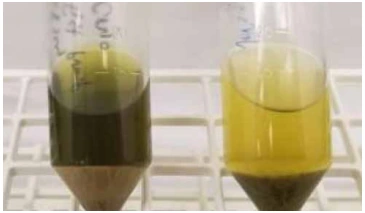
32 g sample (or 8 x 4 g) flower buds have been ground in up to 30 min in a classic grinder or in 2 min using the MM 400 and the falcon tube adapter. Despite the more than 10-fold faster grinding, the sample was better homogenized in the MM 400, resulting in only half of the standard deviation achieved by using the classic grinder.
Homogenization of edibles in Ball Mills like MM 400 or CryoMill
Food samples which are fatty or sticky may block the mill at room temperature. Therefore, cryogenic grinding either in the MM 400 or the CryoMill is the best option to avoid caking of the sample and loss of volatile ingredients. Sample volumes like a few jelly bears or 1-2 cookies are best homogenised in the MM 400. This ball mill is perfectly suited for homogenising sample volumes up to 2 x 20 ml in less than 1-2 minutes. It is important to fill the jar first with the grinding ball(s) and with the sample and close it tightly before embrittling. Care must be taken that no LN2 is enclosed in the grinding jars because the evaporation of LN2 would result in a considerable pressure increase inside the grinding jar. The closed grinding jars, and thus the sample, are embrittled in a LN2 bath for 2-3 minutes. Suitable grinding jars for cryogenic grinding are made of steel or PTFE. Due to the high energy input and the resulting frictional heat, the grinding process should not take longer than 2 minutes to prevent the sample from warming up and to preserve its breaking properties. If longer grinding times are required, these should be interrupted by intermediate cooling of the closed grinding jars in the MM 400. 5 pieces of jelly bears were pulverized in the MM 400 in a 50 ml grinding jar 50 ml by using a 25 mm stainless steel grinding ball. The closed jar was immersed in a liquid nitrogen bath for approximately 4 min, then clamped into the mill. After 90 seconds at 30 Hz, the sample was fully pulverized to a fineness of 0.3 mm.
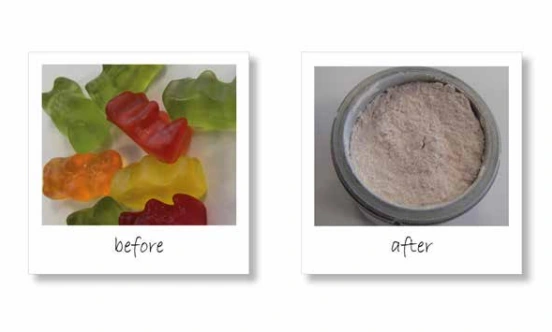
Cryogenic grinding in the CryoMill offers the advantage of continuous cooling of the grinding jar with LN2. This consistent temperature is guaranteed even for long grinding times without the need for intermediate cooling breaks. For heavy-metal-free grinding a zirconium oxide grinding jar should be used. A few pieces of liquorice, one praline or similar samples are typically pulverized in the CryoMill.
Homogenization of cookies in the Knife Mill GM 200
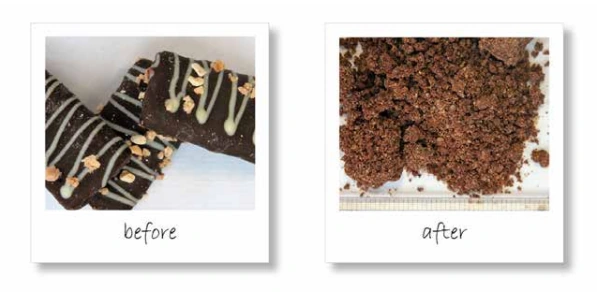
The Knife Mill GM 200 is designed for thorough homogenization of samples with high water, oil, sugar or fat content. It accepts sample volumes up to 700 ml. Thanks to the powerful 1000 W drive, the mill can homogenize even difficult samples very quickly and efficiently without blockages or the need for more than two grinding steps. The innovative Boost function allows for a temporary speed increase to 14,000 min-1, providing extra power for the homogenization of difficult samples in a very short time. The mill may be operated in three different modes: standard mode = cutting, reverse mode = impact, interval mode = improved sample mixing, to optimize the homogenization process with regard to the material properties. Up to 8 programs can be stored for routine applications. The possibility to save 4 program sequences is helpful when combining two grinding steps, for example, pre-crushing in impact mode followed by fine grinding in cutting mode, or if two different speeds are required. Pulverization of 8 large cookies was performed in two steps. In the pre-grinding step at 4,000 min-1, the interval mode was used for 10 seconds to improve mixing of the sample. The use of the standard lid ensures that the sample can move freely in the container, thus reducing the heat development (and subsequent fat release). In the homogenization step, which takes 35 seconds at 10,000 min-1, the use of the reduction lid 0.5 l is preferable to force
Knife Mill GRINDOMIX GM 200
the sample towards the blades and thereby increase the grinding efficiency. In this way, the complete sample was homogenized to < 0.5 mm.
Field Experience
Homogenization of large sample volumes of cannabis in the Knife Mill GM 300 at the Criminal Investigation Office in Dresden, Germany
In the laboratory of the Regional Office in Dresden, the cannabis plants are first reduced in size, followed by an extraction of several part samples of the ground material. The extracts are then analyzed by gas chromatography. “We usually deal with large sample volumes”, explains Thomas Paulick, Laboratory Manager at Dresden’s Regional Office of Criminal Investigation. “Therefore, it is essential to extract a representative part from the entire sample amount, to ensure a reliable quantification of the active component. The GM 300 fulfils this requirement: from up to 4 liters of plant material we receive a homogeneous sample from which we can then take approximately 0.5 g for further analyses. We process leaves with remnants of thin twigs as well as highly resinous blossoms without cooling – which is no problem for the knife mill. Grinding time and speed are selected according to the properties of the plant. The closed design and removable grinding container help to reduce the formation of dust during homogenization. To sum it all up, the new GM 300 has proven to be highly suitable for our requirements.”
Conclusion
With the growing use of cannabis in the medical sector, quality control has become a major issue. To ensure reliable and meaningful analysis results, sample homogenization prior to analysis is an important step. RETSCH offers a range of different laboratory mills for efficient, neutral-to-analysis sample preparation which are highly suitable for the task.
How do processing and analytical objectives change cannabis cutting?
For a process feed, define the cut fraction and the requirements of the receiving operation. For quality control, preserve representativeness and compatibility with extraction. Oily constituents and fibers can affect both preparation and recovery, so one configuration should not be assumed to satisfy both tasks.
| Consideration | Information to provide |
|---|---|
| Working scale | Process feed or analytical portion |
| Required output | Cut fraction or homogenized sample |
| Evaluation | Downstream operation or analytical assay |
Discuss material testing with Glen Mills or Contact Glen Mills for information or a quote.
Explore the equipment discussed
- RETSCH MM 400 Mixer Mill
- RETSCH CryoMill Cryogenic Mixer Mill
- RETSCH SM 300 Cutting Mill
- RETSCH GM 200 Knife Mill