

Is a finely ground feedstock always better for composites?
No. The useful form depends on the composite system and process. Define the required material geometry before selecting a preparation endpoint.
NPSP is a pioneering company dedicated to making composites more sustainable. They are at the forefront of the materials transition, focusing on reducing the environmental impact of their products. NPSP uses natural raw materials and innovative production techniques that exceed current
legislation, ensuring their products are both
environmentally friendly and marketable. Their Nabasco® label guarantees that the products are made in an eco-friendly manner, using local, biobased materials composed of fibres like flax, hemp, recycled toilet paper with biobased resins and bio-circular fillers.
NPSP produces a wide range of innovative and environmentally friendly composite mate rials and products. They focus on creating durable, fiber-reinforced plastics for various sectors, including construction, design, mobility, and industry. Their products are designed to provide beautiful and technical solutions for their clients' needs.
NPSP’s sister company Nabasco Products focusses on form free façade panels, traffic signs and enclosures for electronics. Making beautiful products but the lowest possible environmental footprint is the core principle at NPSP. This implies that sound research on end-of-life options is a must. Together with strategic partners NPSP develops various forms of recycling for which the grinding of products forms always the basis, a subject to closely work together with Retsch. The Retsch equipment is used to the grind material as a filler and transport medium for new composites, or as a basis to perform chemical recycling like pyrolysis and solvolysis, or as a basis for biological recycling where micro organisms break down the fully biobased materials. The end-of-life options are taken into account when setting up a Life Cycle Assessment, resulting in Environmental Product Declarations which are available.
RETSCH power pack to enable a circular economy
The Cutting Mill SM 300 is a versatile and powerful tool designed for the grinding of a wide range of materials. With its robust 3 kW drive and high torque, the SM 300 excels in tough jobs where other cutting mills fail. It is particularly effective in grinding soft, medium-hard, tough, elastic, fibrous, and heterogeneous mixes of products. This makes it an ideal choice for processing materials such as plant fiber, cotton, cocoa, resin. The SM 300's ability to handle these materials is enhanced by its variable speed settings, which range from 100 to 3,000 rpm, allowing for perfect adaptation to specific application requirements. The mill also features a range of bottom sieves with aperture sizes from 0.25 to 20 mm, ensuring a defined final fineness. Attaching a cyclone unit also helps to discharge lighter and fibrous materials from the grinding chamber – thus contributing to the machines' effectivity. Its efficiency and reliability make it a valuable asset in industries that require precise and consistent grinding of diverse materials. Nikolo Pemaj, R&D Lab manager at NPSP: "For example, during the grinding of our fully biobased composite panels, we set the machine at 1,500 rpm in order to efficiently obtain an homogeneous product without the risk of damaging the machine. The machine is also used to grind new materials for our R&D tests to an average size of 10 mm, as hazelnut shells, rice husk and hemp fibres. But before using the powder as a filler, it needs to be milled to a smaller size of 100 µm, this is done with the Rotor Beater Mill SR 300."
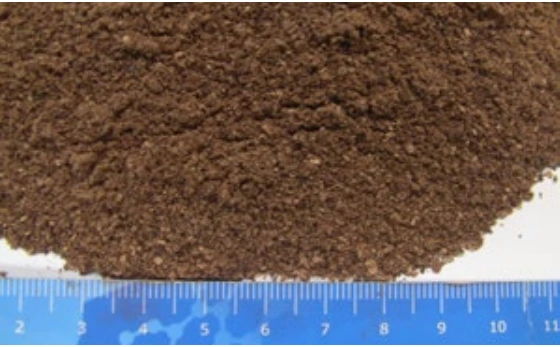
The Rotor Beater Mill SR 300 is a highly efficient tool designed for both coarse and fine size reduction. It is suitable for processing dry, soft, medium-hard, organic, and inorganic substances. The SR 300 is particularly effective in fine grinding applications and comes along with a great versatility – like speed setting from 3,000 to 10,000 rpm, allowing for perfect adaptation to specific application requirements. Nikolo Pemaj, R&D Lab manager at NPSP: "In practical applications, the SR 300 has been used to grind hemp hurds, achieving a fine powder suitable for various uses. For example, the hemp hurd could be ground to 86 % <100 µm. During the milling process of the fully bio-based composite panels, we use the machine at 6,000 rpm, in fact, after a lot of testing we figured out that this is the best and safest speed to work with in order to get the finest and homogeneous powder (92% <100 µm) without overstressing the machine. At the end of the process, we clean each component of the machine in order to avoid contamination between different materials during the next use."
Plan the configuration for your material.
Describe the fiber or waste input and the receiving process before choosing a cutting arrangement. A research feedstock should have a defined size or shape requirement, not just a reduced bulk volume. Assess variation between input batches so that material preparation does not hide changes in composition.
| Consideration | Information to provide |
|---|---|
| Raw feedstock | Fiber source and variability |
| Output form | Size and fiber geometry |
| Process interface | Mixing or forming requirements |
How should the application examples be used?
The results describe the materials and configurations discussed here. Confirm equipment options, contact materials and operating conditions for your own sample before adopting a method. A demonstrated endpoint does not guarantee the same outcome for a different material.
Discuss material testing with Glen Mills or request further information or a quote.