

Does a mechanochemical route always have a lower environmental impact?
Not automatically. Evaluate energy, materials, workup and the complete process when making a comparison, rather than treating the milling mechanism as proof.
In the light of sustainability and Green Chemistry, mechanochemistry offers fast reactions in a solvent-free environment. Mass productivities often exceed the solvent-based reaction equivalents, and the work-up procedures are generally easier. In 2019, IUPAC recognized it to be one of the methodologies that will most revolutionize the field of chemistry. A fast-growing number of papers are published proving the extreme interest in this technology.
In chemistry one often classifies a reaction based on the way the energy is supplied. Consequently, the best-known types of reactions are thermal (energy supplied by heating), electrochemical (energy supplied by electrical current) and photochemical (energy supplied by optical waves). A less known form of chemistry is mechanochemistry where the energy is supplied by impact and shearing forces, typically ball mills are used to conduct those reactions. The 21st century brought with it a growing consciousness of the environmental impact of chemical reactions and chemists started to examine alternatives to solvents, some of them trying to avoid them altogether. Thus, mechanochemistry slowly gained momentum in disciplines like organic chemistry where it was quickly shown that staple reactions like C-C couplings, oxidations, reductions and pericyclic reactions can be transferred into ball mills. It was quickly clear that with mechanochemistry some reactions are conducted faster and thus are energy-saving compared to the classic solvent-based chemistry. Furthermore, problems like poor solubility of the educts can be overcome by mecha-
nochemistry, even reactions can be forced which are simply not possible in solvents, or intermediate substances can be stabilized and purified. Altogether, mechanochemistry offers new opportunities to make processes more sustainable and to develop new reactions ( Advantages of mechanochemical reactions compared to solvent-based processes:
No solvents required, thus up to 90 % of the reaction mass can be avoided, which makes it more cost efficient, environmentally friendly/safer in handling and less time is required to find the best solvent for a reaction New reaction pathways can be investigated as also insoluble educts can be used, intermediates can be stabilized, or reactions simply differ from solvent-based ones. Time saving as usually the reactions run quickly in some minutes to hours compared to up to several days with solvents Yields achieved may be higher if the right conditions are found
How does mechanochemistry work?
For mechanochemistry, the mode of energy impact seems to play a vital role. Whereas in planetary ball mills friction is the predominant size reduction principle, it is impact in mixer mills. Some reactions are conducted more efficiently in planetary ball mills, whereas others seem to require more the impact mode of mixer mills. Beside the type of mill, scientists had to re-evaluate parameters of “classical” chemical reactions, like concentration and temperature, when transferred to a ball mill, as these are different in the solvent-free environment. Up to now, the different influences are point of investigation, as it is not yet clear, what really drives the mechanochemical reactions. Is it the energy supplied by the impacts – and is more energy input always beneficial? Is it creating fresh surfaces by the balls, which can react simultaneously, with mixing effects? Or is it also the comparably high concentration of educts in contrast to soluble systems? High temperatures between the balls when they collide? Or a mixture of all? To gain more insight in those questions, a DFG project with the partners Retsch GmbH, the Ruhr University Bochum and the Technical University Braunschweig started in 2020 : “What drives reactions in ball mills? Qualification and Quantification of the forces in mechanochemical reactions”
Topics addressed with the DFG project: “What drives reactions in ball mills? Qualification and Quantification of the forces in mechanochemical reactions”.
The grinding ball size is also critical because the balls themselves initiate the reaction and have to create a new reactive surface by removing the reacted layer. If the balls are too small, the energy supplied is insufficient and the particles also tend to agglomerate. If the balls are too big, reactions are initiated but the number of reactive collisions is rather small and the reaction product is not efficiently removed from the particle surface, leading to small reaction rates. Suitable balls therefore range from 5 to 15 mm in diameter, offering a good compromise. The jar and ball materials are also very crucial in mechanochemical applications. The material, such as zirconium oxide or stainless steel, must be resistant to the chemicals and not interfere with the reaction itself, while being mechanically stable to avoid excessive abrasion.
Most suitable ball mills for mechanosynthesis
Unlike the mortars used in former times, ball mills allow for precise control of the reaction conditions, a wide range of energy inputs and the possibility to conduct reactions in sealed vessels. Mills typically used for these reactions are planetary ball mills and mixer mills.
The functional principle differs in planetary ball mills and mixer mills. The grinding jars of a planetary ball mill are arranged eccentrically on the sun wheel. The direction of movement of the sun wheel is opposite to that of the grinding jars in the ratio 1:-2 (or 1:-2.5 or 1:-3 in special versions for mechanochemistry, displaying higher energy input). The grinding balls in the grinding jars are subjected to superimposed rotational movements, the so-called Coriolis forces. The difference in speeds between the balls and grinding jars produces an interaction between frictional and impact forces, which releases high dynamic energies. The interplay between these forces produces the high and very effective degree of size reduction of the planetary ball mill. Retsch offers three types of planetary ball mills which keep 1, 2 or 4 grinding jars in sizes between 12 - 500 ml.
A special version of planetary ball mill is the High Energy Ball Mill Emax . The Emax combines high-frequency impact, intensive friction, and controlled circular jar movements to a unique and highly effective size reduction mechanism with a speed up to 2000 rpm, thus a very high energy input. The interplay of jar geometry and movement causes strong friction between the grinding balls, sample material and jar walls as well as a rapid acceleration which lets the balls impact with great force on the sample at the rounded ends of the jars. This significantly improves the mixing of the particles resulting in smaller grind sizes and a narrower particle size distribution than is possible to achieve in other ball mills. The Emax is equipped with a unique water-cooling system, which allows to grind with the extremely high energy input. Sample temperatures can be stabilized - but not regulated - <100 °C in most cases.
Mixer mills work mainly by impact and are originally thought for quick, uncomplicated size reduction of small sample amounts up to 20 ml. The grinding jars of Mixer Mills perform radial oscillations in a horizontal position. The inertia of the grinding balls causes them to impact with high energy on the sample material at the rounded ends of the jars and pulverize it. Also, the movement of the jars combined with the movement of the balls result in the intensive mixing of the sample.
Retsch offers two classic mixer mills for quick sample pulverisation. The MM 400 is commonly used for mechanochemistry because of its ease of use and small compact design. The CryoMill, which constantly cools the samples inside the jars down to -196°C is also quite commonly used, if temperatures influence the reactions.
With the MM 500 series, Retsch offers three different mills, which are suitable for long term processes like planetary ball mills or the Emax. The MM 500 vario keeps up to 6 grinding jars and can be used at higher energy levels than the MM 400 with a max frequency of 35 Hz. The MM 500 nano is designed for achieving nano particles, but also has some advantages
Planetary ball mills and High Energy Ball MIll Emax
Mixer mill range including CryoMill with dewar
for mechanochemistry as the long-term grinding option and high energy input of max 35 Hz.
The most interesting machine of this series for mechanochemistry purposes is the MM 500 control, which offers the option to operate in a temperature range from -100 °C to +100 °C. Thus, it can be used for cooling and heating the reactions inside the grinding jars.
Influence of the temperature
Beside the functional principle, material used, size and number of the grinding balls and the energy input, also the temperature can have a great influence on the efficiency of the reaction or even determine the type of reaction. INCOME 2022 (Cagliari June 2022), the most important mechanochemistry conference, witnessed the scientific community's compelling interest in heating mills to realise a new concept that can be summarised with this motto: beat and heat. Despite heating, also cooling can have an influence on the reaction. In some cases, no influence is obvious. The comparison shows the temperature ranges, for which Retsch ball mills are suitable.
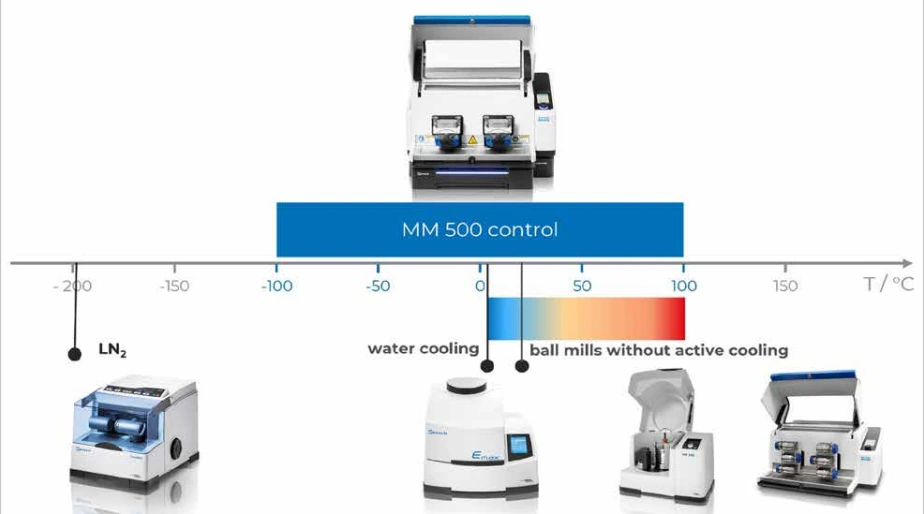
The CryoMill is used for constant cooling at very low temperatures of -196 °C, the Emax offers some counter-cooling options. planetary ball mills and mixer mills do not offer any active cooling or heating options. The MM 500 control can be operated in a range -100 °C to + 100 °C with exceptional options to control and influence the temperature.
The following examples show, if and how the temperature can influence the chemical reaction:
A) No temperature influence:
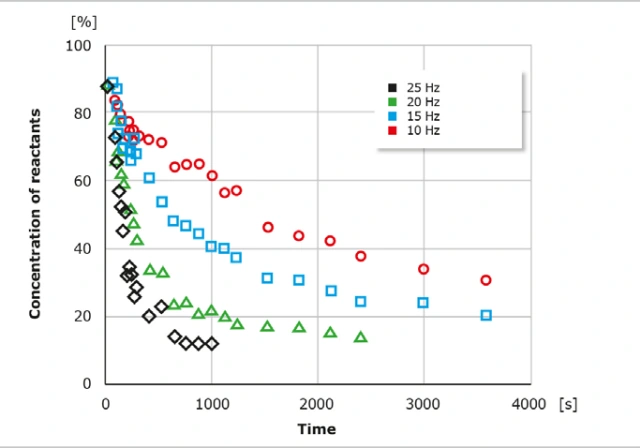
Interesting results have been presented by the group of Stuart James. They conducted a chemical reaction in the MM 400 at different temperatures and milling frequencies and showed that only the frequency has an influence on the kinetics of the reaction while an increase in temperature had no effect. This example also shows, that with increased frequency the reaction is accelerated, as the ball(s) hit the reagents more often per Δt.
The rate of reaction shown as unreacted reactant against time at an energy input varying from 10 to 25 Hz in the RETSCH Mixer Mill MM 400. The rate of reaction increases with the frequency.
B) Cooling enables stabilization of intermediate products (derivates)
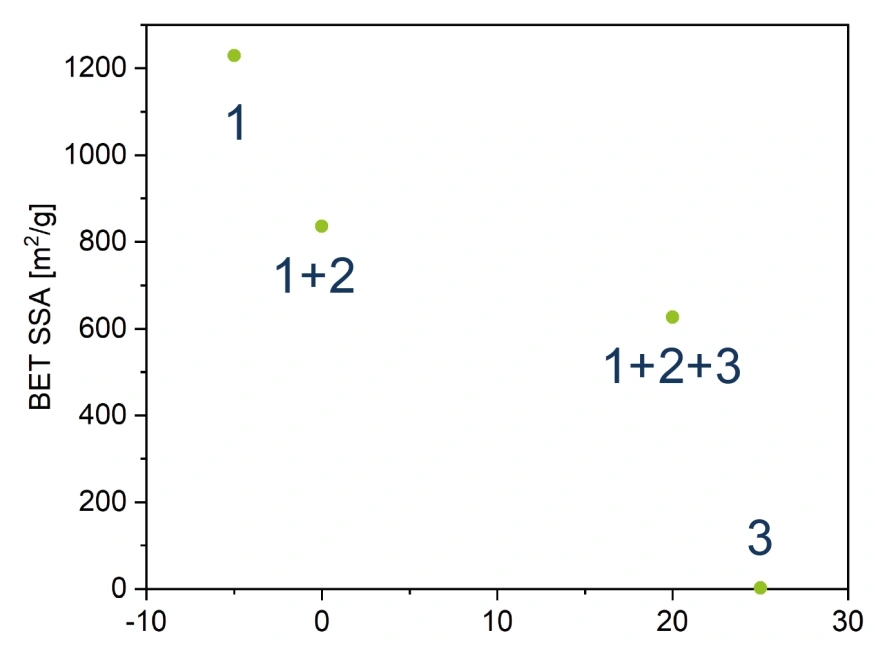
Reactions that proceed via several thermally unstable intermediates can be controlled by synthesizing them while simultaneously cooling them to, for example, -5 °C in the MM 500 control (external chiller temperature was set to -5 °C, the cooling agent counter-cools the thermal plates and thus the jars and the sample). The thermally unstable intermediates can be stabilized and in total their yield is increased. The temperature control of the MM 500 control enables completely new reactions. This is shown by the example of the synthesis of ZIF-8 from 2-methylimidazolium and zinc oxide .
The MM 500 control allows very good control over which products can be generated in a mechanochemical process by using different temperature levels. Since chemical reactions in the MM 500 control can also be stabilized in other temperature ranges down to -100 °C by connecting it to a cryostat or to the CryoPad, this mill offers abundant possibilities for exploring novel synthesis routes and products. With the CryoPad, a true temperature control is possible, as the temperature on the thermal plates can be chosen and regulated in a range from 0 °C to -100 °C.
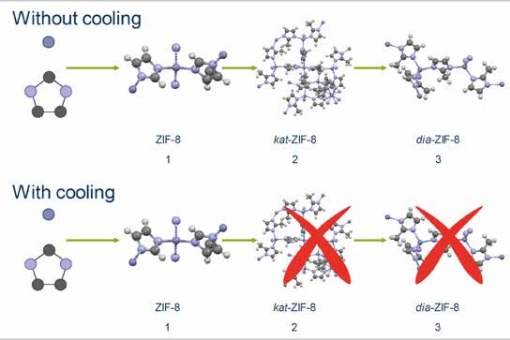
The further reaction to kat-Zif-8 and dia-ZIF-8 could be stopped as soon as the temperature of the thermal plates was set to -5 °C by means of a chiller. An increase by 5 °C still led to the formation of the second intermediate kat-ZIF-8. At 20 °C of the thermal plates, all three products were found; when synthesizing without cooling, the actual reaction is completed, only dia-ZIF-8. Reaction scheme and performance of the experiments:
Dr. Sven Grätz, Ruhr-University Bochum, Faculty of Chemistry and Biochemistry, AG Prof. Borchardt.
C) Heating leads to different results
Despite cooling, also energy input via heat can be beneficial for reactions, lead to better yields or different reaction types. For example, there are reaction pathways such as the Suzuki Miyaura cross-coupling reaction where a higher temperature accelerates the reaction, similar to classical chemistry using Bunsen burners.
In this case, heat guns were used to heat the grinding jars of the MM 400. A more controlled way of heating jars is possible with the MM 500 control, which can be connected to a cryostat, which in turn can heat the thermal plates up to 100 °C with the help of a thermal fluid. In this way heat is transferred to the jars and the reaction. Another example for heating a mechanochemical reaction is shown in figure 7. This project involves the response of a primary amine with phthalic anhydride. The process at room temperature (conducted in the MM 500 vario, with similar results also in the MM 500 control at room temperature) provides only the monoamide, while milling for three h at 80°C the reaction provides the desired imide in about 75 % isolated yields.
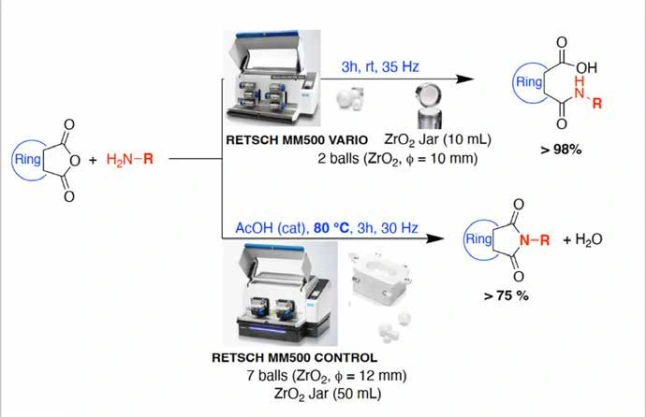
The temperature can determine the type of reaction in a ball mill, as shown in this example. Thus, the reaction can be precisely controlled by controlling the temperature level, and different products can be achieved.
Reaction scheme and performance of the experiments: Prof. Andrea Porcheddu, University of Cagliari, Chemical and Geological Science Department (Italy).
Ma, X., Yuan, W., Bell, S. E., & James, S. L. (2014). Better understanding of mechanochemical reactions: Raman monitoring reveals surprisingly simple ‘pseudofluid’ model for a ball milling reaction. Chemical Communications, 50(13), 1585-1587.
Kubota, Ito et al., Tackling Solubility Issues in Organic Synthesis: Solid-State Cross-Coupling of Insoluble Aryl Halides. Journal of the American Chemical Society, March 30, 2021. DOI:10.1021/ jacs.1c00906; Tackling Solubility Issues in Organic Synthesis: Solid-State Cross-Coupling of Insoluble Aryl Halides.
Plan the configuration for your material.
Describe the reaction objective, formulation and characterization before choosing an operating program. Solvent-free or reduced-solvent work still needs appropriate assessment of the materials and process. Compare the identified products and repeatability rather than assuming that milling time represents reaction completion.
| Consideration | Information to provide |
|---|---|
| Reaction question | Intended transformation or product |
| Formulation | Components and any liquid addition |
| Evidence | Product identification and repeatability |
How should the application examples be used?
The results describe the materials and configurations discussed here. Confirm equipment options, contact materials and operating conditions for your own sample before adopting a method. A demonstrated endpoint does not guarantee the same outcome for a different material.
Discuss material testing with Glen Mills or request further information or a quote.
Explore the equipment discussed
- RETSCH MM 500 control Mixer Mill
- RETSCH Emax High Energy Ball Mill
- RETSCH MM 400 Mixer Mill
- RETSCH CryoMill Cryogenic Mixer Mill