
Is mechanical alloying just fine grinding?
No. The objective is a material transformation. Particle reduction can occur during treatment, but the resulting composition and phases require separate evaluation.
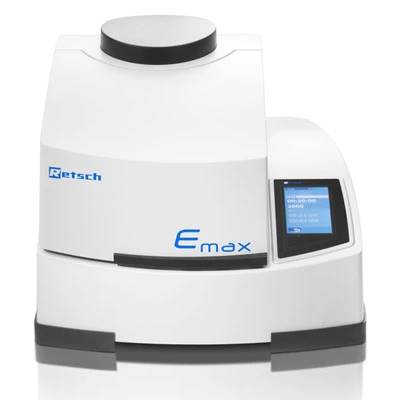
Researchers at the Institute of Inorganic and Analytical Chemistry at the Albert Ludwigs University, Freiburg, Germany, used RETSCH High Energy Ball Mill Emax to test a new approach to mechanical alloying.
The traditional way to produce alloys such
as stainless steel is to fuse the components at very high temperatures. If only small quantities are required, or if melting cannot
fuse the alloys, mechanical alloying is an alternative. One approach to this application is to use ball mills. In the late 1960s, nickel-iron alloys were produced by mechanical alloying to obtain temperatureresistant materials for the first time. Intensive kinetic milling during mechanical alloying connects the solid powder components. High-energy ball mills and planetary ball mills provide the required energy input by impact. The fine particles are deformed plastically between the grinding balls and the materials are welded together. In this way, it is possible to produce alloys when the traditional procedure of metal fusion does not work. Moreover, mechanical alloying allows for variation in the mixing ratios of the components.
Thermoelectric material alloys
Silicon (Si) and germanium (Ge) are the most important elemental semiconductor materials – they paved the way for the development of electric devices such as photovoltaic cells or transistors. The material properties of these alloys can be altered by using different amounts of Si and Ge, resulting in changes to atomic size, mass differences and bandgaps. Thermoelectric alloys of these materials are used in
space missions in radioisotopic thermogenerators, ensuring the power supply of space probes and measurement devices. For commercial applications in the thermoelectric field, materials based on bismuth telluride (Bi2Te3) are most relevant, since they offer the best conversion efficiency of all thermoelectric materials. Peltier elements made of bismuth telluride are used in cooling.
The High Energy Ball Mill Emax
The Emax is a recently developed ball mill specifically designed for high energy milling. The speed of 2,000 min-1, in combination with the special grinding jar design, generates enormous sizereduction energy. The mechanism of the Emax is based on a combination of high impact and intensive friction, which leads to a high-energy input that can be used for fast grinding down to nanometer scale, as well as for mechanical alloying. This combination is generated by the oval shape and the movement of the grinding jars. The jars move on a circular course without changing their orientation, which improves the mixing of the particles, resulting in smaller grind sizes and a narrower particle size distribution. A new liquid cooling system means excess thermal energy is quickly discharged, preventing the sample from overheating, even after long grinding times. Grinding jars are cooled via an internal water cooling system, allowing for continuous grinding without breaks, which are needed when using planetary ball mills. An external chiller, connected to the internal cooling system of the Emax, can be used to further decrease the temperature.
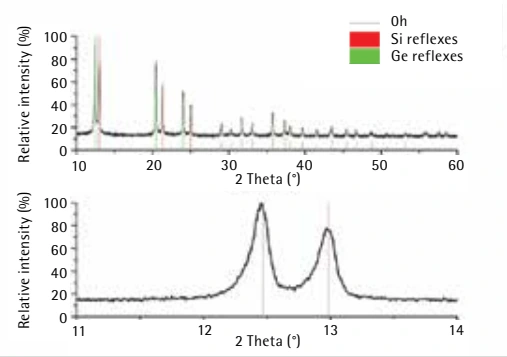
Top left: Powder diffractogram of Si (red) and Ge (green) at the beginning of the mechanical alloying. The upper part shows the whole measurement range from 10°–60°. In the lower part detailed reflexes of the lattice plane 111 of Si and Ge are recognisable.
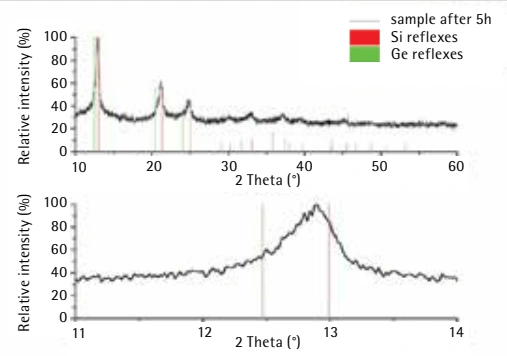
Middle left: Powder diffractogram after five hours of mechanical alloying in the Emax. The upper part shows the whole measurement range. The theoretical lines of Si (red) and Ge (green) are displayed for reference. In the lower detailed diagram, the progress in mechanical alloying becomes visible (shift of 111-reflex and collapse of Si and Ge reflexes).
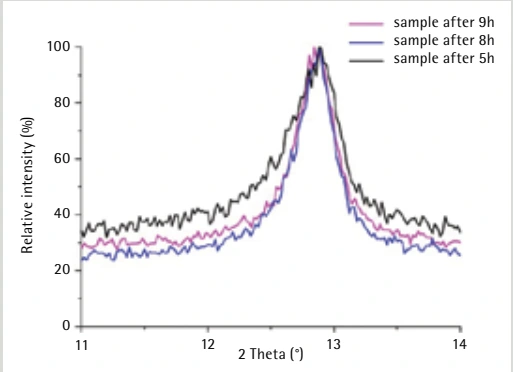
Bottom left: The 111-reflexes of the samples after five, eight and nine hours are shown. The width of the peak has slightly decreased and the peak maximum has slightly been shifted, indicating that the process was nearly finished after only five-six hours.
Planetary ball mills, a previous approach to mechanical alloying of Si and Ge, suffered from a number of problems that the development of the new High Energy Ball Mill Emax sought to address. The initial size reduction of the starting material already took 80 minutes and the full power of the planetary ball mills was not available for the following mechanical alloying process, since even at a moderate speed of 400rpm the sample material was caking in the grinding jars. There was the additional problem of the grinding jars overheating and needing breaks in the planetary ball mill, which which added 90 minutes to the total processing time of 13 hours. The new technology prevents caking at high speeds, removing the need for long breaks and reducing the overall process time.
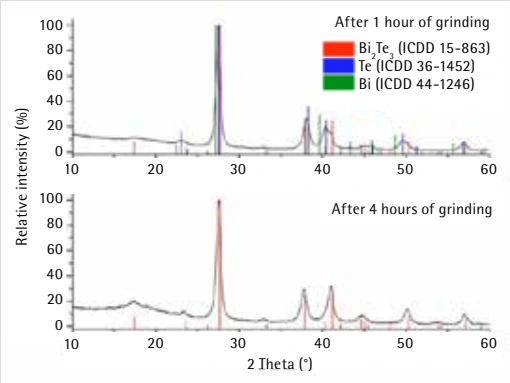
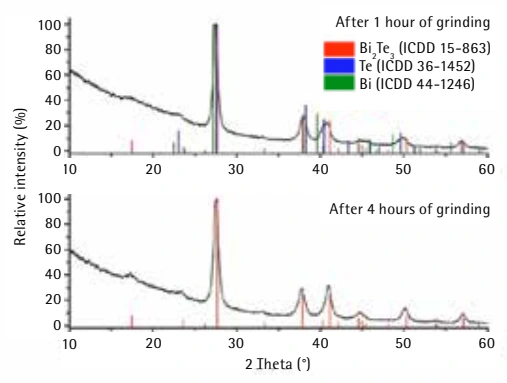
Right: Powder diffractogram after one hour of mechanical alloying Bi and Te in the Emax, powder to ball ratio 1:10 (left), powder to ball ratio 1:5 (right).
MEchanIcal alloyInG of SIlIcon and GERManIuM
MEchanIcal alloyInG of BISMuTh and TElluRIuM
A silicon-germanium alloy mixture was created by milling 3.63g Si and 2.36g Ge in a 50ml grinding jar made from tungsten carbide, using eight 10mm grinding balls of tungsten carbide (sample to grinding ball ratio 1:10). The initial particle sizes of Si and Ge were 1–25mm and 4mm. After grinding at 2,000rpm for only 20 minutes, both components were pulverised without any caking. Mechanical alloying was then conducted for nine hours at 1,200rpm (one hour of grinding followed by a break of one minute to allow for rotation reversal to avoid caking of the material). The starting material was measured via X-ray diffraction (XRD), which allows for both qualitative and quantitative examination of crystalline and amorphous phases. Each substance shows a line pattern with characteristic intensities and positions at particular angles. The characteristic elementary line pattern of Si and Ge at the beginning of the mechanical alloying can be seen on the previous page (top left). Only the reflexes of the pure elements are seen, indicating that hardly any tungsten carbide abrasion occurred. The alloy components remained powdery during the entire process. Temperature in the Emax did not exceed 30°C. The powders were crystalline, and after nine hours of mechanical alloying there was hardly any amorphous material.
To study whether a powder-to-grinding-ball ratio of 1:10 or 1:5 was more effective, a 50ml grinding jar of steel was filled with ten 10mm steel grinding balls. For a ratio of 1:10, 2.09g Bi and 1.91g Te were used, for a ratio of 1:5 it was 4.18g Bi and 3.83g Te. After 70 minutes processing time at 800rpm (cycles of 10 minutes milling and one minute break to programme the direction reversal), the first samples were taken for XRD analysis (see above, left). After the first hour of mechanical alloying, a clear shift of the reflexes of Bi and Te towards Bi2Te3 is discernible, indicating that a part of both samples already consists of Bi2Te3. A ratio of 1:10 resulted in a slightly faster formation of Bi2Te3. The reflex of the educt tellurium shows a higher intensity in the sample with 1:5 ratio, leading to the assumption that more tellurium is still left compared with the 1:10 ratio sample. The alloying process was continued for a further three hours, at an increased speed of 1,200rpm, without the powder caking. Mechanical alloying of Bi2Te3 has previously been performed in a mixer mill at 1,200rpm within 6.5 hours. In contrast to this, the mechanical alloying process using the High Energy Ball Mill Emax was finished after two–three hours.
Plan the configuration for your material.
Specify the starting composition and how the alloying outcome will be identified. Jar and ball materials, loading and treatment conditions can influence the experiment. A visually uniform powder is not sufficient evidence that the intended alloy or phase has formed.
| Consideration | Information to provide |
|---|---|
| Starting composition | Components and proportions |
| Mechanical setup | Tools, loading and cycle |
| Evidence | Phase or material characterization |
How should the application examples be used?
The results describe the materials and configurations discussed here. Confirm equipment options, contact materials and operating conditions for your own sample before adopting a method. A demonstrated endpoint does not guarantee the same outcome for a different material.
Discuss material testing with Glen Mills or request further information or a quote.