
Does milled graphite automatically become an effective spill treatment?
No. Adsorption behavior and practical suitability need their own evidence. Laboratory preparation should not be treated as a field-performance guarantee.
Oil spills in the sea represent a serious threat to aquatic systems, affecting marine life, contaminating shores, and disrupting ecological balances. For instance, the Deepwater Horizon spill in 2010 released approximately 4.9 million barrels of oil into the Gulf of Mexico. Large quantities of oil in the ocean pose a significant risk to marine biodiversity and food security. The impact of oil spills can be long-lasting, leading to severe ecological damage and affecting the health of marine ecosystems.
It is crucial to develop effective solutions to mitigate this problem and protect our oceans. Currently, researchers are exploring novel experimental techniques, such as the utilization of expanded graphite for adsorbing hydrocarbons and oil. The team of Jose Manuel Mendoza Duarte, Ivanovich Estrada Guel, Carlos Garay Reyes, and Roberto Martinez Sanchez at CIMAV, Mexico, is investigating these approaches. These experiments are still in the early stages, primarily conducted in laboratory settings, to assess their effectiveness and potential scalability for environmental remediation.
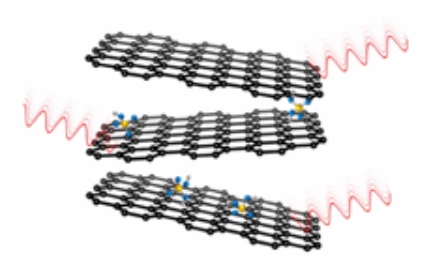
Graphite is one of the forms in which carbon can be found, widely known for its use in pencils, lubricants, and conductive materials. It is found in nature as a shiny black solid. At the microscopic level, graphite is composed of multiple layers of graphene, a twodimensional structure of carbon atoms arranged in a honeycomb pattern. These layers are held together by Van-der-Waals forces, allowing them to slide easily, resulting in their characteristic softness. This arrangement also influences its ability to be modified for various technological applications such as environmental remediation.
How to prepare expanded graphite:
For the preparation of adsorbent expanded graphite, a mechanochemical route is employed where mechanical milling is carried out in stainless steel grinding jar with a capacity of 50 ml, using the Retsch Planetary Ball Mill PM 300. Natural graphite flakes are used as the initial material, which are placed in the steel grinding jars along with steel balls that act as the milling medium. Subsequently, a specific amount of sulfuric acid is carefully added, which will act as an intercalating agent. Once this step is completed, the steel jars are placed in the high-energy planetary mill PM 300, securing them firmly to prevent displacement during operation, as the equipment operates at high revolutions for extended periods. Next, the mill is closed, and the milling conditions are programmed, setting the appropriate time and speed for the process. What happens to our material inside the mill? In planetary mills, the grinding jar rotates simultaneously on its own axis and around the main axis of the mill. This movement causes the grinding balls to generate high crushing energy due to impact and friction forces. As a result of these forces, some sulfuric acid molecules manage to insert themselves between the graphene layers, leading to the formation of intercalated graphite.
Benefits of the PM 300:
The Retsch Planetary Ball Mill PM 300 offers numerous benefits for various applications, particularly in the preparation of adsorbent expanded graphite. One of its primary advantages is its high energy output of out to 64, which ensures efficient and effective milling of materials. • The PM 300's ability to operavte at high revolutions up to 800 rpm for extended periods allows for thorough mixing and grinding, resulting in a uniform and fine particle size. • The planetary movement of the grinding jars generates high crushing energy due to vimpact and friction forces, which is essential for processes like the formation of intercalated graphite. • The PM 300 is also known for its versatility, as it can be used with different materials and milling media, making it suitable for a wide range of applications. • Its robust construction ensures durability and resistance to wear, which is crucial for longterm use. • The programmable milling conditions provide precise control over the milling process, allowing for reproducibility and consistency in results. • Furthermore, the PM 300's safety features, such as secure jar fixation and controlled cooling, minimize the risk of accidents during operation.
What happens after the milling process?
Once the material is obtained, it is cooled to minus 10°C before adding concentrated hydrogen peroxide in a controlled manner. This cooling is crucial as the resulting reaction is highly energetic and can become explosive due to the instant release of a large amount of heat. After adding the hydrogen peroxide, a notable expansion of the graphite is observed, evidenced by a change in morphology from flakes to elongated structures with worm-like appearances. The obtained graphites are washed with deionized water to remove possible residues of hydrogen peroxide and sulfuric acid. They are then filtered to remove the remaining excess water.
Prove of concept and conclusion:
Finally, an adsorption test is carried out in a mixture of water and diesel in which the obtained graphite is added. During the test, the effectiveness and selectivity of the material in removing this hydrocarbon in water is observed, confirming its adsorbent capacity. Overall, the PM 300's combination of high energy output, versatility, durability, and safety features makes it an invaluable tool for researchers and industries involved in material preparation and environmental remediation.
Plan the configuration for your material.
Keep the preparation and adsorption evaluation distinct. Record the graphite feed, grinding media and treatment conditions, then examine the resulting material using a defined test. The ability to prepare a modified powder does not establish performance in an uncontrolled environmental application.
| Consideration | Information to provide |
|---|---|
| Graphite input | Form and starting condition |
| Milling arrangement | Vessel and grinding media |
| Adsorption evaluation | Test material and measurement basis |
How should the application examples be used?
The results describe the materials and configurations discussed here. Confirm equipment options, contact materials and operating conditions for your own sample before adopting a method. A demonstrated endpoint does not guarantee the same outcome for a different material.
Discuss material testing with Glen Mills or request further information or a quote.