
Is matching frequency enough to reproduce a milling reaction?
No. The formulation, vessel, media, loading and treatment sequence also define the experiment and should be recorded.
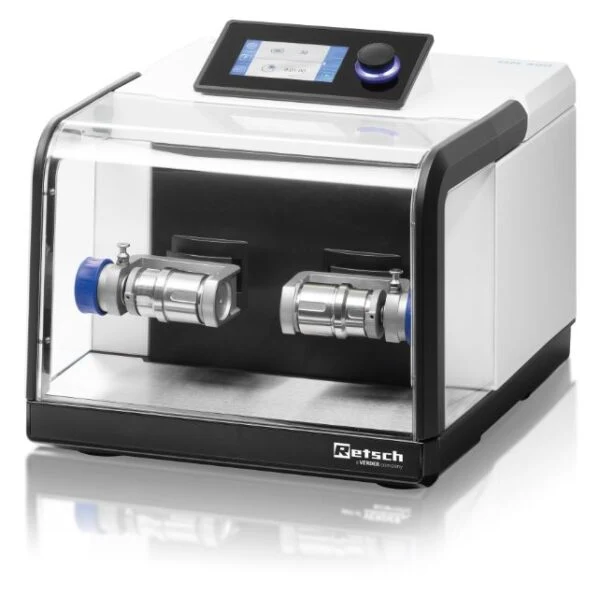
The RETSCH Mixer Mill MM 400 is a versatile laboratory ball mill designed for mixing and homogenizing powders and suspensions within seconds and is also perfectly suitable for the disruption of biological cells. The MM 400 has been redesigned, adding some new features and accessories. Improvements include longer grinding time, program storage, and reduced noise. It is now possible to operate the mill for up to 99 hours, a significant increase compared to the 99 minutes of the previous model. This is especially beneficial for mechanochemistry applications, where long process times are required.
Reproducibility is a fundamental principle of scientific research and is essential for ensuring the credibility and reliability of scientific findings. It allows researchers to verify the results of published studies and strengthen the evidence base. Reproducibility is important not only for ensuring the correctness of results, but also for ensuring transparency in the research process. However, achieving reproducibility can be challenging due to natural variations in experimental conditions, human errors, and other factors. The MM 400 was tested regarding the reproducibility within a mechanochemical reaction, and it could be proven that it displays an excellent reproducibility for both clamping positions, during several repetitions and also between different machine devices.
Reproducibility of grinding results prior to quality analysis
A typical grinding task of the MM 400 is homogenization of hard and brittle samples such as clinker or gravel in less than 2 min. After 2 min grinding at 28 Hz, 29 Hz or 30 Hz, only minor differences of the final fineness occurred. Therefore, grinding time was drastically reduced to 10 s in order to show the very good reproducibility between the left and the right grinding station. A very low standard deviation was observed (mean value of 5 distinct grindings and measurements). The influence of the energy input and the frequency becomes clear with this very short grinding time – the obtained particles become finer with increasing frequency.
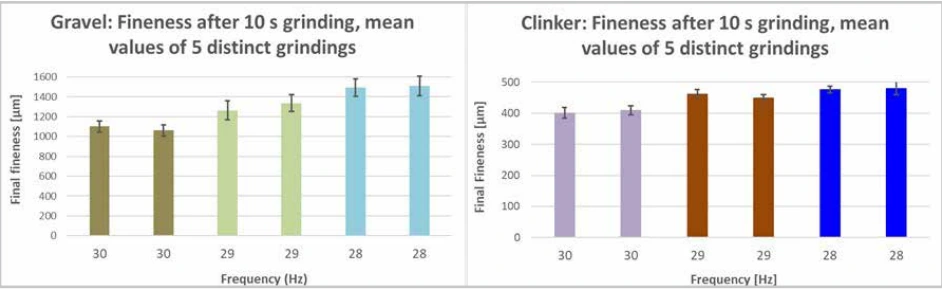
Final fineness of gravel or clinker after 10 s grinding at different frequencies, left and right clamping station, mean value of 5 grindings and measurements each. A good reproducibility between the two clamping stations with very low standard deviation is obvious.
One question is of great importance to ensure reproducible and reliable results: If a specific frequency is set, e.g. 30 Hz – what is the actual frequency during milling? And how much does this change over time? Reliable and reproducible results can only be obtained if the frequency does not change over time due to wear of the drive, for example. If the user sets 30 Hz, but grinding is in fact performed at 29 Hz or even lower, this will a) affect the results directly, and b) the results will change over time. The results shown after very short grinding times could be considered slightly “artificial” but they prove the importance of a well-calibrated machine maintaining the set speed. After longer grinding times, the differences become negligible, and it is even questionable, whether a slightly larger or smaller particle size will actually influence subsequent analysis results.
Therefore, we demonstrate the importance of a reliable mill with a use case involving long grinding times required for mechanochemical reactions. Here, differences in the applied frequency can directly influence the yield obtained by the reaction.
Reproducibility of the MM 400 and the influence of the frequency on a mechanochemical reaction
Special thanks to Professor Claudia Weidenthaler and her group, MPI für Kohleforschung, Mülheim an der Ruhr, for sharing the experimental work and results to prove the excellent reproducibility of the MM 400 for sophisticated applications like mechanochemistry. It could be proven that also minor variations of the frequency from 30 Hz to 29 Hz or 28 Hz have an influence on the yield of the reaction. It is of fundamental interest that the mixer mill maintains a set value, e.g. 30 Hz, and does not deviate from it. A premise which is fullfilled by the MM 400, which comes with a calibration protocol.
The reaction γ-Al2O3 + ZnO -> ZnAl2O4 was conducted in the MM 400 using 25 ml grinding jars and 2 x 15 mm grinding balls. 1 g educts were put into the jars and the reaction was conducted for 30 min at 28 Hz, 29 Hz and 30 Hz. All experiments were carried out 5 times. The products were characterized via XRD and showed clearly that even a small variation in frequency influences the yield, as conversion was low at 28 Hz and best with 30 Hz.
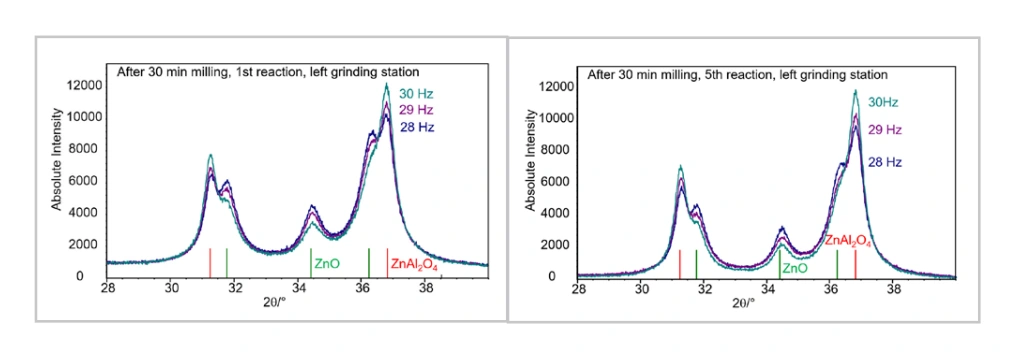
The comparison between left and right clamping station showed highly reproducible results as shown, e. g., for 28 Hz, 5th grinding.
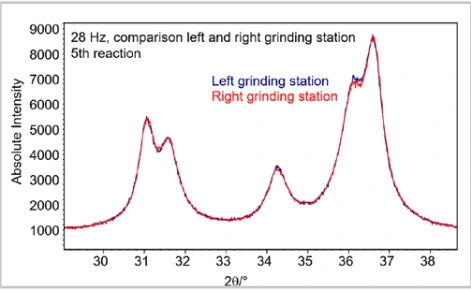
XRD patterns after mechanochemical reaction at 28 Hz, comparison left and right grinding station, 5th reaction each
The almost perfect reproducibility of different mechanochemical reactions is shown in figure 5, again for left and right grinding station separately. The relative intensities of the XRD diagram are almost the same comparing the 5 trials for example at 30 Hz. Interestingly, the first reaction with a new grinding jar and balls shows some minor variations, after that the reflections fit perfectly.
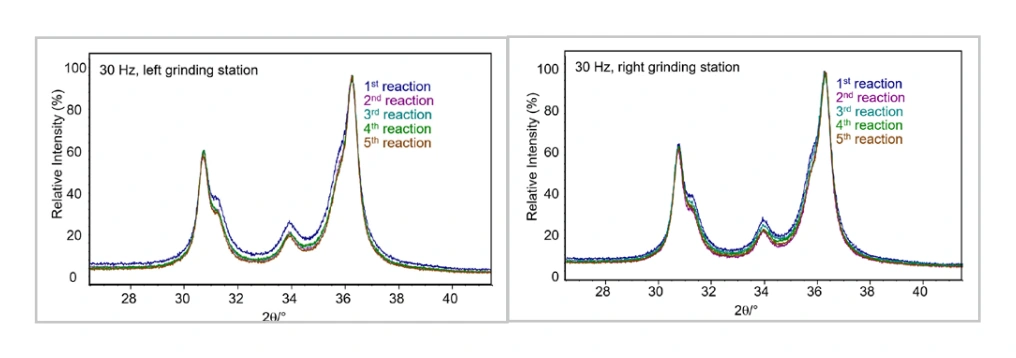
XRD patterns after mechanochemical reaction at 30 Hz, left: left grinding station, 1st to 5th reaction; right: right grinding station, 1st to 5th reaction.
Three months later, a 6th reaction was conducted, again with identical, reproducible results, as obtained with the experiments at 30 Hz (figure 6, left diagram). This shows that the results obtained over time with a MM 400 are reliable and reproducible, even if the machine is heavily used. Next, the experiments were conducted using another MM 400 device to compare the results between the two mills. Again, the excellent reproducibility could be verified for the 5 experiments conducted at 30 Hz, for both, left and right grinding station, (figure 6, right diagram). The first machine showed 16.4% (±0.3%) yield over the 5 reaction cycles for the left jar and 16.0% (±0.3%) yield for the right jar. The second machine provided for both jars 15.0% (±0.3%) yield .
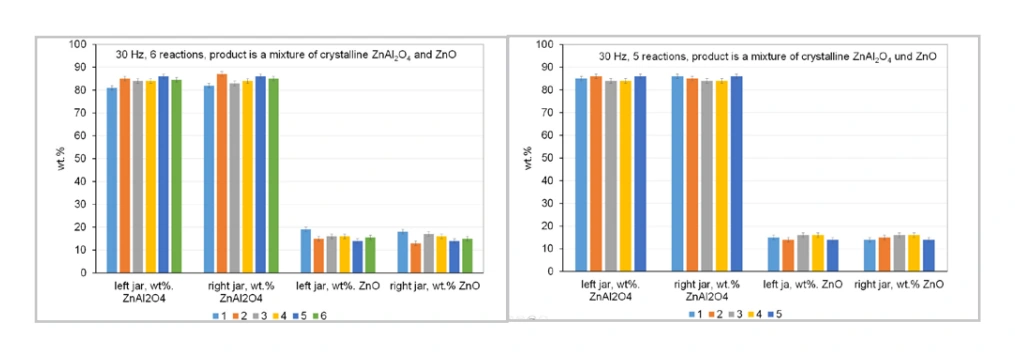
Long term stability of the MM 400 is shown in the left diagram, as the yield of the mechanochemical reaction is still reproducible in a 6th approach after three months of heavy use of the mill (comparable weight % of educts and product). Right diagram: Identical results (weight % of educts and product) and reproducibility are obtained with a different MM 400 device.
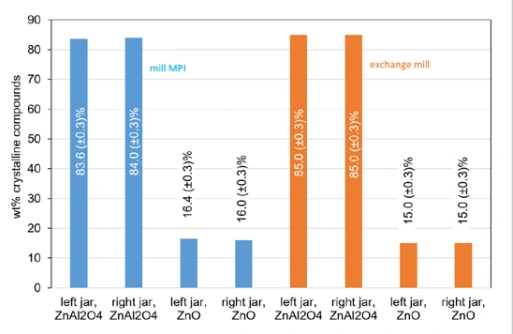
Almost identical results (weight % of educts and product) and reproducibility are obtained with a different MM 400 device.
Conclusion
Reliable results can only be obtained with reliable instruments. The Mixer Mill MM 400 is known for its ease of use and fast grinding in terms of sample preparation prior to quality analysis. Conducting various mechanochemical reactions we have proven that the MM 400 provides reproducible results for both grinding stations with minimal standard deviations between different processes. This is due to the consistent frequency which is stable and reproducible in processes over time. It could also be demonstrated that results obtained with different MM 400 devices are also reproducible.
Plan the configuration for your material.
Specify jar material, media, sample loading and program when comparing runs. Characterize the resulting material with the same method and distinguish station-to-station comparison from run-to-run comparison. A result for one reaction system is not a universal reproducibility claim for all mixtures.
| Consideration | Information to provide |
|---|---|
| Fixed setup | Jar, balls and sample load |
| Comparison design | Stations and independent repeats |
| Outcome | Consistent product characterization |
How should the application examples be used?
The results describe the materials and configurations discussed here. Confirm equipment options, contact materials and operating conditions for your own sample before adopting a method. A demonstrated endpoint does not guarantee the same outcome for a different material.
Discuss material testing with Glen Mills or request further information or a quote.