
Does the cassette-temperature reading replace analytical validation?
No. It is useful process information. Evaluate the prepared food against the requirements of the actual analytical method.
H ardly any group of solids that requires size reduction
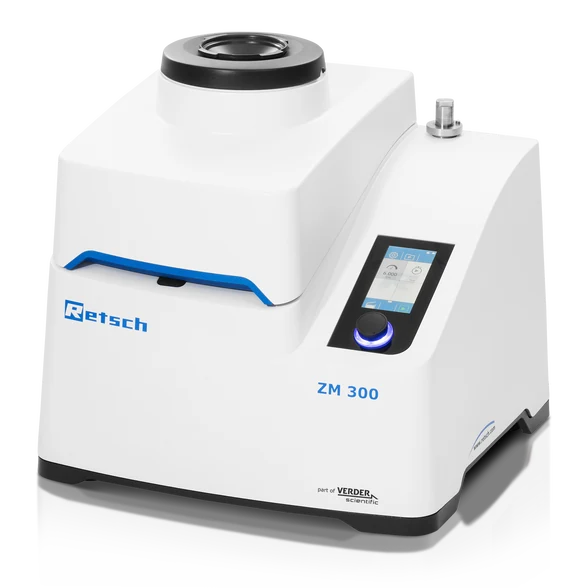
and homogenization for analysis is as diverse, inhomogeneous and challenging as food. The process of producing analytical fineness should ideally take as little time and effort as possible. Reliable analytical results can only be guaranteed if the entire sample preparation process is reproducible. A well-known standard in sample preparation of foodstuffs are ultra-centrifugal mills, which are used for ra pid pulverization of soft, medium-hard, brittle and fibrous food. RETSCH latest model, the ZM 300, offers decisive advantages for food analysis such as temperature monitoring for temperature-sensitive materials, improved sample throughput and wellthought-out handling for particularly ergonomic working. The general design of operation of an ultra-centrifugal mill by impact and shear forces between the ring sieve and the horizontal rotor has not been changed. The maximum feed size is 10 mm. Depending on the sample material, the ZM 300 achieves a final fineness of 40 µm (d90) and below. This is determined by the aperture size of the exchangeable ring sieves, which range from 0.08 mm to 10 mm. The speed of the ZM 300 can be set between 6,000 and 23,000 rpm.
Finer grind sizes and more throughput The high speed of the ZM 300 of up to 23,000 min-1 has a positive effect on grinding performance and sample throughput. Depending on the sample material and the size of the sieve apertures, up to 15 % finer grind sizes can be achieved for food samples, e.g. for grain mix ground with a 0,5 mm ring sieve (Fig.1, left), compared to conventional ultra-centrifugal mills whose speed is limited to 18,000 min -1. With the ZM 300, sample throughput can be increased by up to 15%, as shown by the example of grain mix when using a 0.5 mm ring sieve (Fig. 1, right).
Simple handling, quick cleaning The cassette system of the ZM 300 permits grinding without sample loss as well as quick and easy cleaning. The hood design with its smooth surfaces has also been signi ficantly improved with regards to easier cleaning compared to the previous model ZM 200. The overall height of the ZM 300 is lower than that of the ZM 200, making manual sample feeding much easier. For automatic, uniform feeding of larger bulk samples, the use of the DR 100 vibratory feeder is recommended.
Pulverization of temperaturesensitive samples When grinding larger quantities or temperature-sensitive samples, as well as for cryogenic grinding, it is advisable to use a cyclone with a 3-liter or 5-liter collecting vessel. The cyclone provides better removal of the frictional heat generated during the homogenization process and thus ensures cooling of the sample. The innovative temperature monitoring of the ZM 300 measures the temperature of the cassette lid very close to the grinding process, and an indicative temperature is shown in the display. The temperature in recurring grinding processes is usually known, so that deviations, for example due to the use of an incorrect sieve, can be quickly detected. Even for unknown samples, the user can thus recognize very quickly when the sample is getting too warm and can react, for example, by feeding the sample more slowly or reducing the speed. Temperature-sensitive samples can contain volatile components, such as pyrrolizidine alkaloids in tea, which are lost when heated, or they tend to stick together at higher temperatures, such as green coffee or oilseeds. For the latter, it is recommendable to use distance sieves, which reduce shear forces, thus ensuring less heat development.
Pyrrolizidine alkaloids in tea The group of pyrrolizidine alkaloids comprises 500 chemical substances, which are mainly found in composite plants, borage plants and legumes. 25 g of dried chamomile flowers with a maximum particle size of 5 mm were ground in the ZM 300 using the following parameters: Speed 18,000 min-1, 0.2 mm ring sieve. After 2 minutes, the sample was pulverized to a final fineness of <100 µm. The use of a cyclone ensures continuous material discharge and cooling of the ground material. This procedure preserves the properties of the heat-sensitive pyrrolizidine alkaloids.
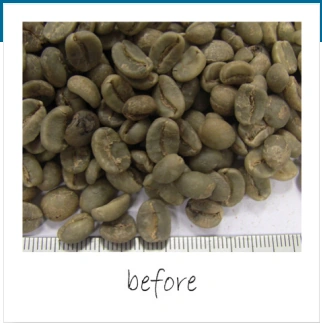
Preserving volatile substances in coffee Coffee is the epitome of aromatic scents. The ingredients responsible for this are slightly volatile and should ideally be preserved during grinding. 50 g of green coffee was pulverized to a particle size of 0.75 mm within 3 min at 23,000 min-1 using a 0.75 mm distance sieve - ideal for further analysis.
Cryogenic grinding in the ZM 300 Soft, tough, sticky or fatty products, such as chocolate or raisins, should be cooled before grinding as without cooling they would only be processed into paste with little homogeneity. One way of cooling is to embrittle the sample with liquid nitrogen (LN2); at a temperature of -196 °C even gummy bears become so hard
Chamomile flowers
Coffee
and brittle that they can be pulverized without difficulty. The sample can also be embrittled by mixing with dry ice (solid CO2). For samples containing volatile components, cryogenic grinding is also the method of choice. Substances that must not become moist, however, are unsuitable for direct contact with a coolant because the moisture in the air condenses on the cold sample. 100 g of dried apples were mixed with dry ice snow and ground to 0.5 mm within 1 min at 18,000 min-1. A 0.5 mm ring sieve was used for this purpose, as well as a cyclone. The viscous sample can only be adequately homogenized and pulverized cryogenically. At room temperature, the sieve apertures would clog.
Conclusion The ZM 300 ultra centrifugal mill takes the reliability and ease of use of its predecessor, the ZM 200, to a new level. The almost unlimited variety of suitable sample materials combined with its outstanding grinding performance and versatility are the reasons why this mill is the undisputed standard in food quality control laboratories around the world.
Plan the configuration for your material.
Define the analytical purpose before optimizing throughput. Heat-sensitive constituents and fine fractions may respond differently to the selected tools and conditions. Record how the sample is fed and recovered so that repeat preparations refer to the complete cycle rather than only the selected speed.
| Consideration | Information to provide |
|---|---|
| Food sample | Texture and sensitive components |
| Preparation setup | Rotor, sieve and collection |
| Routine checks | Thermal behavior and recovery |
How should the application examples be used?
The results describe the materials and configurations discussed here. Confirm equipment options, contact materials and operating conditions for your own sample before adopting a method. A demonstrated endpoint does not guarantee the same outcome for a different material.
Discuss material testing with Glen Mills or request further information or a quote.