
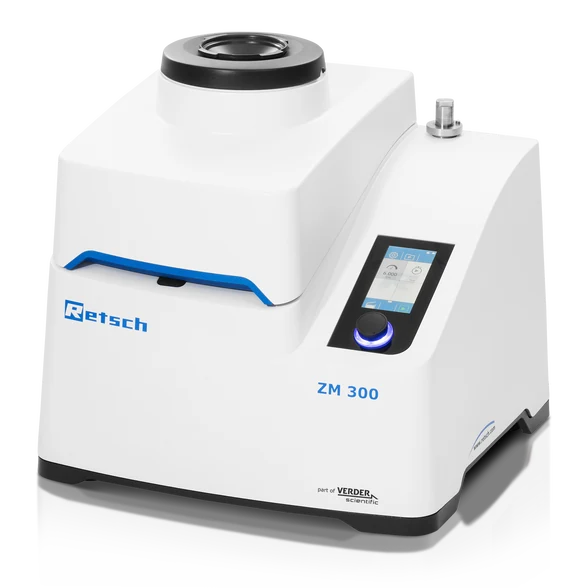
Sample preparation with the RETSCH ZM 300
Nothing matches the performance of the original! RETSCH's Ultra Centrifugal Mills set standards in sample homogenization with more than 20,000 installations world-wide. The outstanding performance, flexibility, user-friendliness and robustness of this highspeed rotor mill make it the undisputed leader in its class.
RETSCH developed the first Ultra Centrifugal Mill ZM 1 half a century ago. The latest model ZM 300 comprises the essence of German engineering expertise combined with high-quality materials and latest software technology. The powerful Ultra Centrifugal Mill ZM 300 provides maximum grinding performance at high speed while, at the same time, ensuring operator convenience and safety.
Ultra Centrifugal Mill ZM 300
Maximum speed for high final fineness and increased throughput
The Ultra Centrifugal Mill ZM 300 is used for the rapid pulverization of soft, medium-hard, brittle, and fibrous materials. Size reduction is effected through impact and shearing forces between a ring sieve and the horizontal rotor. The maximum feed size is 10 mm. Especially with maximum speed, a final fineness of 40 μm (d90) and below may be achieved, depending on the material. This is the maximum achievable fineness amongst all rotor mills in the market. The revolution speed of the ZM 300 ranges from 6,000 to 23,000 min-1, which makes it faster than any other Ultra Centrifugal Mill. Compared to the predecessor model ZM 200 with a maximum speed of 18,000 min-1, it is, on average, 28 % faster. The high speed also has a positive impact on the grinding efficiency and the sample throughput. Depending on the
sample material and the size of the sieve openings, this may result in up to 20 % finer grind sizes at 23,000 min-1 compared to 18,000 min-1.
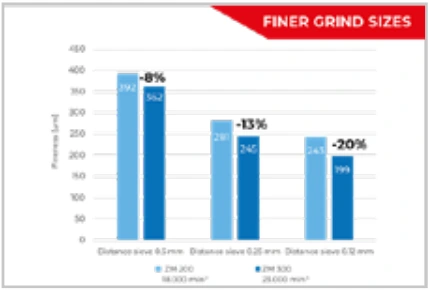
Grind sizes of POM pellets (cryogenic grinding with dry ice). The speed of 23,000 min-1 results in a higher fineness compared to grinding at 18,000 min-1, regardless of the sieves used. The smaller the sieve apertures, the higher the impact of the speed. A similar effect can be observed for cryogenic grinding of PP pellets. When using a 0.5 mm distance sieve, 16 % finer particles were obtained at 23,000 min-1.
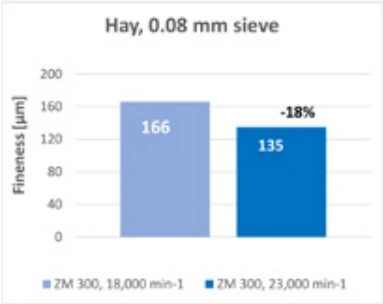
The ZM 300 achieves an increased sample throughput of up to 15 %, as the application example chicken feed shows.
Sample throughput for chicken feed. With a 0.5 mm ring sieve it was increased by 15 % at 23,000 min-1 compared to 18,000 min-1.
Increased reproducibility through temperature monitoring via integrated temperature sensor
Grinding processes lead to increased temperature levels, which strongly depend on the sample material and the chosen speed and aperture size of the sieves. As the grinding process in the ZM 300 is usually very short, the temperature increase is moderate. For highly temperature-sensitive samples RETSCH also offers distance sieves, which lead to less shear forces and thus to lower temperatures, ensuring, for example, preservation of volatile sample components. By using the cyclone, which generates an air stream through the grinding chamber that actively cools the sample, the same effect can be achieved. Despite these options, a rise in temperature cannot be entirely avoided. To ensure that a heat increase does not damage the sample, the ZM 300 is equipped with a temperature sensor in the hood, which measures the temperature of the cassette lid close to the area where the sieve
Push-fit grinding tools allow for easy operation
touches the lid, i.e. very close to the grinding process. The temperature is constantly shown in the mill’s display and allows the user to continuously monitor the grinding process to detect deviations without fail. This is very useful for routine processes where the specific temperature of a particular grinding process is known. The temperature monitoring improves the reproducibility, especially for temperature-sensitive samples.
Convenient operation and easy cleaning
The large touch display with rotary knob allows for convenient parameter setting. In addition to the speed setting and Start / Stop, the user can also define a delayed starting time. If the automatic feeding system DR 100 is connected, the feed rate can be controlled via the display as well. It is recommendable to use the Vibratory Feeder DR 100 for automatic and uniform feeding of large amounts of free-flowing materials. It helps to prevent overloads caused by feeding the sample too quickly.
The push-fit cassette principle of the ZM 300 guarantees 100 % sample recovery and easy cleaning. All surfaces of the mill, especially inside the hood, are smooth and without edges where sample material could get trapped, thus avoiding cross contamination of the next sample. Another benefit is easy cleaning of the surfaces. To increase operating convenience and allow for ergonomic manual sample feeding, the ZM 300 is lower in height than its predecessor.
If large quantities or temperature-sensitive materials are processed, the use of a cyclone, e. g. with a 3-liter or 5-liter collector, is recommended. The frictional heat generated during the grinding process is partly discharged through the cyclone, which helps cooling the sample.
Cryogenic grinding in the ZM 300
The ZM 300 is also suitable for cryogenic grinding of tough sample materials like plastic pellets. The sample is directly immersed into a container filled with liquid nitrogen before being continuously but slowly fed to the hopper of the mill with a steel spoon or tongues. When using dry ice as grinding aid, this needs to be mixed with the sample (1 part sample, 2 parts dry ice) and the entire mixture is then pulverized in the mill.
Using a cassette in combination with a cyclone is recommended for cryogenic grinding in the ZM 300 to ensure that the evaporating cooling agent is completely discharged during the grinding process. The use of dry ice rather than LN2 should be preferred if the sample is already smaller than 1 mm, as the transfer of a dry ice-sample mixture to the mill is much easier than fishing the sample with a spoon from the LN2 bath.
If the sample has a low thermal capacity, dry ice is also preferable as it cools the sample during grinding. If the sample has a high fat content or is very heat-sensitive, embrittlement usually improves the grinding process as the cooling counteracts the effects caused by frictional heat.
Great versatility thanks to wide range of accessories
The ZM 300 can be equipped with different rotors and ring sieves . The standard rotor with 12 teeth is suitable for almost any material, whereas the rotor with 6 teeth is typically used for fibrous samples. For samples with small feed sizes the rotor with 24 teeth is best suited. Sieves are available with reinforced rim (for standard applications) or as distance sieves (for temperature-sensitive samples). All sieves have four grooves for easy insertion and secure locking. The grinding tools are available in various materials like titanium for neutral-to-analysis grinding procedures, e.g. to avoid abrasion of heavy metals.
Wide selection of rotors and ring sieves
Usually, sample batches up to 300 ml are ground in the standard cassette. An optional large volume cassette doubles the batches to 600 ml. An optional cyclone with collecting vessels of 3 l or 5 l is available to process even larger quantities.
Application examples
| Sample | Feed size in mm | Feed quantity in g | Speed in rpm | Time in min | Final fineness in mm |
|---|---|---|---|---|---|
| PMMA | 4 | 65 | 23,000 | 2.5 | 0.2 |
| Clay | 5 | 100 | 23,000 | 1.5 | 0.04 |
| Dried apples | 10 | 180 | 18,000 | 1 | 0.3 |
| Petroleum coke | 10 | 130 | 23,000 | 3 | 0.04 |
| Pills | 50 (length) | 20 | 18,000 | 0.4 | 0.5 |
| Powder painting chips | 20 | 200 | 18,000 | 10 | 0.1 |
| Tobacco | 10 | 50 | 23,000 | 0.4 | 0.5 |
| Barley | 10 | 150 | 23,000 | 0.25 | 0.5 |
Conclusion
The Ultra Centrifugal Mill ZM 300 takes the reliability and ease-of-use of its predecessor ZM 200 to a new level. The almost unlimited variety of sample materials it can process in combination with its outstanding grinding performance and versatility are the reasons why this mill is the undisputed standard in quality control laboratories all over the world.
Which sample details determine the ZM 300 configuration?
Define the starting material, target fineness, sample quantity and analytical requirements before selecting the RETSCH ZM 300 configuration.
Discuss material testing with Glen Mills or Contact Glen Mills for information or a quote.
Explore the equipment discussed
RETSCH ZM 300 questions
Does higher speed guarantee a finer sample?
No. Material behavior, tool choice and operating conditions matter. Compare settings using the same material and a defined measurement method.
Is ring sieve aperture the final particle size?
No. A ring sieve opening describes the tool. The final particle-size distribution must be checked against the needs of the analysis.
Who should I contact for a RETSCH ZM 300 quotation?
Contact Glen Mills for further information or a quote. Include your material, batch quantity, starting size and target result.