
Can analyzer precision overcome a biased food sample?
No. Repeatedly measuring the wrong portion can give precise but unrepresentative results. Preparation and sampling need their own controls.
Food analysis is a key tool for ensuring food quality, safety, and compliance with legal requirements. However, modern analytical methods such as chromatography, spectroscopy, or wet chemical methods only yield valid and reproducible results if the underlying sample is representative of the source material and sufficiently homogeneous. Foodstuffs, in particular, pose a special analytical challenge due to their complex composition of fats, proteins, carbohydrates, water, and functional additives, as well as their widely varying consistencies, structures, and moisture contents.
Against this backdrop, sample preparation plays a key role in the entire analytical chain. The reliability of analytical results depends largely on effective grinding and homogenization, as this is the only way to obtain a representative subsample that accurately reflects the composition of the total material. Inadequately prepared samples, on the other hand, can lead to systematic errors, increased variability, and distorted measurement results. A targeted reduction in particle size also helps minimize the standard deviation of subsequent analyses. The selection of suitable grinding and homogenization technologies is therefore not merely a preparatory step, but a quality-determining one in food analysis. As the world’s leading supplier of laboratory equipment for sample preparation, RETSCH supports reproducible and matrix-adapted sample preparation for virtually any food product with a broad portfolio of mills, sieve shakers, and accessories.
1.1 Dry, Granular, and Crystalline Samples
Granular or crystalline foods such as grains, sugar, or salt are considered relatively easy to grind. Nevertheless, controlled grinding is still necessary here to achieve defined final particle sizes without altering the chemical composition. Rotor and centrifugal mills, such as the ZM 300 or the SR 300, are particularly well-suited for this purpose, as they can achieve reproducible particle sizes in the micrometer range. For example, crystalline sugar can be ground to finenesses below 50 µm using ultracentrifugal mills, which is sufficient for most analytical procedures.
1.2 Oily, moist, and sticky samples
Sample preparation is significantly more complex for foods with high fat, sticky sugar, or water content, such as chocolate, cheese, meat, or baked goods. These samples tend to smear or stick together during grinding, which can result in uneven particle sizes. For such matrices, RETSCH recommends the use of high-performance knife mills that enable rapid and intensive homogenization. It is crucial to monitor the temperature during the grinding process to prevent thermally induced changes in the sample. Most of these samples can be homogenized excellently in the GM 200 knife mill. Meat, for example, even when a thick rind must be ground along with it, poses no challenge when used correctly. 250 g of the fattiest, toughest meat can thus be completely homogenized in 2 minutes. The use of gravity lids is essential here. A standard household blender cannot handle this type of sample!
1.3 Samples with a high moisture content
Foods with a high water content, such as fresh vegetables, fruits, or processed products like soups and sauces, present special challenges for sample preparation, as the high moisture content can facilitate homogenization but also carries the risk that sample material will adhere to the walls of the grinding chamber and avoid contact with the rotating blades.
For such matrices, high-performance knife mills such as the GRINDOMIX GM 200 or GM 300 are suitable, as they enable fast and intensive grinding even of moist samples. In the case of foods with a very high water content, such as tomatoes or fruit mixtures, the high liquid
content prevents the sample material from sticking, allowing complete homogenization to be achieved in a short time; the use of a gravity lid with overflow channels ensures that the sample remains within the cutting area of the blades. For larger sample volumes, the GM 300 offers an efficient solution with its larger container volume.
Foods with moderate water content, such as cabbage or leafy vegetables, on the other hand, often have a firmer structure, so that despite high speeds, individual pieces of the sample may escape the grinding process. In such cases, the use of the gravity lid, the targeted addition of small amounts of water, and a two-stage grinding strategy with interval mode improve mixing and lead to reproducible homogenization.
1.4 Chewy, fibrous, and hard foods
Fibrous samples such as dried herbs, plant materials, or freeze-dried fish pose special challenges for sample preparation due to their low bulk density, voluminous structure, and often heterogeneous composition. They tend to form clumps or agglomerates, which is why larger sample quantities and often manual pre-grinding are required to ensure representative and efficient grinding.
Cutting effects are particularly suitable for such samples: cutting mills such as the SM 100 enable effective pre-grinding of fibrous materials, with the SM 100 typically achieving final particle sizes of approximately 4 - 6 mm. For finer final particle sizes below 1 mm, we recommend using more powerful systems such as the SM 300 in combination with a cyclone, which improves the discharge of lighter materials while also helping to cool the sample. For smaller sample quantities, the compact SM 50 bench-top cutting mill is ideal; thanks to its integrated cyclone system, it is particularly well-suited for such samples and is also exceptionally easy to clean - significantly simplifying daily operations. When particle sizes below 0.5 mm must be achieved, a two-stage strategy consisting of pre-comminution in a cutting mill followed by fine grinding in a rotor or ultra centrifugal mill has proven effective, with the selection of suitable sieves being critical. The use of cyclone systems also minimizes the loss of volatile constituents, while ball mills enable complete structural destruction in the case of particularly stubborn fibrous materials.
Sample preparation also plays a crucial role in quality control, particularly in the detection of mycotoxins. Cutting mills are particularly well-suited for this purpose, as they enable the comminution of larger sample containers, which is essential for reliably detecting localized mycotoxin clusters and incorporating them into the overall sample. Only by grinding sufficiently large and representative sample quantities can the risk of false-negative results be minimized. Homogeneous sample preparation thus forms the basis for robust and reproducible mycotoxin analysis.
2. Cryogenic sample preparation as a special case
Cryogenic grinding is a special case in food analysis. It is primarily used for very soft, sticky, or temperature-sensitive samples. By cooling the sample - for example, with dry ice or liquid nitrogen - the material becomes brittle and can be efficiently pulverized. Cryogenic grinding not only prevents clumping but also reduces the loss of volatile components. In particular, high-fat products such as chocolate or nut mixes can be homogenized in this way without fat phases separating or aromatic components being lost. The ability to equip existing mills with cryogenic kits significantly expands the range of applications and makes the method practical for many laboratories. The CryoMill and the MM 500 control vibrating mill are specifically optimized for the cryogenic grinding of samples and as well offer the highest level of safety.
3. Equipment Designs and Mill Types in Food Analysis
RETSCH offers a wide range of specialized mill types for food analysis. These include, among others:
Knife mills for soft, fatty, and moist samples Rotor and centrifugal mills for dry, brittle, and granular materials Cutting mills for fibrous and tough samples Ball mills for fine and ultrafine grinding
The selection of the appropriate mill depends on several factors, including initial particle size, desired final fineness, sample quantity, and thermal sensitivity. Sample preparation must always be adapted to the subsequent analytical method to avoid false results. Reproducible results can only be achieved through the correct combination of equipment, accessories, and process parameters.
4. Reproducibility and Quality Assurance
Reproducibility is a key quality criterion in food analysis. Different laboratories or users must be able to achieve identical results under comparable conditions. RETSCH therefore follows an approach based on standardized sample preparation. High process reliability is ensured through defined grinding parameters, programmable machines, robust equipment designs, and comprehensive application support. Achieving a specific degree of homogenization is crucial for reproducibility.
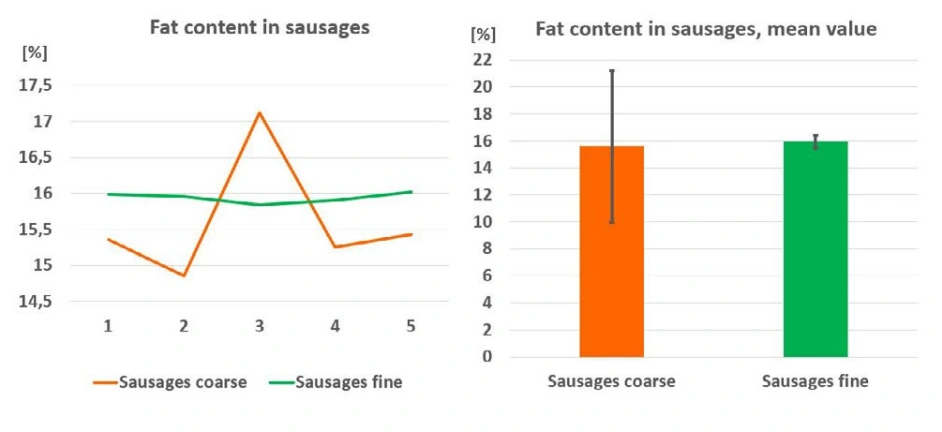
The standard deviation is generally significantly higher for coarsely ground samples than for fully finely ground samples. The following example illustrates this: A sausage sample with a particle size of 4–5 mm and a homogenized sample with particles < 0.5 mm were analyzed for fat content five times in a row. The analysis was performed using microwave-assisted drying in combination with NMR spectroscopy. For each measurement, 4 g of sample was dried within 2.5 minutes and then analyzed within 1 minute.
The fat content of the coarse sausage sample showed significantly greater fluctuations than that of the finely homogenized sample. In the coarse fraction, the measured fat content ranged from 14.85 % to 17.12 % with a standard deviation of 0.88 %.
In the homogenized sample, the standard deviation was reduced by a factor of more than 10 to 0.07 %; the fat content here fell within a narrow range of 15.84 % to 16.02 % (relative standard deviation reduced from 5.63 % to 0.45 %).
In addition, auxiliary equipment such as cyclones contributes to improved cooling and efficient sample discharge. This is particularly relevant for larger sample volumes, such as those encountered in quality control or interlaboratory tests. Furthermore, dust contamination of the laboratory environment (personal protection) and machine bearings (reduced
maintenance costs) is significantly reduced when a cyclone system is used. The combination of technical precision and application-oriented consulting is a key reason for the widespread acceptance of RETSCH systems in the food industry.
5. The Importance of Sieving in Quality and Production Control
In addition to grinding and homogenization, sieving plays a central role in food analysis, particularly when it comes to particle size distributions, fractionation, and in-process quality control. Particle size influences numerous product properties such as solubility, flowability, sensory characteristics, and extraction behavior. In the food industry, it is therefore a critical quality parameter, for example in flour, sugar, cocoa, spices, milk powder, or functional additives.
In quality control, sieve analysis serves, among other things, to:
Verify compliance with product-specific particle size specifications Monitoring grinding and mixing processes Ensuring consistent product properties across batches Detecting agglomerates or oversized particles
Mechanical sieving methods reach their limits with very fine, light, or agglomeration-prone powders. Here, air jet sieving offers decisive advantages, as it enables effective dispersion of the particles.
5.1 Air-jet sieving as a key technology
Air jet sieving is based on a rotating air jet that disperses the sample material precisely across the sieve mesh. Finer particles pass through the sieve, while coarser fractions are retained. This principle is particularly gentle and prevents both sieve clogging and mechanical damage to sensitive food particles. Typical applications include flour types, starch, cocoa, milk powder, protein powder, and flavorings. With the AS 200 jet pro, RETSCH has consistently further developed air jet sieving and created an all-in-one system for particle analysis.
The device combines air jet sieving, an integrated precision balance, and software-supported evaluation in a compact benchtop unit. This eliminates the need for sample transfers between the sieving machine and an external balance, significantly reducing material loss, contamination risks, and operator errors. The integrated balance, with a resolution of 0.01 g, is directly integrated into the instrument design and enables continuous measurement of mass fractions during the sieving process. In conjunction with the software, particle size distributions can be automatically calculated, documented, and archived. This is particularly important for quality assurance in accordance with ISO 9000 and related standards, as well as for audit-related applications.
The AS 200 jet pro supports laboratories in performing standardized and reproducible sieve analyses. Features such as guided sieving processes, method storage (SOPs), automatic parameter checks, and optional wizards increase process reliability. Especially in food analysis, where large sample series and regular batch controls are frequently performed, this contributes significantly to the efficiency and comparability of results. The ability to reliably separate the finest particles in the range of approximately 10 µm to 4 mm makes the AS 200 jet pro a versatile tool for research, development, and routine analysis in the food industry.
Conclusion
Sample preparation is a critical success factor in food analysis and forms the foundation of any reliable analysis. The wide variety of food matrices requires flexible, high-performance, and reproducible solutions that enable both effective grinding and homogenization as well as controlled particle classification. RETSCH offers a comprehensive portfolio for this purpose, ranging from the classic grinding of dry samples to the cryogenic homogenization of complex, temperature-sensitive foods and precise sieving. Supplemented by the use of cyclone systems, sample discharge, cooling, and dust reduction can be specifically optimized, which contributes to increased process reliability and reproducibility, particularly when handling larger sample volumes. Through its consistent focus on reproducibility, user safety, and analytical neutrality, RETSCH has established itself as a key player in food analysis.
Plan the configuration for your material.
Choose the preparation route around the matrix and the measurement. Nutrient analysis, contaminant testing and molecular assays may require different handling. Preserve the complete ingredient mixture when reducing sample quantity, and assess whether preparation changes any property that matters to the chosen test.
| Consideration | Information to provide |
|---|---|
| Analytical purpose | Nutrients, contaminants or identity |
| Matrix | Ingredients and physical texture |
| Preparation evidence | Homogeneity and retained components |
How should the application examples be used?
The results describe the materials and configurations discussed here. Confirm equipment options, contact materials and operating conditions for your own sample before adopting a method. A demonstrated endpoint does not guarantee the same outcome for a different material.
Discuss material testing with Glen Mills or request further information or a quote.
Explore the equipment discussed
- RETSCH AS 200 jet pro Air Jet Sieving Machine
- RETSCH GM 200 Knife Mill
- RETSCH GM 300 Knife Mill
- RETSCH SM 100 Cutting Mill