
Why is grinding only the hardest ingredient insufficient?
The laboratory needs a representative mixture. Preparation must address all relevant constituents rather than only the component that determines grinding time.
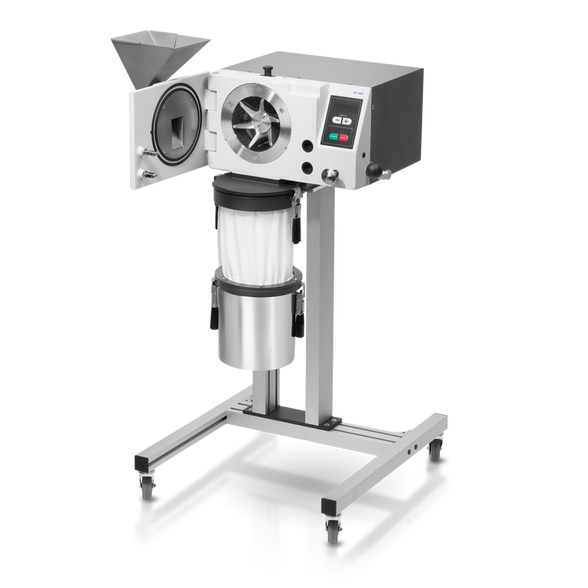
Size reduction of feed pellets of various sizes in the Rotor Beater Mill SR 300
Grain, compound feeds or feed pellets occur in a variety of forms; compound feeds are usually inhomogeneous. Feedstuff is analyzed, for example, to determine the nutritional value, to detect hazardous substances or genetically modified ingredients. To ensure meaningful and reliable analysis results, representative and homogeneous samples are required. Therefore, sample preparation involves homogenization and size reduction of the material to a defined particle size. RETSCH laboratory mills are perfectly suited for this process.
Usually only a few grams or milligrams of sample are required for analysis; these, however, have to represent the entire original sample. Depending on the part of the material from which a sample is taken, information on its composition may vary
adapted to both the sample properties and
control involves daily analysis of a number
greatly. To determine the nutritional value
analysis requirements. This means that
of samples which in some cases are
of compound feed, for example, all
grinding parameters and accessories have
extracted from a few kilograms of material
components need to be equally represented
to be selected in a way that the properties
which are first homogenized to ensure
in the sample which can be achieved by
to be analyzed will not be modified in the
representativeness. Easy and intuitive
thorough homogenization.
process. For most digestion and extraction
operation, effective size reduction and quick
To obtain a correct and meaningful analysis
Feedstuff varies greatly with regards to
efficiency in the lab. Medium-hard and
result, the preparation process needs to be
hardness, moisture or fat content. Quality
grainy feed material is best ground with a
methods a particle size of 0.5 mm is ideal.
cleaning of the mills help to increase
combination of impact and shearing forces. Impact lets the grains or pellets disrupt and the particles are then further reduced in size by shearing.
Homogenization of large feed pellets without preliminary size reduction
Thanks to its robust design and the possibility to process large sample volumes up to 30 l in one working run, RETSCH’s Rotor Beater Mill SR 300 – which is now available in a completely updated and revised version – is perfectly suitable for use in the laboratory and for small scale production. The large free surface of the 360° sieves ensures rapid processing. A selection of accessories makes the mill adjustable to a wide range of applications. The new SR 300 features variable speed from
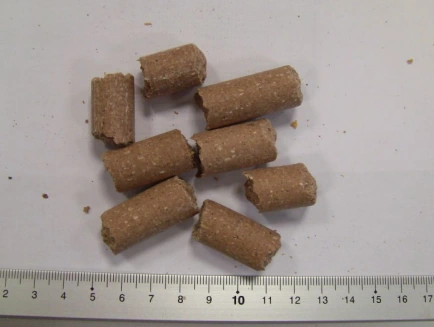
Size reduction of feed pellets (left) and a
3000 to 10,000 rpm and a powerful 2.2 kW
poultry grain mix (right) in the ZM 200
drive; it accommodates feed sizes of up to 25 x 25 mm resp. 35 x 15 mm. The application example of two different samples of horse feed (500 g each) illustrates the performance of the new SR 300. The soft, round pellets (25 x 25 mm - Fig. 1, left) are ground at 10,000
Homogenization of compound feed and corn in the Ultra Centrifugal Mill ZM 200
outwards. The particles hit the rotating teeth of the rotor and are crushed in the process. Further size reduction is achieved when the particles are ground between
rpm, using a 0.5 mm 360° sieve, to a particle
The high-speed rotor mill ZM 200 is
rotor and sieve through shearing forces. The
size of 90% < 0.5 mm within 2.5 minutes. The
particularly suitable for grinding slightly
sample remains in the grinding chamber for
hard, longish pellets (15 x 35 mm - Fig. 1,
fatty grain or compound feed as well as
only a very short time so that its properties
right) are homogenized to a particle size
small feed pellets. The sample passes
are not altered during the grinding process.
< 0.5 mm after 3 minutes, using a 0.5 mm
through a hopper and hits a horizontal
100 g of feed pellets (10 x 3 mm - Fig. 2, left)
360° sieve and maximum speed.
rotor, where centrifugal forces throw it
is processed in the ZM 200 at 18,000 rpm,
For grinding soft, temperature-sensitive or slightly fat or oily samples an optional distance rotor is available. The larger gap between rotor and sieve serves to reduce frictional heat during grinding so that smudged sieves and rotor blockings are successfully avoided. The use of a cyclone helps to improve sample discharge and provides additional cooling. Thanks to a ring filter and collecting receptacle with convenient bayonet locking mechanism the grinding process is virtually dust-free. Cleaning the mill can be done very quickly due to the removable grinding cassette, push-fit rotor
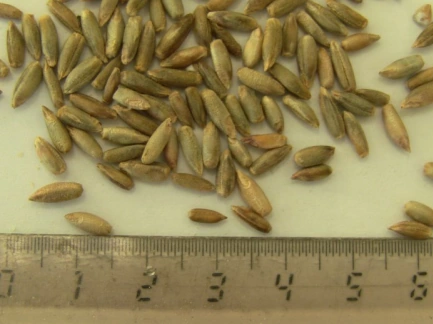
Size reduction of rye in the Cyclone Mill
and removable hopper.
TWISTER
using a 0.5 mm ring sieve, to a particle size
adaption to a wide range of samples. A 160
below 0.5 mm (d90 value) in less than 30
g sample of rye was milled at 14,000 rpm to
seconds. The ground sample is collected in a
a fineness <1.5 mm within 60 seconds, using
cassette. The patented system ensures that
a 2 mm sieve .
ring sieve and cassette are removed together thus allowing for full sample
Conclusion
recovery and avoidance of cross contaminations.
RETSCH mills are suitable for grinding and homogenizing all types of grain and
A mini cassette with matching sieves and
feedstuff quickly, reproducibly and
rotor is available for sample volumes below
neutral-to-analysis. Rotor mills have become
20 ml. It can be used, for example, to grind
the standard in the industry thanks to their
10 g of a poultry grain mix with a 0.25 mm
great flexibility and wide selection of
sieve and an 8-tooth rotor at 18,000 rpm to
accessories. Efficiency in the lab can be
a fineness of <200 microns within 20
greatly improved by using RETSCH mills.
seconds (Fig. 2, right).
The ZM 200 is also suitable for milling slightly fatty and grainy seeds. For this type of sample the use of a distance sieve is recommendable. A small gap to the rotor ensures that the sieve apertures are not smudged by fatty sample particles. In addition, less frictional heat is generated so that this sieve is also suitable for grinding temperature-sensitive samples. By using a cyclone, the sample is not only discharged more quickly but is also cooled; with a cyclone up to 5 l can be processed in one working run.
Cyclone Mill TWISTER for non-fatty grain samples
RETSCH’s cyclone mill TWISTER is the perfect choice for grinding feedstuff or grain such as wheat or rye. It is mainly used for sample preparation to subsequent NIR analysis. The mill quickly grinds fibrous and soft samples by impact and friction to analytical fineness. The high speed and the optimized shape of the rotor and the grinding chamber generate an air stream which transports the sample through the integrated cyclone into the 250 ml sample bottle while the sample is cooled. Additionally, most of the sample residues are removed thanks to the air stream. Three speeds and sieves with different aperture sizes allow for optimum
The latest generation of the rotor Beater Mill SR 300
Plan the configuration for your material.
Record the feed type, moisture condition and required test portion. Check that preparation does not preferentially retain or lose a constituent. A finer product is useful only when it supports representative analysis and does not introduce a change relevant to the target measurement.
| Consideration | Information to provide |
|---|---|
| Feed composition | Grain, pellets or compound mix |
| Material condition | Moisture and hard components |
| Analytical portion | Homogeneity and acceptable losses |
How should the application examples be used?
The results describe the materials and configurations discussed here. Confirm equipment options, contact materials and operating conditions for your own sample before adopting a method. A demonstrated endpoint does not guarantee the same outcome for a different material.
Discuss material testing with Glen Mills or request further information or a quote.