
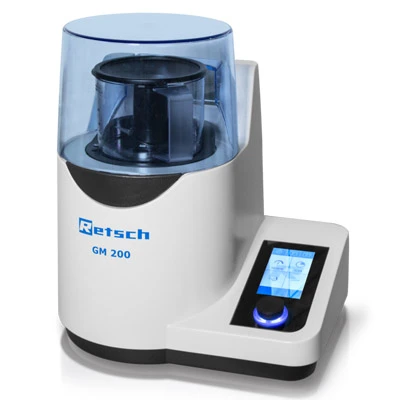
Is a smooth-looking food sample necessarily homogeneous?
No. Check whether the analytical portions represent the full mixture, especially when ingredients differ in density, texture or composition.
The diversity of foodstuffs with their often very different properties represents a challenge for food testing laboratories. Before the actual analysis, the sample materials – which can vary strongly with regards to e. g. hardness, fat/sugar content or moisture – need to be homogenized and reduced to a sufficiently small particle size. The Knife Mill GRINDOMIX GM 200 sets standards in food sample preparation. The cutting effect produced by the steel blades results in the perfect homogenization of samples with high water, oil, sugar or fat content. The GM 200 which accepts sample volumes up to 700 ml has been completely revised and upgraded. This mill covers a wide application range from grainy food stuff such as rape seed, rice, soy beans or corn to fibrous or tough samples such as meat, fish, sticky candy or cheese.
New features improve homogenization of difficult samples
Thanks to new features like the powerful 1000 W drive, the mill can homogenize even difficult samples like tough meat with skin or fibrous plants very quickly and efficiently without blockages or the need for more than two grinding steps. The innovative Boost function allows for a temporary speed increase to 14,000 min-1, providing extra power for the homogenization of difficult samples in a very short time. The mill offers three different operation modes (standard mode = cutting, reverse mode = impact, interval mode = improved sample mixing) to optimize the homogenization process regarding the material properties. Up to 8 programs can be stored for routine applications as well as 4 program sequences which is ideal to combine two grinding steps. This is very
useful, for example, for pre-crushing in the impact mode followed by fine grinding in the cutting mode, or if two different grinding speeds are required.
A wide selection of accessories allows for individual adaptation to application requirements. The grinding containers are available in steel, glass, polycarbonate, and polypropylene and accept up to 700 ml of sample material. A patented gravity lid reduces the sample volume during the grinding process, thus permitting thorough homogenization of the entire sample. For samples with a high liquid content, another type of gravity lid is available with overflow channels through which the liquid which flows up the container walls (capillary effect) is returned to the center of the container, thus ensuring that no sample material is lost, and the results are not falsified. The so-called reduction lids reduce the container volume to 0.3 l or 0.5 l thus submitting smaller sample volumes continuously to the grinding process. Beside the standard knife, a knife with serrated blades for tough samples like meat or a knife with pure titanium blades for heavy-metal free homogenization are available.
Meat/Bacon/Fish with very tough or thick skin
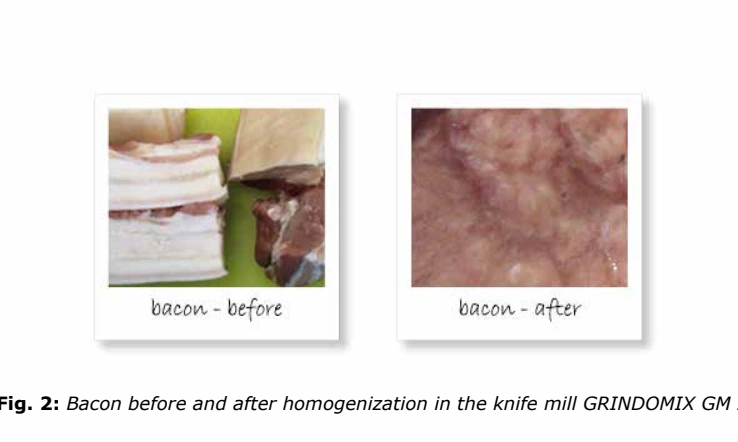
Meat samples may be very tough, especially, if larger fatty parts are included or if the skin needs to be homogenized as well. 450 g of meat were pre-cut manually to pieces of approximately 50 mm. Until now, complete homogenization of such meat samples had to be carried out in 4-5 grinding steps with increasing speed to avoid blocking of the blades. In the new GM 200, however, the sample was fully homogenized in only two grinding steps thanks to the improved powerful 1,000 W drive. Pre-cutting was performed at a revolution speed of 7,000 min-1 for 10 seconds. The standard lid was used in this step, so that the large initial sample pieces had enough space to move inside the grinding container. The gravity lid was used in the fine grinding step at a revolution speed of 10,000 min-1 for 20 seconds as the lid automatically reduces the volume of the grinding chamber with decreasing sample volume. The use of the serrated blades knife increased the cutting efficiency on the tough bacon. If the sample starts to bounce at a revolution speed of 7,000 min-1, the speed should be lowered at the beginning. The Boost function with a speed of 14,000 min-1 may be useful to homogenize the toughest parts of the sample.
Vegetables with low water content
Vegetables often contain moisture (like kohlrabi) or even consist predominantly of water (like tomatoes). In the latter case, complete homogenization is facilitated by the high water content, as sample pieces are too wet to stick on the walls of the grinding container where they no longer come into contact with the rotating knifes. This is not the case with samples like kohlrabi which have a lower water content. The sample pieces tend to stick on the wall of the grinding container, thus evading contact with the knife blades. A few sample pieces may remain in the mostly homogeneous sample, even if maximum speed was used. Using a specific lid like the gravity lid with overflow channels helps to improve the grinding effect, but full homogenization is often achieved by adding water to the sample. 280 g kohlrabi was cut manually in four pieces. Grinding was performed in two steps. It is recommended to use a low speed of 2,000 min-1 for the first 10 seconds. For fine grinding at 5,000 min-1, 50 ml water was added to achieve a good homogeneity after 20 seconds. The gravity lid with overflow channels was used to ensure thorough homogenization. The interval mode during the fine grinding step improves mixing of the sample and thus increases grinding efficiency.
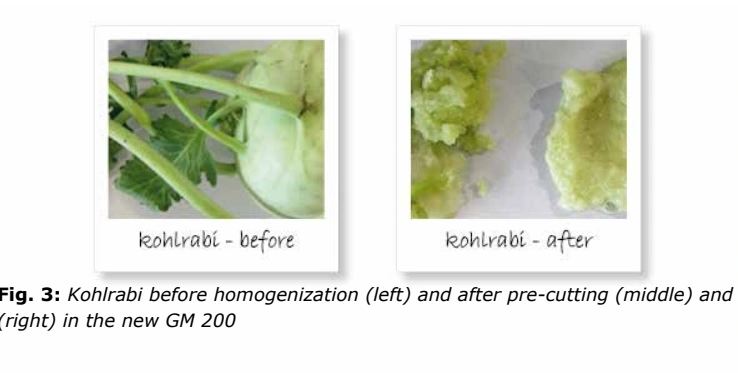
Kohlrabi before homogenization (left) and after pre-cutting (middle) and fine grinding (right) in the new GM 200
Frozen fruit or vegetables
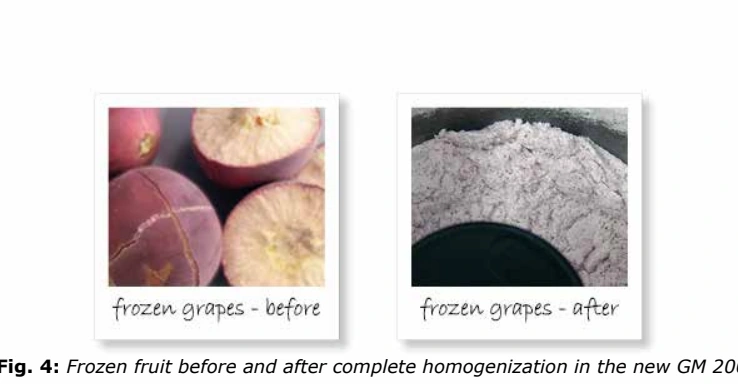
Frozen fruit or vegetables have quite a hard consistency; therefore, the grinding container of stainless steel should be used to minimize wear. Grinding of 220 g frozen grapes was performed in two steps. In the pre-crushing step (10 seconds at revolution speed 4,000 min-1) the impact mode was used to reduce wear on the sharp end of the blades. After the fine grinding step (10 seconds at revolution speed 6,000 min-1) a final fineness of predominantly <500 µm was achieved.
Sticky samples like raisins, sweets, cheese
Sticky samples like raisins, cheese or sweets tend to agglomerate and stick on the knife blades or the walls of the grinding container. Thus, the degree of homogenization can be rather low. The strong 1,000 W power drive of the GM 200 now ensures that the blades do not get blocked even when homogenizing e. g. 200 g of very sticky and tough raisins at revolution speed of 10,000 min-1 for 10 seconds in cutting mode. The reduction lid forces the sample against the blades, thus improving the degree of homogenization.
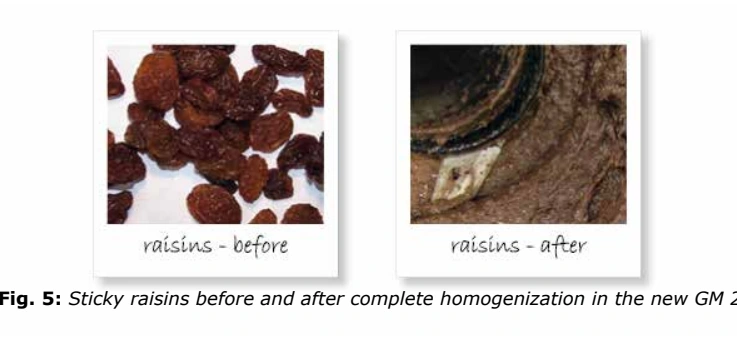
Granulous samples like corn, seeds, soy beans
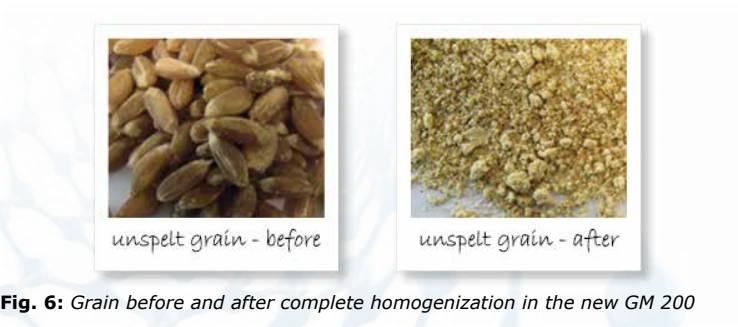
50 g unripe spelt grain were pulverized to a particle size of 800 µm in just 15 seconds at a revolution speed of 10,000 min-1 in cutting mode. Due to the small sample quantity the volume reduction lid 0.3 liter was used. The reduced grinding chamber volume ensures that the sample is continuously hit by the knife blades, thus greatly improving the degree of homogenization.
Plan the configuration for your material.
Treat the sample as a mixture, not just its easiest component to cut. Vessel selection, loading and the preparation sequence need to accommodate the complete food matrix. Check homogeneity against the intended analytical portion instead of assuming that a visually smooth product is sufficient.
| Consideration | Information to provide |
|---|---|
| Food matrix | Moisture, fat and fibrous components |
| Vessel loading | Quantity and configuration |
| Endpoint | Homogeneity for the planned test |
How should the application examples be used?
The results describe the materials and configurations discussed here. Confirm equipment options, contact materials and operating conditions for your own sample before adopting a method. A demonstrated endpoint does not guarantee the same outcome for a different material.
Discuss material testing with Glen Mills or request further information or a quote.