
Does rapid fat measurement remove the need for homogenization?
No. A fast measurement still characterizes only the portion tested. Representative preparation remains part of the analytical method.
The fat content is one of the most important parameters for the quality control of food and feed. On the one hand, fat contributes greatly to the nutritional value of a product; on the other hand, fats like milk or cocoa fat are quite expensive components which should be used economically. Due to various directives on food labelling, it is up to the manufacturers to indicate the true fat content of their products on the wrapping.
A major task of food testing laboratories is to verify the labelling of wrapped food, for example regarding the fat content, by analyzing the product in question. There are various methods of quantitative fat analysis and it depends on the sample material, the required accuracy and the time frame which method is applied. To carry out analytical examinations during production control can be problematic due to the time it takes until the results are obtained. This makes quick interventions in the production process almost impossible. Fast and reproducible sample preparation, e. g. by homogenizing the sample with an appropriate laboratory mill combined with microwave-induced NMR techniques for fat content measurement is a quick and efficient way to obtain reliable results. In this article, examples of homogenization of different food samples are given and the influence of different particle sizes on the analysis results and standard deviations are explained.
Homogenization of samples with a high fat content Food occurs in a great variety of consistencies and is often inhomogeneous, but an inhomogeneous part-sample taken for fat analysis does not represent the original material because some components may be overrepresented or missing altogether.
Ultra Centrifugal Mill ZM 200
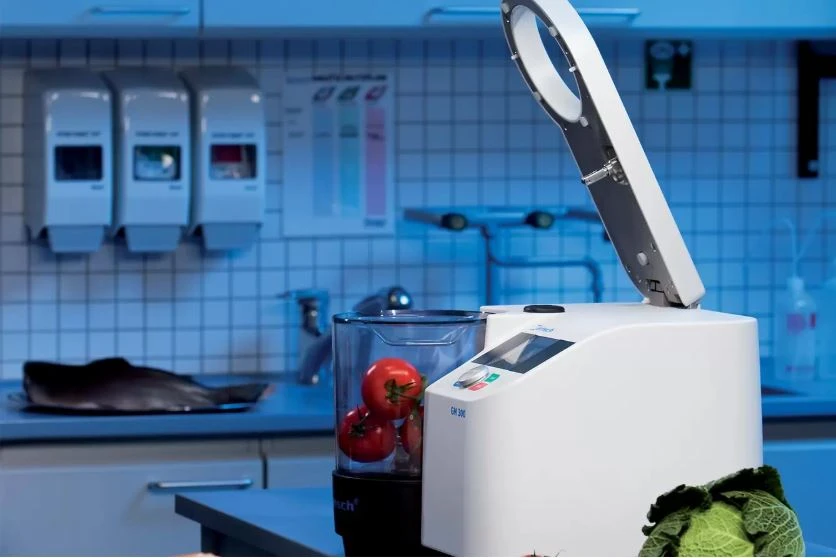
Knife Mills GRINDOMIX GM 200 and GM 300
Food testing labs require representative samples to produce meaningful and reproducible analysis results, therefore, food samples must be homogenized and pulverized, ideally with as little time and effort as possible. For thorough homogenization of samples with a high fat or oil content, RETSCH offers three suitable mills: RETSCH´s Ultra Centrifugal Mill ZM 200 and the Knife Mills Grindomix GM 200 and GM 300.
The Ultra Centrifugal Mill ZM 200 is a rotor mill which is used for fine size reduction of medium-hard products with a moderate fat content such as oil seeds, cookies, feed pellets or dog food. The sample is ground mostly by shearing effects between the rotor and a fixed ring sieve. The aperture size of the ring sieve determines the degree of fineness. For fat analysis through extraction, a final fineness of 0.5 to 1 mm is usually sufficient and can be achieved with aperture sizes of 0.75 to 1.5 mm. The use of smaller sizes may lead to fat separation, therefore, the rule “not as fine as possible, but as fine as necessary" should be applied when selecting the sieve. The use of so-called distance sieves, which are designed in a way to reduce friction, is usually beneficial for fatty samples. The revolution speed of the ZM 200 ranges from 6000 to 18,000 min-1. The cassette principle guarantees 100 % sample recovery and easy cleaning. The use of the optional Vibratory Feeder DR 100 ensures automatic and uniform feeding of large amounts of free-flowing materials. If large quantities or temperature-sensitive materials are processed, the use of a cyclone, e. g. with a 3-liter or 5-liter collector, is recommended. The frictional heat that is generated during the grinding process is partly discharged through the cyclone which helps to cool the sample.
The Knife Mills Grindomix GM 200 and GM 300 are preferably used for materials with a high fat content such as fish pellets, meat, sausages or cheese. The mills grind and homogenize the sample through cutting effects in a liquid-tight container. The final fineness and the degree of homogenization are determined by the variable speed. The grinding process can also be carried out in a liquid phase, e.g. the extraction medium. Thus, the loss of fat can be avoided if the complete contents of the container is transferred to the extraction thimble. The GM 300 homogenizes sample amounts up to 4500 ml and is therefore the only mill which can homogenize a whole pizza or loaf of bread in one batch.
When the mills are operated in reverse mode, the blunt edge of the blades hits the sample with impact and crushes it instead of cutting it like in standard mode. A wide range of accessories is available: different knives and lids, containers of polypropylene, polycarbonate, stainless steel, and glass. Except for the polypropylene version, all containers can be autoclaved. By using one of the volume reduction lids the volume of the container is reduced to 0.5 l or 0.3 l. This is very useful in case of tough, fatty samples like bacon or meat with skin, as the sample is forced towards the blades and does not stick above the rotating blades on the grinding jar. The powerful drive of the GM 200 generates up to 10,000 min-1 which is beneficial for homogenizing this type of sample.
Cryogenic grinding of fatty samples Most sample materials can be ground to the required analytical fineness at room temperature. Fatty or sticky food samples like cheese, pizza, or marzipan, however, may block the mill. Cryogenic grinding is the best way to pulverize such food samples without clumping. It involves grinding aids such as liquid nitrogen LN2 (-196 °C) or dry ice (solid CO2; -78 °C) which embrittle the sample and make it break more easily.
Using a cassette in combination with a cyclone is recommended for cryogenic grinding in the ZM 200 to ensure that the evaporating cooling agent is completely discharged during the grinding process. The sample is directly immersed into a container filled with LN2 before being continuously but slowly fed to the hopper of the ZM 200 with a steel spoon. When using dry ice as grinding aid, this needs to be mixed with the sample (1 part sample, 2 parts dry ice) and the entire mixture is then pulverized in the ZM 200. Dry ice is also the choice for cryogenic grinding in the GM 300. The use of LN2 is not recommended as the knife mills are not designed for temperatures as low as -196 °C. Care should be taken not to use any plastic accessories when carrying out cryogenic grinding in the knife mills as these could be damaged during the process.
SMART 6 Moisture and Solids Analyzer and the Universal Fat Analyzer Oracle, CEM GmbH
Suitable accessories include a grinding container of stainless steel, a full metal knife and a lid with aperture to allow evaporation of the gaseous carbon dioxide. Even chocolate, which simply becomes paste-like when processed at room temperature, can be successfully pulverized cryogenically in a GM 300.
Solvent-free fat analysis in the shortest possible time The new CEM Oracle is a combination of microwave-induced drying and NMR fat analysis , fast enough to control the fat content even in raw materials just in time and to alter production steps if required. The Oracle is based on a fast, universal and solvent-free technique and is even suitable for food with a high water content up to 99 % (such as ice cream, cheese, meat, fish, animal feed, cookies, pizza, sausages, chips etc.). The Oracle is easily installed and can be directly used without complicated calibrations for different matrices and products. The NMR technique has been used for fat content determination in dry food samples (such as nuts, seeds, chocolate) for many years but was not suitable for food with high water content, as the water disturbs the fat signal. Drying of food samples was problematic in the past, as it required several hours, hence the NMR technique was not used for production control steps. With the new microwave-induced NMR technique of the Oracle these problems are solved. The complete fat analysis is done in three steps:
1. Drying of the homogenized sample in the microwave oven Smart 6 which yields a fully dried sample within 2-3 minutes. The sample material is put on a special sample carrier and placed on an integrated balance in the microwave. The sample is heated and water evaporates without forming any crusts at the surface which would hinder further water evaporation. The temperature is always controlled, thus avoiding any degradation effects. As soon as the weight of the sample remains constant (precision of + 0.1 % dry substance), drying is completed.
2. Then the sample is transferred to the NMR-module via a Trac-module.
3. Finally, the fat content is measured in the Oracle-module within only 30 seconds. The fat molecules give a characteristic signal when the sample is introduced in a high magnetic resonance field for 8 seconds. The complicated spectral results are immediately calculated to a nominal fat content value. The combined system can be controlled via touch screen. Table 1 gives some application examples for different meat products compared with traditional drying methods and fat analysis via solvent extraction. The results are comparable but achieved much faster with the new analytical method (less than 4 minutes compared to hours).
Comparison fat analysis with the SMART 6 and Oracle compared with traditional drying methods and fat analysis via solvent extraction
| Sample | Moisture / SMART 6 | Moisture / drying oven | Reported moisture difference | Fat / ORACLE | Fat / solvent extraction | Reported fat difference |
|---|---|---|---|---|---|---|
| Hot Dog | 52.97 | 53.66 | 0.60 | 30.25 | 30.09 | 0.15 |
| Beef | 67.57 | 67.82 | 0.34 | 12.08 | 11.94 | 0.14 |
| Chicken | 72.65 | 73.05 | 0.53 | 7.95 | 7.84 | 0.11 |
| Pork | 70.23 | 70.08 | 0.26 | 10.26 | 10.14 | 0.12 |
| Catfish | 66.56 | 67.09 | 0.08 | 15.60 | 15.57 | 0.03 |
| Potted Meat | 69.99 | 70.00 | 0.19 | 12.87 | 13.04 | 0.17 |
Also, animal feed must be analyzed regarding the fat content. A common sample is dog food pellets. They can be easily homogenized with the ZM 200. 20 g sample have been pulverized in 10 seconds with the 12-teeth rotor and the distance sieve 2 mm at a speed of 18,000 min-1 prior to fat analysis via Oracle . Two measurements resulted in fat values of 14.66 % and 14.74 %, thus a mean value of 14.7 % + 0.08 %. The reference value was 14.79 + 0.18 %. Thus, the new fat analyser provides very precise results.
before
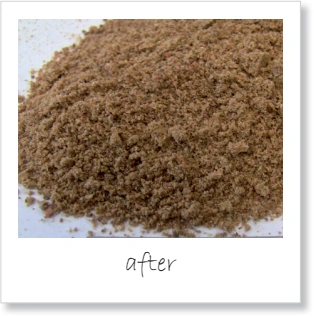
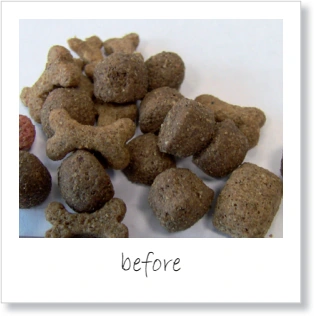
after
Sample homogeneity and the influence on the standard deviation A good example to understand the importance of sample homogeneity is fat analysis of pizza. Only a few milligrams of pizza are required for analysis. Random sampling might result in a piece of mushroom or salami or cheese which would falsify the total fat content in the subsequent analysis.
whole pizza
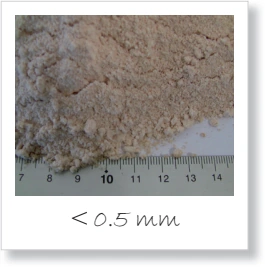
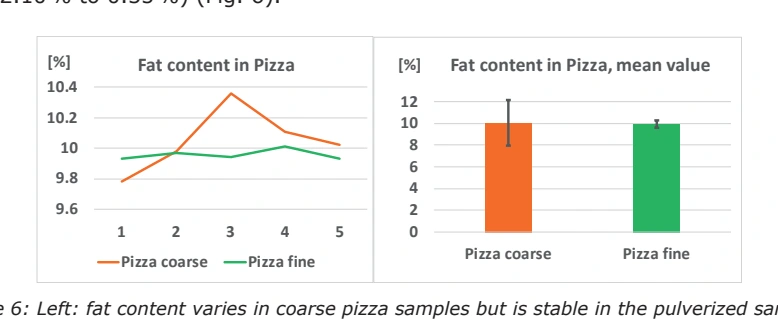
First, the whole Pizza was torn manually in 5 pieces and ground half frozen in the GM 300 at 4000 min-1 within 90 seconds to the 5 mm sample . A part sample was taken directly for fat analysis. The remaining sample was pulverized under cryogenic conditions. For this purpose, the sample was mixed with dry ice snow in a ratio of 1:2 after the first grinding step, and the mixture was then filled into the stainless steel grinding container. Using the full metal knife and a lid specifically designed for cryogenic grinding, the sample was pulverized at 4000 min-1 for 20 seconds to 0.5 mm particles. The standard deviation of any subsequent analysis can be minimized drastically by particle size reduction and homogenization of the analytical sample. Both the coarse and the homogenized sample were analyzed for their fat content five times by microwave-induced drying with a SMART 6 combined with NMR spectroscopy in an Oracle fat analyzer. For each measurement, 4 g sample were dried in 2.5 min and analyzed within 1 min. The fat content varies in the pizza samples with particle sizes around 5 mm, whereas it is much more consistent in the homogenized samples. The standard deviation SD is reduced from 0.21 % to 0.03 % (relative SD from 2.10 % to 0.35 %) .
Fat content in Pizza
Fat content in Pizza, mean value
Pizza coarse
Pizza fine
Pizza coarse
Pizza fine
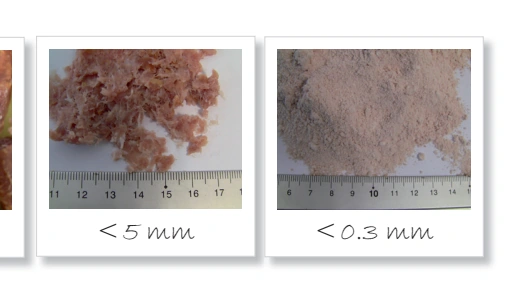
Sausages often contain large fatty particles. They need to be thoroughly homogenized to ensure reliable analysis results. 400 g of sausages were cut manually into pieces of approximately 20 mm and then ground in the GM 300 in two steps. The first grinding cycle was carried out at a revolution speed of 4000 min-1 using a knife with serrated blades. The sample was cut to pieces smaller than 5 mm in only 15 seconds . The serrated blades help to tear the fibrous meat. In the second, cryogenic grinding step (procedure identical to pizza example), the sausages were fully homogenized in 30 seconds to fineness of <0.3 mm.
sausages
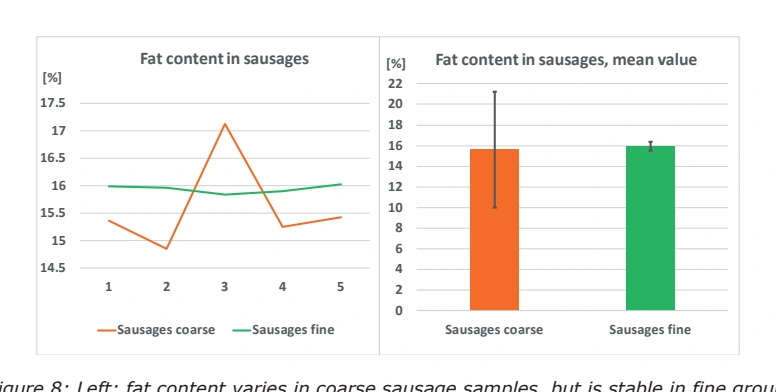
Just like in the pizza example, the fat content was determined in each 5 sub samples of the coarser and the fully homogenized sausage sample. The fat content of the independent samples of the coarse sausage vary more than that of the finely ground samples. The fat content of the coarser fraction was measured in a range from 14.85 % to 17.12 % with a standard deviation (SD) of 0.88 %. The SD was reduced more than 10-fold to 0.07 % in the homogenized sample with a fat content ranging from 15.84 % to 16.02 % (relative SD reduced from 5.63 % to 0.45 %) .
Fat content in sausages, mean value
Fat content in sausages
Conclusion
Thorough sample preparation with laboratory mills is a premise for reliable and reproducible results. Retsch offers mills and crushers for reproducible and fast homogenization of food and feed samples. Combined with the SMART 6 and the Oracle fat analyzers from CEM, fat analysis can be done in less than 10 min.
Plan the configuration for your material.
Define the preparation endpoint with the fat-analysis procedure. Ingredients with different fat or moisture content can produce variable portions if mixing is incomplete. Compare preparation consistency and the measurement result together, rather than attributing every difference to the analyzer.
| Consideration | Information to provide |
|---|---|
| Sample mixture | Fat-rich and lean constituents |
| Preparation endpoint | Uniform analytical portion |
| Method connection | NMR handling and comparison conditions |
How should the application examples be used?
The results describe the materials and configurations discussed here. Confirm equipment options, contact materials and operating conditions for your own sample before adopting a method. A demonstrated endpoint does not guarantee the same outcome for a different material.
Discuss material testing with Glen Mills or request further information or a quote.