
Is one mill type the best choice for all food samples?
No. The physical matrix and analytical endpoint determine which preparation mechanism and configuration should be evaluated.
Food testing labs need representative, homogenized, and pulverized samples for accurate analysis. This can be achieved through particle size reduction and homogenization. Suitable mills are knife mills, rotor mills, cutting mills and ball mills. It's crucial to choose grinding tools that do not alter sample properties. Different processes are needed for fatty/moist/sticky samples versus grainy/tough/fibrous materials. Large initial feed sizes or volumes require different techniques than smaller ones. Retsch shows some use cases for the different sample properties and requirements:
1) Very sticky samples
1) Very sticky samples or those with volatile ingredients need cryogenic treatment or cooling during grinding. Cooling sample materials improves breaking behavior and allows for easier pulverization of soft, tough, sticky, and fatty foods. It is also recommended to preserve volatile ingredients such as terpenes. Cryogenic grinding using liquid nitrogen or dry ice is effective, but care must be taken with materials that must not become moist and cooling agents should not be used in closed grinding tools. Cryogenic grinding can be performed in knife mills, rotor mills or balls mills. Usually, a full pulverization of fatty/sticky materials is only possible with cryogenic grinding.
2) Grainy samples
2) Grainy samples: Pulverizing free-flowing, grainy, or crystalline samples like corn or sugar is straightforward. Various mills, including rotor mills, are suitable. For example, sugar can be ground to less than 0.05 mm with the Ultra Centrifugal Mill ZM 300 using a 0.08 mm ring sieve. A cyclone helps discharge and cool the sample, allowing processing up to 4.5 l per batch. Corn or spices can be ground to around 250 µm using a ZM 300 or Rotor Beater Mill SR 300. When grinding unknown samples, starting with a medium sieve size is recommended followed by reducing the aperture size of the sieve
RETSCH CryoMill for cyrogenic grinding
if it doesn't block. The SR 300 is also suitable for larger quantities up to 30 l with a cyclone and can handle feed sizes up to 25 mm.
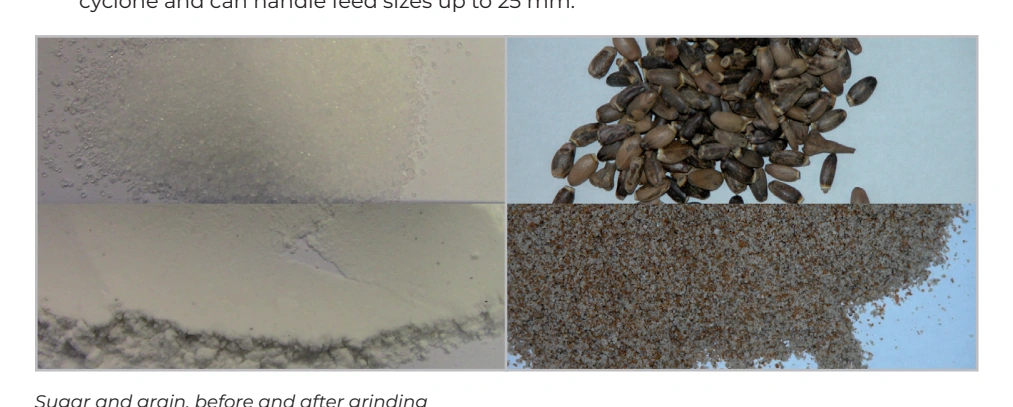
Sugar and grain, before and after grinding
3) Hard samples
3) Hard samples like confectionery can be sticky, greasy, or moist. For hard candy with high sugar and starch syrup content, the Knife Mill GRINDOMIX GM 200 is used. First, 100 g of hard candy is roughly ground at 2000 rpm in reverse mode to protect the knife. Then, interval grinding is done at 4000 rpm for 15 seconds, followed by further grinding at 6000 rpm for 6 to 12 seconds. This step-by-step process prevents the sample from sticking to the knife.
Hard candy before and after grinding
4) Samples with high moisture or water content
4) Samples with high moisture or water content like vegetables (stem cabbage, tomatoes) or processed products (noodle soup) are easier to homogenize as the high water content prevents sticking on the grinding container walls in a GRINDOMIX GM 200 or GM 300. For example, 180 g of tomatoes can be homogenized in the GM 200 for 10 seconds, first at 4000 rpm, then at 8000 rpm. The gravity lid with overflow channels prevents spillage. For larger portions up to 4.5 l, the GM 300 is ideal. Stem cabbage has lower water content, causing sample pieces to stick to the grinding container walls and evade the knife blades. Adding a bit of water can help achieve full homogenization. For example, 280 g of stem cabbage can be cut into four pieces and ground in two steps. Start with 10 seconds at 2000 rpm, then add 50 ml of water and grind for 20 seconds at 5000 rpm. Using the gravity lid with overflow channels and interval mode during fine grinding improves mixing and efficiency.
5) For fibrous samples
5) For fibrous samples like dried herbs, plant materials, or freeze-dried fish, cutting effects are best for homogenization. The Cutting Mill SM 100 is suitable for basic grinding, achieving fineness down to 4-6 mm. For particles < 1 mm, a cyclone with the SM 300 is recommended. The Ultra Centrifugal Mill ZM 300 produces finer particles but accepts smaller pieces, so pre-cutting followed by fine grinding is ideal. The SR 300 can pulverize larger initial feed sizes to < 0.5 mm. A cyclone improves discharge and cools the sample, minimizing volatile ingredient loss. For preserving volatiles, avoid too fine sieves. Ball mills like the MM 400 or PM 100 are better used in the fine-grinding step for avoiding long fibers.
6) Fatty, oily, sticky samples
6) Fatty, oily, sticky samples like fatty bacon are challenging to homogenize. Knife mills are best for this, especially with a strong motor and serrated blades for quick size reduction. Short grinding times prevent heat build-up, and the process may need two or three steps. For example, 250 g of pork shoulder can be processed in a GM 200. Start with 30 s at 3000 rpm using a serrated blade, followed by two cycles of 30 s at 7000 rpm, and finish with 30 s at 10,000 rpm. Use a standard lid initially and a volume-reduction lid for fine grinding. Remove and return material sticking to the container wall as needed.
RETSCH Knife Mill GRINDOMIX GM 300
Cheese samples can also be tricky as they are fatty and sticky. 130 g sample were homogenized to < 0.5 mm in 2 x 10 s grinding steps at 10,000 rpm using the GM 200. It was important to employ the volume reduction lid 0.25 l to force the sample towards the blades. Between the grinding steps, the sample can be mixed manually with a spoon to loosen sticky parts. Samples like raisins are even more sticky than cheese, but 200 g can be homogenized in a similar way as described for the cheese sample within about 20 s.
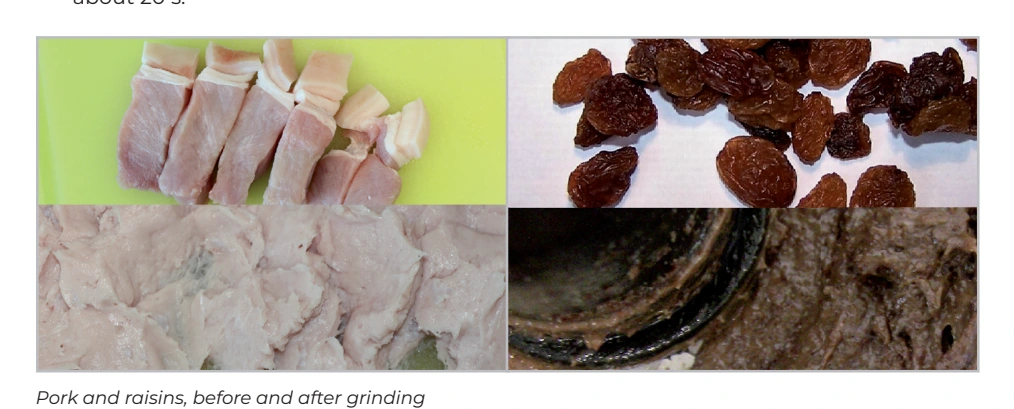
Pork and raisins, before and after grinding
7) Large sample volumes
7) Large sample volumes for detection of mycotoxins or GMO: For some analyses, large sample amounts are needed to detect traces of analytes or clusters, like mycotoxins or GMO. Open systems like rotor mills are ideal for this as they accept large feed quantities. First, reduce the size of a representative amount (e.g., 2 kg per ton of nuts) to 3 mm using the Cutting Mill SM 100. Then, divide the sample into sub-samples with the Rotary Tube Divider PT 100 for high accuracy. Next, perform fine size reduction with the Ultra Centrifugal Mill ZM 300. For hazelnuts, use distance sieves to grind temperature-sensitive, brittle materials gently, avoiding fat release. A cyclone helps discharge and cool the sample, achieving a fineness of 300 µm for mycotoxin extraction.
8) Small sample quantities
8) Small sample quantities for PCR analysis: For fairly homogeneous samples or PCR analysis, only small sample volumes are needed. Ball mills are ideal for this application. The Mixer Mill MM 400, with two grinding stations, can handle up to 20 ml samples. It pulverizes 6.5 g dried peas to 0.4 mm in 30 seconds using a 50 ml stainless steel jar and a 25 mm ball. Similarly, 8 g dried hibiscus is pulverized to 100 µm in 2 minutes. The grinding ball should be three times larger than the biggest sample piece for efficient crushing. The MM 400 also accommodates adapters for single-use vials, allowing batch homogenization of 8 or 20 samples, which is beneficial for PCR analysis. The Mixer Mill MM 500 vario offers higher throughput with 6 grinding stations, accommodating 50 x 2 ml single-use tubes or 24 x 5 ml stainless steel jars per batch.
9) Influence of particle size on taste and flavor
9) Influence of particle size on taste and flavor: Particle size directly impacts the taste of food and beverages. For instance, high-quality chocolate requires a specific grain size with a uniform distribution. In coffee, optimal extraction of ingredients from ground coffee is crucial. The grind size significantly influences the extraction rate and time. If the grind size doesn't match the brewing duration and temperature, the coffee may become over-extracted, leading to a bitter taste, or under-extracted, resulting in a weak aroma and watery taste. Therefore, balancing grind size, brewing time, and temperature is key to coffee quality. By reliably determining the particle size for example with the AS 200 jet, a reproducible grind can be achieved, resulting in great-tasting coffee with balanced aromas.
RETSCH Cutting Mill SM 100
RETSCH Air Jet Sieving Machine AS 200 jet
For more information visit our website
Plan the configuration for your material.
Dry grains, fibrous ingredients and sticky or moist foods may need different preparation routes. Confirm the test portion, contact materials and recovery method alongside the milling principle. Cooling can be considered for a defined problem, but it should not become a default substitute for understanding the matrix.
| Consideration | Information to provide |
|---|---|
| Matrix behavior | Dry, moist, fibrous or sticky |
| Measurement needs | Required form and preservation |
| Equipment discussion | Tools and recoverable amount |
How should the application examples be used?
The results describe the materials and configurations discussed here. Confirm equipment options, contact materials and operating conditions for your own sample before adopting a method. A demonstrated endpoint does not guarantee the same outcome for a different material.
Discuss material testing with Glen Mills or request further information or a quote.
Explore the equipment discussed
- RETSCH GM 200 Knife Mill
- RETSCH ZM 300 Ultra Centrifugal Mill
- RETSCH GM 300 Knife Mill
- RETSCH SM 100 Cutting Mill