
Does every difficult sample need cryogenic grinding?
No. Identify the actual preparation problem and compare suitable mechanisms. Cooling is useful when it addresses that problem within a compatible method.
A solid sample material should always be sufficiently prepared by size reduction and homogenization before it is subjected to chemical or physical analysis. Care should be taken that the analysis sample fully represents the original material and that the sample preparation process is carried out reproducibly. Only then are meaningful results guaranteed. Most sample materials can be reduced to the required analytical fineness at room temperature by choosing a mill with a suitable size reduction principle (impact, pressure, friction, shearing, cutting).
However, there are limits for size reduction at room temperature, for example when even a small temperature increase affects the sample in a negative way; or when the material is very elastic and the above mentioned size reduction principles only cause deformation. The perfect solution for these types of samples is cold or cryogenic grinding. This involves grinding aids such as liquid nitrogen (-196 °C) or dry ice (-78 °C) which embrittle the sample by cooling and make it break more easily. Another advantage is the preservation of volatile components of the sample. In this discussion we explain for which sample materials cryogenic grinding is applicable, which laboratory mills are suitable and which other aspects need to be taken into consideration.
For which materials is cryogenic grinding advisable?
- Samples with elastic behavior
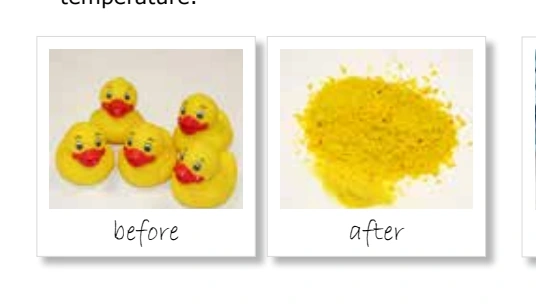
Many polymers (plastics such as PP, PET, PA, etc.), as well as other materials, show visco-elastic behavior during grinding which results in a plastic deformation. This means that a crack initiation - and thus a break-up - does not occur. Elastomeres like silicone baking dishes or rubber tires which, due to their flexibility, are used at room temperature, have a so-called glass transition temperature far below room temperature. If elastic plastic samples are immersed in liquid nitrogen, their temperature falls below the glass transition temperature; this reduces the ability of the material to resist a high mechanical stress by elastic-plastic behavior or viscous flow. If this pre-cooled material is then ground in a mill, the sample shows brittle breaking behavior. Cryogenic grinding is also suitable for hard plastics even though this material is brittle at room temperature. For a successful size reduction process the temperature of the sample must not exceed the glass transition temperature.
before
after
before
after
- Samples with volatile components
Materials with volatile components like solvents (benzene, toluene, PCB, PCP, etc.) are difficult to prepare properly for analysis because a temperature rise during grinding may lead to a loss of the analytes. The increased particle surface resulting from the grinding process further promotes the emission of volatiles. The low temperature of liquid nitrogen or dry ice substantially reduces the high vapor pressure of the components and embrittles the sample matrix. Thus the volatile components are hardly affected by the relative temperature increase which occurs during the grinding process.
- Biological and medical samples
If biological samples are prepared, for example for subsequent extraction of nucleic acids from yeast, bacteria, plants or human/animal tissue, they may react highly temperature-sensitive during and after the process and may even be destroyed. In such cases, cryogenic grinding helps to improve the process by embrittling groups of cells and cell walls, making them disrupt more easily and slowing down the subsequent decomposition of the cell fragments. Undesired cell reactions are practically “frozen” by immersing the sample into LN2 so that cell activities can be observed at a later point in time.
- Sticky or tough food samples
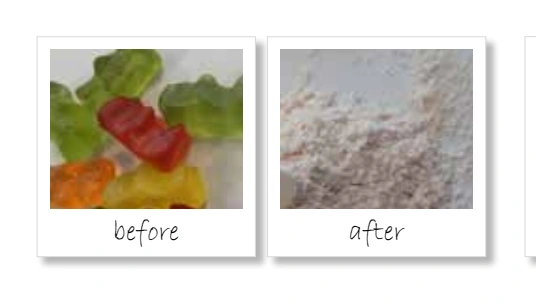
Sticky or tough sample materials like cheese, raisins, wine gum or marzipan simply clump together when ground at room temperature and are not sufficiently homogenized. The low temperature of the cryogenic process prevents the sample from clumping so that it is thoroughly homogenized and suitable for analysis.
before
after
before
after
| Sample | Mill | Accessories / cooling | Feed quantity | Grinding time | Speed | Result |
|---|---|---|---|---|---|---|
| Gummy bears | MM 400 | Two 50 mL stainless steel jars; two 25 mm stainless steel balls; CryoKit and liquid nitrogen | 10 pieces | 1 min | 30 Hz | <300 µm |
| Caoutchouc | CryoMill | 50 mL stainless steel jar; 25 mm stainless steel ball; liquid nitrogen | 4 g | 2 min | 30 Hz | <500 µm |
| E. coli bacteria | CryoMill | 50 mL stainless steel jar; 25 mm stainless steel ball; liquid nitrogen | 10 mL frozen cell pellets | 2 min | 30 Hz | Complete cell disruption in the example |
| Plastic granulate | ZM 200 | 12-tooth push-fit rotor; 0.5 mm distance sieve; cyclone; liquid nitrogen | 40 g | 20 s | 18,000 min⁻¹ | <500 µm |
| Refuse-derived fuels | ZM 200 | 12-tooth push-fit rotor; 0.75 mm distance sieve; cyclone; 300 g dry ice | 150 g | 30 s | 18,000 min⁻¹ | <0.75 mm |
| Wine gum | GM 300 | Stainless steel container; full metal knife; cryo lid with aperture; dry ice | 500 g | 40 s and 20 s | 1000 min⁻¹ and 4000 min⁻¹ | <0.8 mm |
| Rubber duck | SM 300 | Parallel-section rotor; 2 mm bottom sieve; liquid nitrogen | 5 pieces | 40 s | 3000 min⁻¹ | <2 mm |
| Pills with liquid filling | RM 200 | Stainless steel mortar and pestle; liquid nitrogen | 40 pieces | 3 min | 100 min⁻¹ | <250 µm |
Mixer Mill MM 400
CryoMill with 50 liter tank
Application Videos Cryogenic Grinding
- CryoMill: Licorice and plastics with LN2 • Knife Mill GRINDOMIX GM 300: Raisins with dry ice • Mixer Mill MM 400: Gummy bears with LN2 • Ultra Centrifugal Mill ZM 200: Plastic granulate with dry ice • Ultra Centrifugal Mill ZM 200: Plastic pellets with LN2
Suitable Lab Mills for Cryogenic Grinding
When selecting a suitable laboratory mill for cryogenic grinding various aspects need to be considered. On the one hand, the sample volume is crucial for the decision, on the other hand the feed size and desired final fineness are important factors as well. The mixer mills MM 400 and CryoMill are designed for processing small sample volumes. These mills often achieve finer grind sizes, even with difficult plastic samples, than for example rotor mills because the sample remains for a longer period inside the closed grinding jar compared to the open grinding chamber of the rotor mills. The sample is cooled continuously during the entire grinding process, in the CryoMill even with a constant temperature of -196 °C.
Rotor mills, mortar grinders, knife mills or cutting mills process substantially larger volumes and feed sizes than mixer mills. However, the size reduction principles of these mills usually produce larger grind sizes, especially when grinding plastics. The Knife Mill GRINDOMIX GM 300 is suited for cryogenic grinding mainly of food samples, with the restriction that only dry ice and no liquid nitrogen can be used as the mill is not designed for temperatures as low as -196 °C. Rotor and cutting mills, however, accept both dry ice and liquid nitrogen as grinding aids. Due to the very low temperature liquid nitrogen is particularly suitable for materials with a glass transition temperature below -50 °C. Dry ice has the advantage of evaporating less quickly than liquid nitrogen; moreover, it can be mixed with the sample for grinding thus extending the cooling effect. This is particularly beneficial for materials of low thermal capacity which cannot hold the low temperature, for example thin plastic foils. Sample feeding with dry ice is generally easier, especially if the particles are smaller than 1 mm, than extracting the material from liquid nitrogen. In addition, dry ice is safer to handle as the danger of asphyxiation, for example, is much smaller. Also, dry ice doesn’t splash during grinding as it is mixed completely with the sample material. Regardless of these aspects, appropriate safety regulations should always be observed when dealing with cryogenic grinding aids. The following section introduces a range of laboratory mills suitable for cryogenic grinding.
- Mixer Mills MM 400 and CryoMill
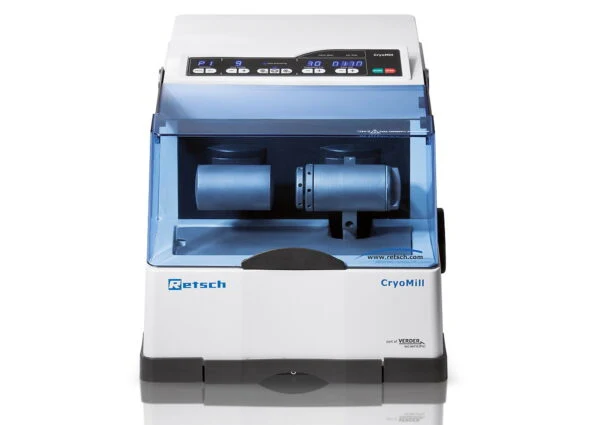
The mixer mills MM 400 and CryoMill are perfectly suited for homogenizing small sample volumes with a maximum feed size of 8 mm. These mills feature two, respectively one, grinding stations into which the screw-top grinding jars - filled with grinding balls and sample - are securely clamped for grinding. The closed grinding jars, and thus the sample, are embrittled with liquid nitrogen.
Suitable grinding jars of the MM 400 are made of steel or PTFE; single-use vials of 1.5, 2 and 5 ml are also available. Care must be taken that no liquid nitrogen is enclosed in the grinding jars. The frictional heat of the grinding process causes LN2 to enter the gaseous phase, resulting in a considerable pressure increase inside the grinding jar. With the help of tongs the closed grinding jar is placed for 2 to 3 minutes in an insulation container filled with liquid nitrogen and is then clamped into the MM 400. Due to the high energy input and the resulting frictional heat, the grinding process should not take longer than 3 minutes to prevent the sample from warming up and to preserve its breaking properties. If longer grinding times are required, these should be interrupted by intermediate cooling of the closed grinding jars. Unlike the MM 400 the CryoMill offers the advantage of continuous cooling of the grinding jar with liquid nitrogen, reducing the temperature of jar and sample to -196 °C within minutes. Thus a consistent temperature of -196 °C is guaranteed even for long grinding times without the need for intermediate cooling cycles. Moreover, the user comes at no point into contact with liquid nitrogen which makes operation of the CryoMill safe and user-friendly. The automatic pre-cooling function ensures that the grinding process does not start before a temperature of -196 °C is reached and maintained. For heavy-metal-free grinding a zirconium oxide grinding jar is available.
Ultra Centrifugal Mill ZM 200 with cyclone
Knife Mill GRINDOMIX GM 300 with steel container
- Ultra Centrifugal Mill ZM 200
Another mill which is perfectly suitable for cryogenic grinding is the Ultra Centrifugal Mill ZM 200 which accepts larger sample volumes than the mixer mills. This high-speed rotor mill even pulverizes some types of elastomeres, such as polystyrene, without cooling. However, in most cases embrittlement of the material is required. The sample, which can be granulate or pre-cut molded parts, is directly immersed into a container filled with LN2 and is then slowly but continuously fed to the hopper of the ZM 200 with a steel spoon. If the sample has a high fat content or is very heat-sensitive, embrittlement usually improves the grinding process as the cooling counteracts the effects caused by frictional heat. When using dry ice as grinding aid, this needs to be mixed with the sample in a 2:1 ratio and the entire mixture is then pulverized in the ZM 200. Dry ice is pure carbon dioxide and therefore evaporates from the sample without residues. We recommend using a cassette in combination with a cyclone to ensure that CO2 as well as residues of LN2 evaporate during the grinding process.
- Cutting Mill SM 300
The aforementioned aspects influencing the choice of a grinding aid are also relevant when carrying out cryogenic grinding in the Cutting Mill SM 300. This mill is particularly suitable for processing tough materials such as shoe soles or bitumen and accepts larger feed sizes than the ZM 200. Even roughly cut and embrittled car tires can be homogenized with the SM 300. The embrittled sample material is rather hard, therefore we recommend to use the 6-disc rotor as it works more like a shredder. It is also suitable to cut heterogeneous samples such as frozen chicken parts including bones. For grinding thin plastic foil, which is often part of refuse-derived fuels, we recommend using dry ice due to the continuous cooling effect during the grinding process.
- Knife Mill GRINDOMIX GM 300
Sticky and tough food samples such as cheese, raisins, wine gum or marzipan are perfectly homogenized with the Knife Mill GRINDOMIX GM 300. Even chocolate, which simply becomes paste-like when processed at room temperature, can be successfully pulverized cryogenically. The sample is mixed with dry ice in a ratio of 1:2; after a few minutes it is thoroughly cooled and the grinding process starts. The dry ice keeps the sample cool all the time. Care should be taken not to use any plastic accessories when carrying out cryogenic grinding in the GM 300 as these could be damaged during the process. Suitable accessories include a grinding container of stainless steel, a full metal knife and a lid with aperture to let the gaseous carbon dioxide evaporate.
- Mortar Grinder RM 200
In a mortar grinder samples are pulverized by pressure and friction and are submitted to the grinding process for as long as it takes to achieve the desired final fineness. The Mortar Grinder RM 200 is not a closed system; it is possible to add dry ice or liquid nitrogen during the grinding process through a window in the cover. For cryogenic applications mortar and pestle need to be made of stainless steel. Tablets with liquid filling, for example, can be successfully pulverized in a mortar grinder.
| Mill | Feed size | Maximum feed quantity | Fineness | Preparation arrangement |
|---|---|---|---|---|
| CryoMill | <8 mm | 1 × 20 mL | 50 µm | Continuous cryogenic grinding; no user contact with LN₂; zirconium oxide jar available. |
| MM 400 | <8 mm | 2 × 20 mL | 100 µm | Leak-free steel or PTFE jar; embrittle before grinding; intermediate cooling may be necessary. |
| ZM 200 | <10 mm | 4000 mL | 300 µm | LN₂ can embrittle samples with glass-transition temperature below −80 °C. Dry ice is preferred for low thermal capacity or particles below 1 mm. Cyclone mandatory. |
| GM 300 | <40 mm | 2000 mL | 500 µm | Dry ice cools during grinding and suits low thermal capacity; full metal knife, stainless steel container and special cryo lid. |
| SM 300 | <80 mm | 4000 mL | 2000 µm | Six-disc rotor and cyclone specified for cryogenic applications; bottom sieves 2–20 mm. |
| RM 200 | <8 mm | <190 mL | 10 µm | Dry ice or LN₂ may be added during grinding; stainless steel mortar and pestle only. |
1 Depending on sample material and grinding parameters 2 Volume may differ for applications without cryogenic grinding aids
Conclusion
For many materials pulverization with liquid nitrogen or dry ice is the only possible way of obtaining a sample suitable for subsequent analysis. RETSCH offers a range of laboratory mills which allow for gentle and efficient cryogenic sample preparation. Their use considerably reduces both the cost and labor required for low-temperature grinding. A selection of suitable accessories ensures that the grinding process is carried out safely.
Plan the configuration for your material.
Define the problem before selecting the cooling arrangement. The preparation needs compatible equipment, an appropriate handling sequence and an evaluation of the recovered material. Cooling should be discussed as part of the full method, including transfer and collection, rather than an isolated temperature label.
| Consideration | Information to provide |
|---|---|
| Reason for cooling | Deformation or target preservation |
| Supported arrangement | Equipment and cold handling |
| Method check | Recovery and analytical suitability |
How should the application examples be used?
The results describe the materials and configurations discussed here. Confirm equipment options, contact materials and operating conditions for your own sample before adopting a method. A demonstrated endpoint does not guarantee the same outcome for a different material.
Discuss material testing with Glen Mills or request further information or a quote.
Explore the equipment discussed
- RETSCH CryoMill Cryogenic Mixer Mill
- RETSCH MM 400 Mixer Mill
- RETSCH GM 300 Knife Mill
- RETSCH SM 300 Cutting Mill