
Does cryogenic grinding guarantee complete volatile recovery?
No. Recovery must be evaluated for the complete method. Handling before and after grinding can also affect the measured components.
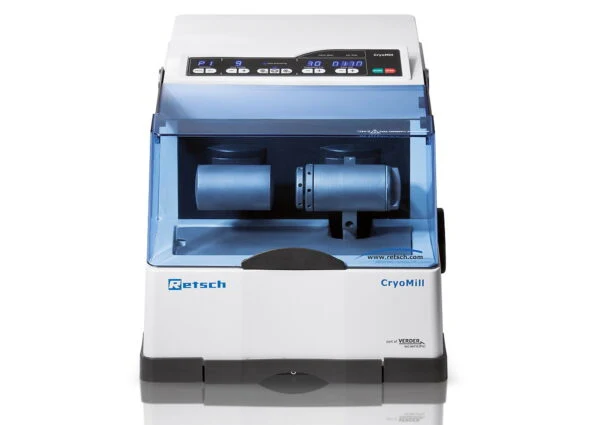
CRyoMILL
Fast, efficient cryogenic grinding at –196 °C
High final fineness down
to 5 µm due to grinding by impact and friction
Very effective and safe thanks to integrated cooling system with Autofill
Screw-top grinding jars ensure leak-proof opeation
Low LN2 consumption Programmable cooling and grinding cycles
For the size reduction of many materials it is more suitable to use a cryogenic mill than a laboratory mill which operates at room temperature. The sample is embrittled by liquid nitrogen which improves its breaking behavior when submitted to impact, pressure and friction; moreover, volatile components of the sample are preserved. The RETSCH CryoMill is not only the most modern and safest cryogenic mill in the market, it also provides excellent grinding results.
Due to the wide range of accessories, the application field of the CryoMill is very varied:
Screw-top grinding jars The screw-top grinding jars of hardened steel and stainless steel have been specifically designed for use in the CryoMill. The fact that no sample material can escape makes them particularly safe. They are available with volumes of 5 ml, 25 ml, 35 ml and 50 ml. For applications where steel jars cannot be used due to possible sample contamination, RETSCH offers a 25 ml grinding jar of PTFE and matching grinding balls.
Adapters Various adapters make the CryoMill a versatile instrument. If only very small sample amounts need to be processed, an adapter for 2 resp. 4 grinding jars of 5 ml is recommendable. It is also possible to use 2 ml reaction vials with the CryoMill thanks to another adapter which can hold up to 4 tubes.
Mixer Mill MM 400 with CryoKit
The well-proven combination for cryogenic grinding with external pre-cooling.
LN2 containers For safe and comfortable operation of the CryoMill, the unit is equipped with an autofill system for liquid nitrogen which can be obtained with either a 10 liter (for up to 5 samples) or 50 liter (for up to 20-30 samples) container. It is also possible to connect existing cryo tanks to the mill. For such applications, a connection tube with safety valve is available. The system is particularly safe as the user does not come into direct contact with the liquid nitrogen at any time.
Technical University of Cottbus, Germany
The profile of the Technical University of Cottbus (BTU) is marked by a focus on energy, environment, material, construction, information and communication technology. The department “Processing and Recycling of Raw and Residual Materials” which is part of the faculty of Environmental Sciences and Process Engineering works on a wide range of research topics. The focus lies on the recycling of materials from automobile and electronic waste. In addition to the recovery of non-ferrous and precious metals through innovative procedures, activities are centered on the processing of plastic recyclates.
“In the beginning, our aim was to improve the size reduction of recycled plastics from electronic waste as an important preliminary step to the analysis of brominated flame retardants”, explains Jens Markowski from the department Processing and Recycling of Raw and Residual Materials. “Over time we realized that the CryoMill is also very suitable for the grinding of other materials such as renewable raw materials.”
In the context of different national research projects, the researchers from Cottbus have been dealing with the treatment of plastics from electronic waste and automobile recycling for some time. The correct sorting of the plastics is done with the help of Near- Infrared methods. However, polymers which contain brominated flame retardants and are therefore not allowed to recirculate, are not detected with these methods.
For the analysis of reference samples containing, for example, ABS, PS or PC-ABS, gas chromatography / mass spectrometry (GC/MS) are the methods of choice. In the past, Markowski and his team used an older model of a RETSCH ultra centrifugal mill for the size reduction of such materials. The problem was that the plastic samples heated up very quickly during the grinding process which led to gas emission and chemical conversion of a part of the volatile bromine compounds so that the subsequent analyses results were not reliable. Nor was the permanent cooling of the plastic material and the grinding chamber with liquid nitrogen sufficient to achieve the desired effect either.
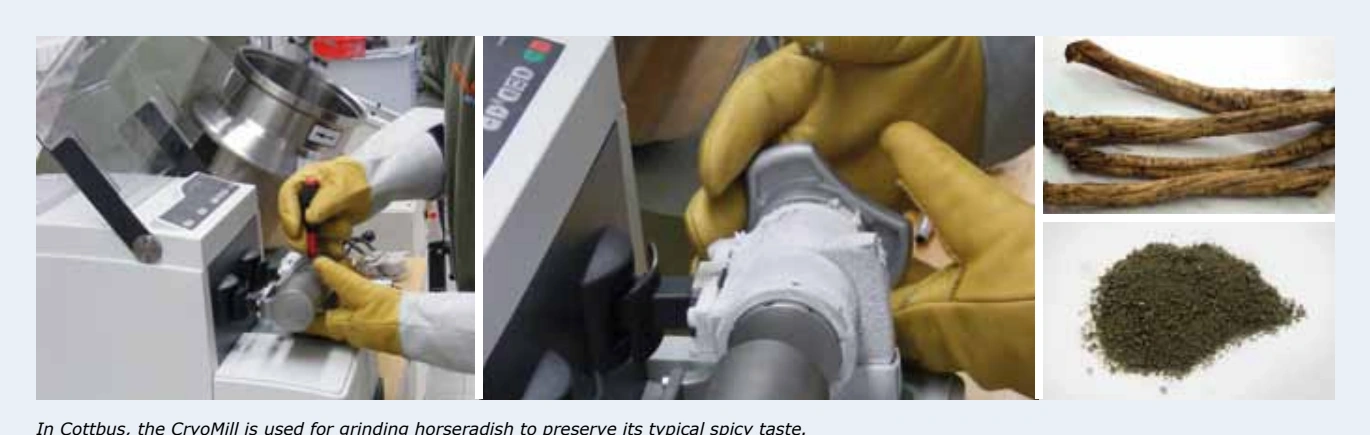
Since summer 2009 the lab at Cottbus University has been using a CryoMill for the size reduction of brominated plastics. They first embrittle the samples in a closed grinding jar and then grind them in various cycles down to a fineness of 10 microns and below. Gas emission, thermal stress or sticking together of the plastic particles during grinding are no longer a problem. The grind size and thus the homogeneity of the samples have improved as well. “We can now be sure that the extraction and subsequent GC/MS analysis of the samples provide us with the true content of brominated flame retardants”, says Jens Markowski, “and the grinding procedure has become much safer and more convenient.”
In Cottbus, the CryoMill is used for grinding horseradish to preserve its typical spicy taste.
The CryoMill is also used for the processing of various biological materials. “Leaves, stalks, roots – none of these are a problem for the CryoMill. Due to the individual setting of the pre-cooling cycle which leads to an embrittlement of the sample, even products with a high water content and a tendency to smear during grinding can be ground very finely without loss of volatile components.” The option to
choose from various grinding balls is also helpful. Whereas one 25 mm ball with a weight of 63.5 g is used for the grinding of hard plastics, two 15 mm balls weighing 13.7 g each produce perfect results when grinding leaves.
A current application from the field of bio materials is the grinding of fresh horseradish. A local Chocolatier would like to refine his
high-quality dark chocolate with it. The problem is that the horseradish needs to be ground very finely and as a result loses its typical spicy taste. The Chocolatier asked the BTU team for help. “The problem is optimally solved with cryogenic grinding. The horseradish is embrittled and then pulverized, so that those components which carry the characteristic taste are preserved in the powder.”
Plan the configuration for your material.
Evaluate preservation across the full workflow, including transfer and recovery after grinding. A cold mill stage alone cannot establish that the analytical target remains unchanged. Discuss the sample, collection arrangement and compatible RETSCH CryoMill tools before adopting a preparation cycle.
| Consideration | Information to provide |
|---|---|
| Target components | Volatility and analytical sensitivity |
| Cold sequence | Storage, grinding and recovery |
| Comparison | Prepared material versus suitable controls |
How should the application examples be used?
The results describe the materials and configurations discussed here. Confirm equipment options, contact materials and operating conditions for your own sample before adopting a method. A demonstrated endpoint does not guarantee the same outcome for a different material.
Discuss material testing with Glen Mills or request further information or a quote.