
Is adding water always an acceptable way to homogenize moist food?
No. Additional liquid may change the basis or suitability of the sample. The preparation must remain compatible with the intended analysis.
suitable for cryogenic grinding
The homogenization of food samples is a crucial step prior to the actual analysis. Due to the various properties of food – dry, moist, sticky, tough, hard, soft, etc. – a versatile laboratory mill is required to ensure reproducible preparation of the analytical sample.
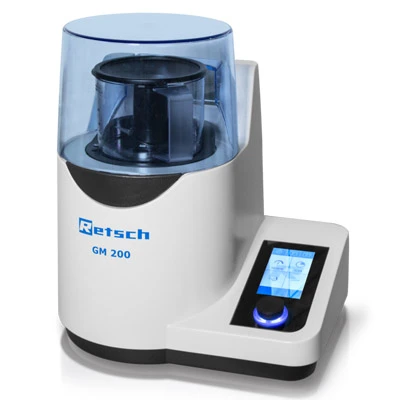
RETSCH’s knife mill GRINDOMIX GM 200 is employed in laboratories all over the world for the homogenization of food samples as well as samples with a high water, oil, sugar or fat content. This mill covers a wide application range, from granular products like rape seed, rice, soybeans to fibrous or tough samples like meat, fish, candy, cheese or plants.
Cryo kit: Everything you need for cold grinding
RETSCH Knife Mill GRINDOMIX GM 200
For cryogenic preparation of moist samples without addition of water or of very sticky samples with dry ice, the GRINDOMIX GM 200 knife mill can now be equipped with a cryo kit . This kit consists of a full metal knife and a special stainless-steel grinding container with lid. The knife used for cryogenic grinding has four blades and is made entirely of steel. This makes it much more resistant against embrittlement and hard impact effects - which occur when frozen food is processed – than the standard knife with plastic components. For the same reason, the stainless-steel grinding container should be used for hard samples. This container is specially designed for cryogenic grinding, with baffles that ensure thorough mixing of the sample and, as a result, optimum homogenization. Since the frozen CO2 is warmed
Cryo kit with stainlesssteel grinding container, special lid and full metal knife
during the grinding process with dry ice, it evaporates and would cause overpressure inside the closed container, the special lid features a small opening to let carbon dioxide escape.
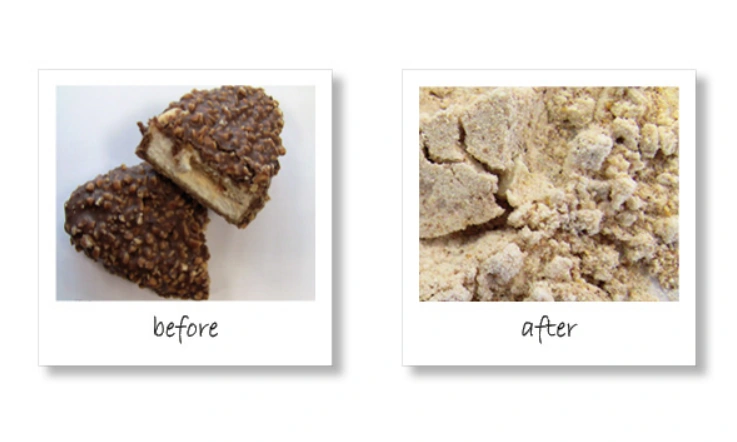
Chocolate
Creamy chocolate pieces can only be fully homogenized cryogenically. This type of sample is fatty as well as sticky, sometimes it contains nut pieces which are preserved when grinding is done at room temperature. One or two sample pieces should be homogenized to obtain a particle size of <0.5 mm
First, the sample is cut to pieces of approximately 20 mm but no larger than 50 mm. The sample is mixed with dry ice snow in a 1:2 ratio and is filled into the special “cryo” grinding container after a few minutes of cooling. After 10 seconds in reverse mode at a speed of 2000 rpm, homogenization is done for 30 seconds at 10,000 rpm. In the reverse mode, the hard sample is hit by the blunt side of the full metal knife at a low speed to minimize
wear. Further homogenization with the sharp side of the knife takes place at full speed; the sample is pulverized to a particle size of 0.5 mm within 40 seconds.
Vegetables
Another example is cryogenic grinding of vegetables which typically can only be fully homogenized at room temperature if water is added; however, this causes a dilution effect which needs to be taken into account in the following analysis process. For this type of application, the so-called gravity lid with overflow channels is used; the channels transport the water which rises on the grinding container walls due to capillary effects back to the center of the container. However, if the selected speed is too high, sample and water may splash out of the container anyway. Cryogenic homogenization is more effective. 100 g frozen vegetables are cut by hand to pieces of 10 mm. These are mixed 1:2 with dry ice snow and processed in two steps, just like in the chocolate example. Primary size reduction takes 60 seconds, full homogenization 40 seconds, i. e. the whole sample is pulverized to a particle size of 0.5 mm after 100 seconds.
Sticky, tough samples
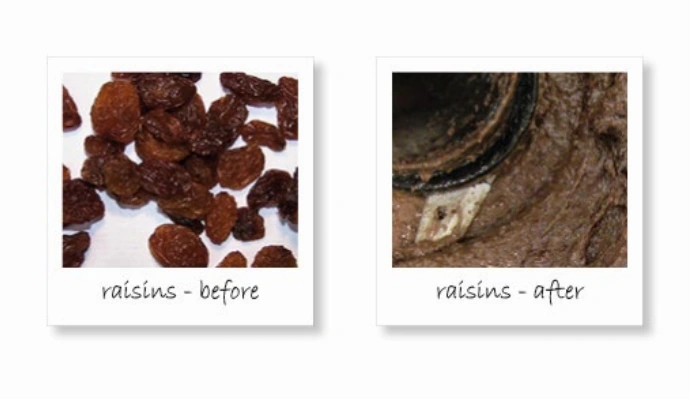
Sticky samples tend to agglutinate and adhere to the knife blades or container walls which leads to a low degree of homogenization. The powerful 1000 W drive of the GM 200 ensures that the knives don’t get blocked, even when homogenizing, for example, 200 g sticky raisins at 10,000 rpm for 10 seconds in cutting mode. The reduction lid forces the sample against the blades, thus ensuring thorough homogenization. Cryogenic grinding as described in the above examples is a good alternative for this type of samples as well.
Conclusion
The GRINDOMIX GM 200 is the perfect mill to homogenize dry, oily, fatty, soft and tough sample material up to 700 ml – for analysis results with minimum standard deviation. With the new accessories for cryogenic grinding, consisting of a 4-blade full metal knife, stainless-steel grinding container with baffles and special cryo lid, this knife mill is suitable for homogenizing virtually any food sample.
Plan the configuration for your material.
Identify whether the problem is clumping, heat sensitivity or the addition of an unwanted liquid phase. Confirm the compatible vessel and cooling arrangement before developing a cycle. Review material recovery and the analytical portion after preparation, rather than judging success solely by easier cutting.
| Consideration | Information to provide |
|---|---|
| Matrix difficulty | Moisture, stickiness or heat sensitivity |
| Compatible tools | Vessel and cooling accessories |
| Analytical check | Homogeneity and preserved sample basis |
How should the application examples be used?
The results describe the materials and configurations discussed here. Confirm equipment options, contact materials and operating conditions for your own sample before adopting a method. A demonstrated endpoint does not guarantee the same outcome for a different material.
Discuss material testing with Glen Mills or request further information or a quote.