
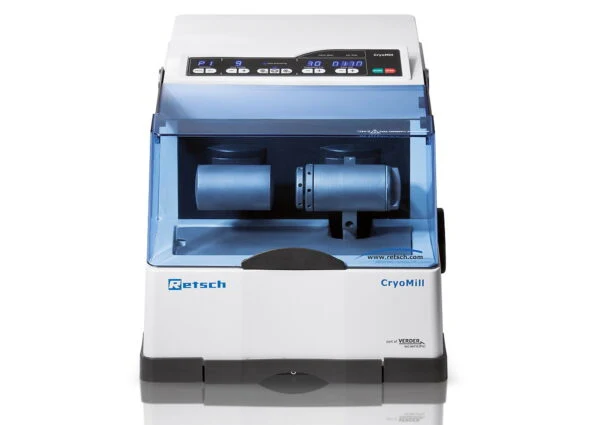
Should every food sample be ground cryogenically?
No. Use cooling when it addresses a defined material or analytical problem. It introduces additional handling considerations and does not replace representative sampling.
Most sample materials can be ground to the required analytical fi neness at room temperature. However, there are limits, for example when even a small temperature increase affects the sample in a negative way; or when the material is very elastic and will only be deformed. Moreover, food samples which are fatty or sticky may block the mill. Therefore, cryogenic grinding is the best way to pulverise food samples like cheese, raisins, wine gum or marzipan which simply clump together when ground at room temperature.
Another important aspect is the preservation of volatile sample components. The heat which is generated during the grinding process would cause volatiles like alcohol or residues of softeners from plastic wrappings to escape. This effect is prevented by using grinding aids like liquid nitrogen (LN2; -196°C) or dry ice (solid CO2; -78°C) which also embrittle the sample and make it break more easily. In the following, the special requirements for cryogenic grinding in different mills will be discussed as well as which other aspects need to be taken into consideration (Table 1).
Overview of mills suitable for cryogenic grinding
| Mill | Feed size and max. feed quantity * | Remark |
|---|---|---|
| Mixer mill | <8 mm 2 x 20 ml | • Sample is placed in leak-free grinding jar of steel or PTFE and embrittled before grinding, LN 2 preferred over dry ice • Intermediate cooling may be required |
| CryoMill | <8 mm 1 x 20 ml | • Continuous grinding at -196 °C with LN 2 • User comes at no point in contact with LN 2 • Zirconium oxide grinding jar available for cryogenic grinding |
| Knife mill | <40 mm 2000 ml | • Embrittlement with dry ice • Dry ice cools sample during grinding • Use of full metal knife, grinding container of stainless steel and specifi c lid mandatory |
| Ultra centrifugal mill | <10 mm 4000 ml | • Embrittlement with dry ice or LN 2 • Dry ice preferred if sample material is < 1 mm or has low thermal capacity • Use of cyclone mandatory |
| Cutting mill | <80 mm 4000 ml | • Cryogenic grinding with dry ice or LN 2 • Use of 6-disc rotor and cyclone mandatory • Bottom sieves 2 – 20 mm suitable |
*both depending on sample material
The CryoMill offers the advantage of continuous cooling of the grinding jar with LN2
grinding jars because the evaporation of LN2 would result in a considerable pressure increase inside the grinding jar. The closed grinding jars, and thus the sample, are embrittled in a LN2 bath for 2-3 minutes. Suitable grinding jars for cryogenic grinding are made of steel or PTFE; it is not recommended to use jars made of different materials (e. g. steel jar with lining of zirconium oxide). This is important, as these may react differently to extreme temperatures of -196°C which may lead to damages of the jar. Single-use vials of 1.5, 2 and 5 ml are also available for cryogenic grinding when it comes to sample amounts below 0.7 ml. Due to the high energy input and the resulting frictional heat, the grinding process should not take longer than 2 minutes to prevent the sample from warming up and to preserve its breaking properties. If longer grinding times are required, these should be interrupted by intermediate cooling of the closed grinding jars in the MM 400.
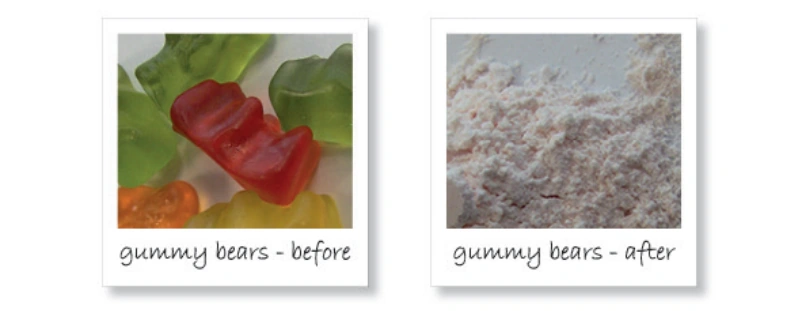
Small Sample Volumes and Feed Sizes in the Mixer Mill MM 400 and the CryoMill Sample volumes like a few gummy bears, some strips of chewing gum, a small piece of meat or small amounts of fatty spices are best homogenised in the MM 400. This ball mill is perfectly suited for homogenising sample volumes up to 2 x 20 ml in less than 1-2 minutes. It is important to fi ll the jar fi rst with the grinding ball(s) and with the sample and close it tightly before embrittling. Care must be taken that no LN2 is enclosed in the
Cryogenic grinding in the CryoMill offers the advantage of continuous cooling of the grinding jar with LN2, thereby reducing the temperature of jar and sample to -196°C within minutes. This consistent temperature is guaranteed even for long grinding times without the need for intermediate cooling breaks. An automatic pre-cooling function ensures that the grinding process does not start before a temperature of -196°C is reached and maintained. Moreover, operation is particularly safe as the user comes at no point into
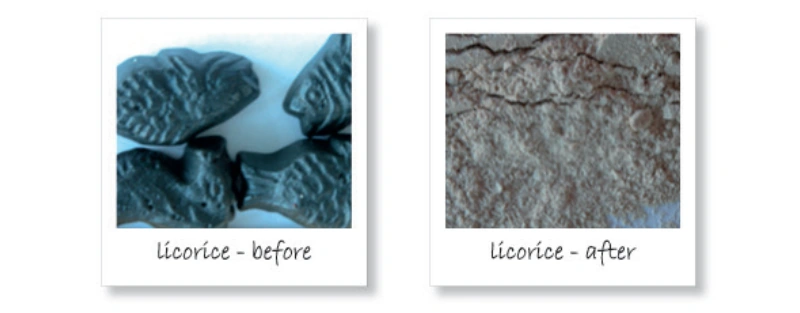
contact with LN2. For heavy-metal-free grinding a zirconium oxide grinding jar should be used. Further suitable materials are stainless steel or single use vials (1.5 or 2 ml). A few pieces of liquorice, one praline with liquid fi lling or some beans of green coffee are typical samples for the CryoMill.
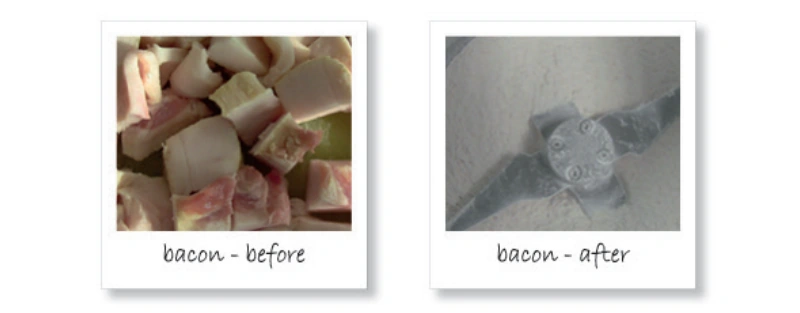
Medium Sample Volumes with Medium Initial Sample Size in the Knife Mill GM 300 Medium sample volumes of up to 2 l with a feed size not bigger than 40 mm, such as 500 g wine gum, 250 g grapes, 400 g pure bacon or 800 g raisin, can be homogenised perfectly in the GM 300 by using dry ice snow as grinding aid. The use of LN2 is not recommended as the mill is not designed for temperatures as low as -196°C. The sample is mixed with dry ice in a ratio of 1:2; after a few minutes, it is thoroughly cooled, and the grinding process starts. The dry ice keeps the sample cool all the time. Care should be taken not to use any plastic accessories when carrying out cryogenic grinding in the knife mills as these could be damaged during the process. Suitable accessories include a grinding container of stainless steel, a full metal knife and a lid with aperture to allow evaporation of the gaseous carbon dioxide.
Food & Beverage Analysis
Large Sample Volumes with Small Initial Sample Size in the Ultra Centrifugal Mill ZM 200 The Ultra Centrifugal Mill ZM 200 accepts large sample volumes up to 4 l with a feed size < 10 mm, such as 100 g cereals, 150 g onions or 100 g dried apple pieces. The sample is directly immersed into a container fi lled with LN2 before being continuously but slowly fed to the hopper of the mill with a steel spoon. When using dry ice as grinding aid, this needs to be mixed with the sample (1 part sample, 2 parts dry ice) and the entire mixture is then pulverised in the mill. Using a cassette in combination with a cyclone is recommended for cryogenic grinding to ensure that the evaporating cooling agent is completely discharged during the grinding process.
Large Sample Volumes with Large Feed Sizes in the Cutting Mill SM 300 Large sample volumes up to 4 l with feed sizes up to 80 mm, like a block of 100 g chocolate, 1 kg trout (whole fi sh) or 20 kg potatoes are best processed in the Cutting Mill SM 300. The use of both LN2 and dry ice is possible. The embrittled sample material is rather hard, therefore the use of the 6-disc rotor is recommended as it works rather like a shredder. It is also suitable to cut heterogeneous samples such as frozen chicken parts including bones. The SM 300 is designed for pre-crushing bigger sample pieces <4 mm. Pulverisation of the samples then follows in one of the other mills described above.
Ultra Centrifugal Mill ZM 200
Conclusion Some foodstuff needs to be pulverised under cryogenic conditions, i. e. by using dry ice or liquid nitrogen as grinding aid, to obtain a sample which is suitable for subsequent analysis. Retsch offers a variety of laboratory mills designed for gentle and effi cient cold grinding of food samples which ensure the whole process is time and cost effective. A wide range of accessories helps to make the grinding process safe and user-friendly.
Plan the configuration for your material.
Fatty and sticky ingredients may need a different preparation arrangement from dry grains. Specify the permitted cooling medium and compatible tools, then review the handling sequence with Glen Mills. Temperature management should preserve the properties needed for analysis rather than simply make grinding easier.
| Consideration | Information to provide |
|---|---|
| Room-temperature behavior | Smearing or elastic deformation |
| Cooling arrangement | Supported equipment and handling |
| Analytical target | Components that preparation must preserve |
How should the application examples be used?
The results describe the materials and configurations discussed here. Confirm equipment options, contact materials and operating conditions for your own sample before adopting a method. A demonstrated endpoint does not guarantee the same outcome for a different material.
Discuss material testing with Glen Mills or request further information or a quote.
Explore the equipment discussed
- RETSCH CryoMill Cryogenic Mixer Mill
- RETSCH SM 300 Cutting Mill
- RETSCH MM 400 Mixer Mill
- RETSCH GM 300 Knife Mill