
Does colder preparation always produce a better biochemical result?
Not necessarily. The appropriate thermal conditions depend on the target and method. Evaluate preservation and homogenization together for the actual sample.
The temperature plays an important role in biochemical analyses. To ensure that the properties of biological samples are not altered during sample preparation, it is necessary to continuously cool or sometimes even freeze the sample material.
This application article describes how the Mixer Mill MM 500 control with its possibilities of temperature-controlled sample processing is used for preparing biochemical samples. As an application example, we present the cell disruption process of a global pharmaceutical and diagnostics company.
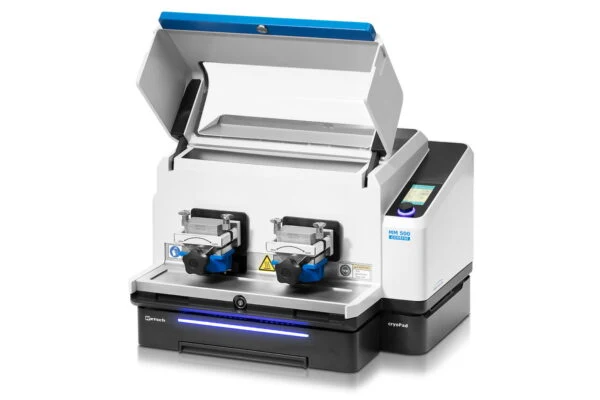
Mixer Mill MM 500 control
Patented sample cooling
The MM 500 control from RETSCH is an innovative mixer mill with two grinding stations for screw-lock sample vessels and a vibration frequency of up to 30 Hz. It is the first mixer mill in the market that allows to continuously cool the sample during the process, making it ideally suited for biochemical applications. The cooling is realized with the so-called cooling plates: These are part of the oscillating clamping system to which the sample vessels are attached, thus ensuring cooling during the entire process. The actual temperature of the cooling plates is continuously monitored and shown on the display.
This patented cooling concept increases the reliability of biochemical applications to a new level: Intermediate cooling of the sample during sample preparation, e. g. in a refrigerator or ice bath, or even working in a cold room is no longer necessary. The continuous sample cool-
ing and easy handling of the MM 500 control allow for an efficient and safe process flow.
The MM 500 control can be configured in two different setups for cooling, depending on the temperature range in which the sample must be cooled. Just like with other Retsch mixer mills, and in addition to the active cooling possibility of the MM 500 control, there is also the option of selecting cycle programs with cooling pauses or reduced frequency to reduce the energy input and heat development.
Cooling setup 1: Cooling with a recirculating chiller
For this configuration, a recirculating chiller is connected to the mill:
I For longer process times I To realize a moderate sample cooling e.g. at – 10 °C
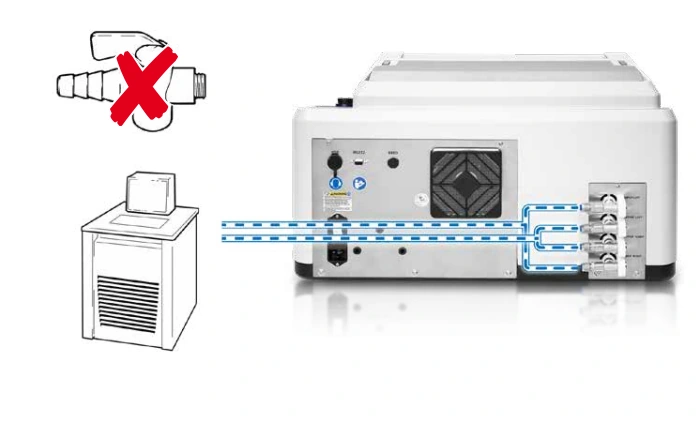
In this setup, the recirculating cooling medium (e. g. water, ethylene, glycol or another thermofluid) flows through the cooling plates of the mixer mill to cool them down. The temperature of the cooling plates is transferred to the sample vessels.
In this setup, the temperature of the cooling medium is manually set on the recirculating chiller unit. The actual temperature resulting at the cooling plates is shown in the display. Modifications of the cooling temperature are made manually at the recirculating chiller unit.
Cooling with a recirculating cooling medium is suitable for biochemical processes with long process times and moderate cooling temperatures. Depending on the cooling performance and on the given temperature range of the specific chiller unit used, cooling temperatures of -10 °C, for example, are achieved. Using a recirculating chiller with moderate cooling options is suitable, for example, for cell disruption, to keep temperatures below 10 °C (see the application example in the second part of the article).
Cooling setup 2: Cooling with liquid nitrogen
In this configuration, the MM 500 control is equipped with the cryoPad module and connected to a nitrogen tank:
I For sample cooling down to – 100 °C I Automatic temperature regulation with the help of the device extension cryoPad
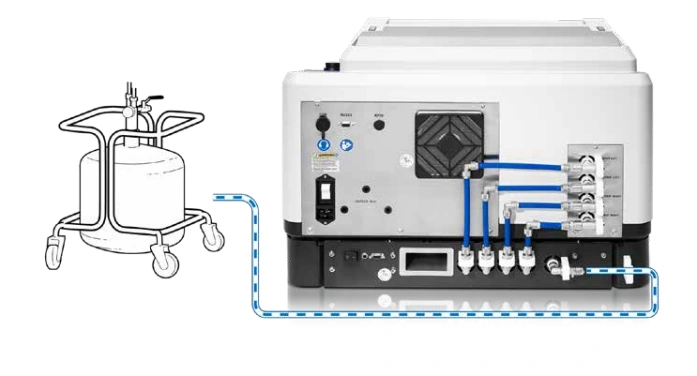
In this configuration, liquid nitrogen flows through the cooling plates of the mill and cools them down to temperatures up to - 100 °C. The temperature of the cooling plates is transferred to the sample vessels. The very low temperature of liquid nitrogen of - 196 °C effectively counteracts the heat development during grinding.
In this setup, the desired temperature of the cooling plates can be selected between 0 and - 100 °C in steps of 10 °C via the display of the MM 500 control. Fully automated temperature regulation ensures a consistent temperature during the entire process.
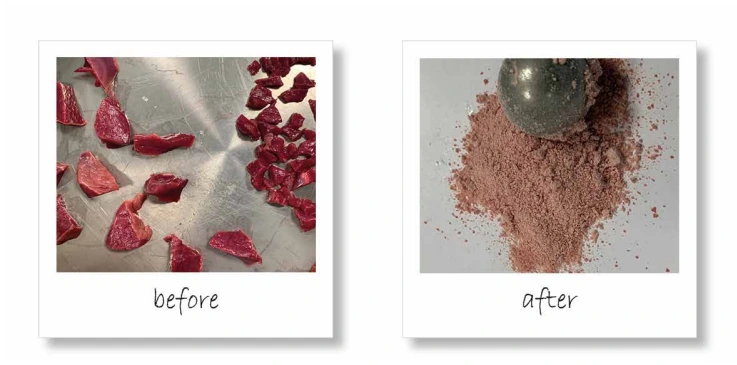
Cooling with liquid nitrogen allows to freeze the samples, or to further process frozen samples. The freezing of fatty samples or materials that contain a considerable amount of water, makes them brittle, so that they can be crushed by impact and friction forces in a ball mill (see example in figure 3).
Wide selection of accessories - optimum setup for each application
The MM 500 control offers sample processing in screw-lock sample vessels, which are conveniently inserted on the cooling plates and can be opened during process breaks. There is no need to take away the vessel from the station, for example, for intermediate sampling during a process. Sample cooling is ensured during the entire process, i.e., also during process breaks.
For optimal, contamination-free processing of a particular sample material, the screw-lock sample vessels of the MM 500 control are available in stainless steel, zirconium oxide and tungsten carbide with jar sizes ranging from 50 ml to 125 ml .
Screw-lock sample vessels of different sizes and materials.
For special applications that require modified atmosphere inside the sample vessel, or to monitor the variables "pressure" and "temperature", functionalized lids are available for the screw-lock sample vessels .
Temperature-controlled disruption of yeast cells with the MM 500 control
Cell disruption is a biochemical process to access proteins, RNA or other biological components of a cell. To break down the cell wall, for example, the so-called "bead beating" method is used. The cell suspension is placed in a reaction vessel together with glass beads and shaken vigorously. The shaking is usually carried out with vibrating homogenizers or in mixer mills. The induced friction effects shear the cell walls and allow access to the cell components for analysis. However, the friction also induces heat development so that the temperature of the sample rises during the process. Already temperatures above 10 °C can be critical and destroy the homogenates of the cell. Accordingly, sample cooling is required during the entire process.
The following application example of a global pharmaceutical and diagnostics company describes the in-process control of enzyme production with yeast cells. Here, the two yeast cells P. pastoris and C. baidinii were considered. Previously, this company performed cell disruption with a vibratory homogenizer with characteristic tumbling motion. Therefore, in this discussion, not only the advantage of continuous cooling, but also the quality of cell disruption in the Mixer Mill MM 500 control are evaluated. Results are compared to those obtained with the previously used vibrating homogenizer, a device that is widely used for cell disruption.
Aeration lid modifies the atmosphere in the sample vessel
GrindControl monitors pressure and temperature inside the vessel
Adapter for 18 reaction tubes, e. g. Eppendorf tubes 1.5 ml or 2 ml.
Setup and process parameters during application
I Setup 1 is used for the Mixer Mill MM 500 control, involving a recirculating chiller unit for cooling and water as cooling medium. I Two 125 ml screw-lock sample vessels made of stainless steel are used for contamination-free cell disruption. For a feasibility study, also the adapter (shown in Figure 6) for 18 reaction vessels is tested. I Glass beads with 0.5 - 1.0 mm diameter are added to the suspension for bead beating. I A frequency of 30 Hz over a time of 8 - 10 minutes is set on the machine and a program with cooling intervals is selected
Results
The efficiency of cell disruption in the MM 500 control is comparable to the previously used vibrating homogenizer, see measurement results listed in the appendix. For cell disruption, the screw-lock sample vessels, but also the 2 ml Eppendorf reaction vials, can be used. The change from the old vibratory homogenizer with tumbling motion to the Mixer Mill MM 500 control is possible without quality losses.
The cooling option of the MM 500 control provides continuous sample cooling and increases the efficiency of the workflow. Manual intermediate cooling of the sample material in an ice bath during sample preparation is no longer necessary. Monitoring the actual temperature of the thermal plates during the entire process provides valuable feedback and enhances process reliability.
Additionally, process time can be saved by processing two samples simultaneously in the two grinding stations. The handling of the sample in the preparation process has improved significantly using the MM 500 control, due to the easy filling, removal, and cleaning of the screw-lock sample vessels. The lower noise level of the MM 500 control offers an additional improvement in the everyday laboratory work.
Conclusion
The Mixer Mill MM 500 control is ideally suited for biochemical applications where continuous sample cooling is required because temperature plays an important role. The advantages were demonstrated with a user example for disruption of yeast cells performed by a global pharmaceutical and diagnostics company. The patented cooling concept of this mixer mill increases process safety and efficiency. Furthermore, the MM 500 control produces high-quality process results and offers a more convenient handling of the sample material than other homogenizers.
Annex: Measurement Results
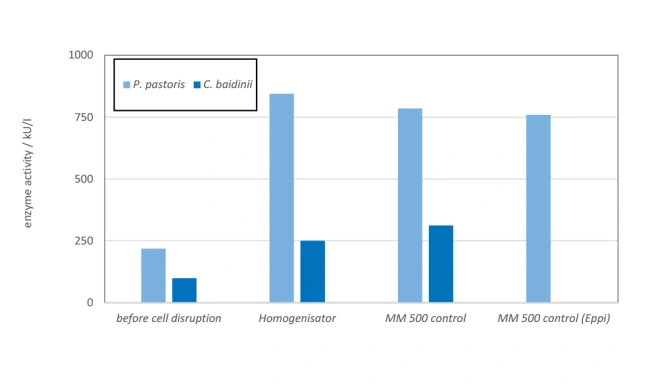
The effectiveness of cell disruption was evaluated using protein concentration and OD578. The comparison shows that the degree of disruption and the OD578 that is achieved in the MM 500 control is of the same magnitude as in the previously used vibratory homogenizer. Also, the enzyme activity after cell disruption is comparable to the previously used method with tumbling motion.
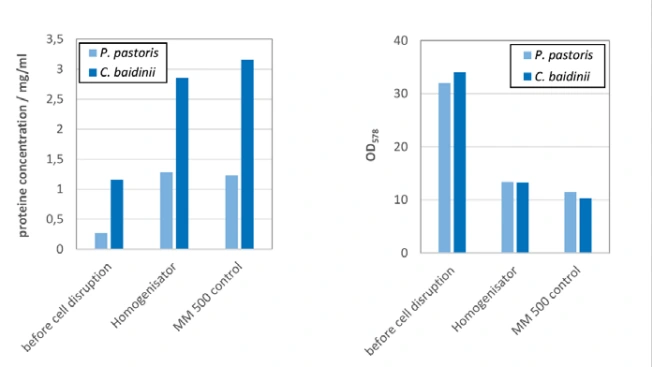
Protein concentration and OD578 of P. pastoris and C. baidinii before and after the cell disruption. The higher the difference between the measured values and the value before cell disruption, the higher the degree of disruption.
Plan the configuration for your material.
Start with the biological target and handling conditions rather than a universal cold setting. Define sample quantity, vessel arrangement and the acceptable preparation cycle. Assess the recovered material using the relevant biochemical method, since mechanical disruption and target preservation are distinct outcomes.
| Consideration | Information to provide |
|---|---|
| Target material | Protein, nucleic acid or other component |
| Sample format | Quantity and vessel needs |
| Evaluation | Integrity and suitability after preparation |
How should the application examples be used?
The results describe the materials and configurations discussed here. Confirm equipment options, contact materials and operating conditions for your own sample before adopting a method. A demonstrated endpoint does not guarantee the same outcome for a different material.
Discuss material testing with Glen Mills or request further information or a quote.