
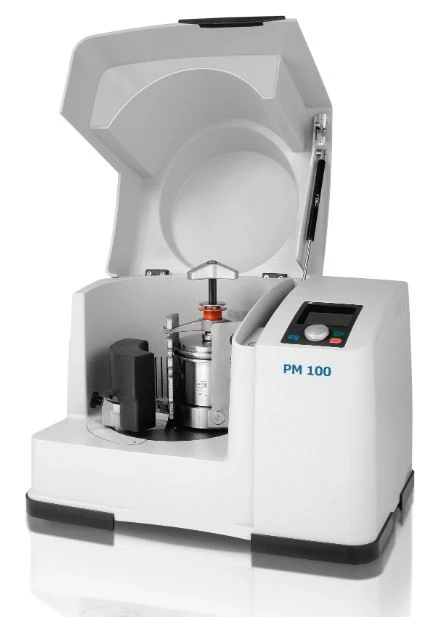
Is a planetary mill automatically a cryogenic system?
No. Confirm the permitted equipment arrangement and handling procedure. A research use with a specific protocol does not extend operating approval to every cooled configuration.
Planetary Ball Mill PM 100
The Rockefeller University was founded in 1901 by John D. Rockefeller Sr. as The Rockefeller Institute for Medical Research. The first institution in the United States devoted solely to using biomedical research to understand the underlying causes of disease, Rockefeller is today one of the foremost biomedical research centers in the world, and its scientists have made numerous seminal contributions to biology and medicine.
Click here to watch the video: Rout Protocol
“With more than 90 % of lysed cells, this method with the PM 100 is more efficient compared to lysis protocols performed in a liquid environment.” Dr. Célia Plisson-Chastang, LBME
PERFORMANCE DATA
PM 100 Applications:
pulverizing, mixing, homogenizing, colloidal milling, mechanical alloying soft, hard, brittle, fibrous - dry or wet
Feed material: Material feed size*: < 10 mm Final fineness*:
< 1 µm, for colloidal grinding < 0.1 µm
Cryogenic Disruption of Yeast Cells
according to the Rout Protocol
The Michael Rout Lab at the Rockefeller University in
New York, NY, initially contacted RETSCH Inc. in 2006 to discuss the possibility of using the Planetary Ball Mill to cryogenically grind yeast cell pellets. The aim of their experiment was to explore the construct of Nuclear Pore Complexes located on the cell walls of yeast cells. The decision to use a Planetary Ball Mill for this application was mainly based on the fact that it produces very small particle sizes which were considered an important prerequisite for more in-depth analysis of the yeast cells. Particle sizes in the submicron range promote a high yield for the following protein purification.
Since the Planetary Ball Mills are not specially designed for cryogenic grinding, the Rout Lab worked out a very specific protocol to achieve high yields (~90 %) of lysed yeast cells. The Rout Lab Protocol, “Cryogenic Disruption of Yeast Cells (RETSCH PM 100)”, which was developed in March of 2007, is available from their website. In addition to this protocol, the lab members made a video as well to provide a visual walk through of the process (
To date, the Rout Lab continues to utilize the Planetary Ball Mill for cryogenically grinding yeast cells for continued research on the above mentioned project as well as other universities research projects. RETSCH Inc. has currently 10 installations of the PM 100 Planetary Mill within US universities as a result of the Rout Lab collaboration.
according to the Rout Protocol
Cryogenic Disruption of Yeast Lysing of frozen yeast cells using a RETSCH PM 100 Planetary Ball Mill.
1.) Always wear cryo-gloves.
8.) Be sure no liquid nitrogen is in
10.) Between each cycle the jars are
2.) Fill a rectangular ice bucket about
¼ full with liquid nitrogen.
3.) Pre-chill everything. Immerse the
stainless steel grinding jars, the stainless steel lid, the grinding balls and the storage tube, with the frozen yeast noodles, in the liquid nitrogen.
4.) Pre-cooling is finished when nitrogen bath is no longer bubbling vigorously.
5.) Once everything is chilled pour the noodles into the grinding jar. - 20 mL - 50 mL of noodles: 125 mL jar - 20 mL and less of noodles: 50 mL jar
6.) Weigh the grinding jar with noodles and then adjust the counterbalance weight.
7.) When using the 125 mL jar, use 7-11
of the 20 mm stainless steel balls. - 50 mL Falcon tube requires 7-9 balls - < 50 mL of noodles requires 9-11 balls - < 25 mL of noodles requires 11 balls - < 15 mL of noodles use 50 mL grinding jar requires 3 balls
the grinding jar prior to grinding to avoid an explosion.
9.) Grinding is done in 8 cycles, each
cycle is set in the following manner: - 400 RPM - 3 minutes - 1 minute reverse rotation with no breaks between rotations (NOTE: You MUST hear the balls rattling around in the jar! If there is no rattling then add/remove balls to the jar until you hear it rattle. It is not considered a grinding cycle unless there is rattling.) When using the 50 mL jar the grinding settings are as follows: - 500 RPM - 3 minutes - 1 minute reverse rotation with no breaks between rotations (NOTE: You MUST hear the balls rattling around in the jar! If there is no rattling then add/remove balls to the jar until you hear it rattle. It is not considered a grinding cycle unless there is rattling.)
removed and cooled in liquid nitrogen. DO NOT REMOVE THE LID (removal of lid may result in cell loss)! To ensure lid is chilled use an empty Falcon tube to pour liquid nitrogen over the top of the grinding jar while the bowl of the grinding jar cools in the liquid nitrogen bath. DO NOT SUBMERGE THE JAR COMPLETELY as this will allow liquid nitrogen into the grinding bowl and may also result in cell loss.
11.) When 8 cycles are complete remove
powder with a spatula – if there is powder stuck to the side of the jar repeat 1 grinding cycle at 350 RPM, 2 minutes, 1 minute reverse rotation no breaks between rotations.
12.) Jars and balls can be cleaned with
warm water and Windex.
13.) Typically ~90 % of yeast cells can be disrupted in such procedure. Frozen ground cells are stored at -80 °C.
Genetic Research in France
Not only in the US is the Planetary Ball Mill used for the cryogenic disruption of yeast cells. The University of Toulouse, Fance, hosts the Laboratory of Eukaryotic Molecular Biology (LBME) which follows the Rout Protocol for this application as well and has so far obtained very good results.
The research at LBME focuses on the genetic control of eukaryotic gene expression in normal and pathological contexts. These are fundamental research projects: the objective is to understand the molecular basis underlying pathologies such as, for example, breast cancer. Their research relies on several model systems that range from unicellular to whole organisms, from yeast to mammals including primary and transformed cell lines.
Dr. Célia Plisson-Chastang appreciates the benefits of this method: “RETSCH’s PM 100 allows to process up to 25 g pf frozen yeast noodles in one working of run. With more than 90 % of lysed cells, this method is more efficient compared to lysis protocols performed in a liquid environment. Cells and cell grindates are manipulated at very low temperatures (ranging from -80 °C during storage to -196 °C when cooled in liquid nitrogen) all the time, thus preventing our ribonucleoproteic particles of interest to be damaged by released enzymes, such as proteases and nucleases.”
The RETSCH CryoMill is also highly suitable for cryogenic cell disruption.
Dr. Célia Plisson-Chastang of LBME operates the PM 100 with a 125 mL grinding jar of stainless steel and 7 to 11 grinding balls with 20 mm diameter of the same material to disrupt the yeast noodles. The next step is the chromatographic purification of the protein particles and after that functional and structural analyses using electron microscopy and image analysis. With the PM 100 approximately 90 % of the yeast cells are disrupted.
Plan the configuration for your material.
Cooling, vessel handling and the research endpoint are linked. Reproducing a published operating condition in a different sample or setup does not establish equivalent recovery. Discuss the exact equipment, supported cooling arrangement and biological preparation needs before adopting a process.
| Consideration | Information to provide |
|---|---|
| Sample state | Frozen pellet composition and quantity |
| Handling plan | Cooling and transfer sequence |
| Research endpoint | Material required after lysis |
How should the application examples be used?
The results describe the materials and configurations discussed here. Confirm equipment options, contact materials and operating conditions for your own sample before adopting a method. A demonstrated endpoint does not guarantee the same outcome for a different material.
Discuss material testing with Glen Mills or request further information or a quote.