
Does finer wool preparation identify cashmere on its own?
No. Grinding prepares the fibers for extraction. Identification depends on the validated biological assay and its interpretation.
Cashmere wool is the best known precious wool. It is taken from the cashmere goat which originates from the high mountain region of the same name. Due to its properties such as softness and warmth, cashmere wool gains more and more popularity in the manufacture of clothing. Genuine cashmere is won solely from the goat’s downy hair and must possess a certain hair structure with an exactly defined length and thickness.
The Fraunhofer Institute for Molecular Biology and Applied Ecology (IME) deals with applied life sciences from molecule to eco system.
The focus lies on research and development in the following areas:
- diagnosis of human, animal and plant diseases ■ protection and improvement of agricultural crop and food ■ detection and evaluation of the risks of synthetic biogenous materials for environment and consumer ■ development of strategies for risk minimization
The Institute currently employs 140 persons at two locations in Germany. It is closely connected to the Institute of Molecular Biotechnology of the University of Aix-la-Chapelle.
DNA extraction from wool
Due to the fact that only a very small amount can be won from each animal, cashmere wool is an expensive resource for the textile industry which makes it susceptible to falsifications. Instead of cashmere, the cheaper sheep wool is used and the product is then declared as genuine cashmere. Or products only contain a small amount of cashmere while the rest is wool from other animals which is processed without declaration.
Therefore, the textile industry and testing laboratories need detection methods which guarantee reliable testing of cashmere products. The Fraunhofer Institute for Molecular Biology and Applied Ecology (IME) has developed a method which allows for the reliable detection of the falsification of such products. The basis of this method is a procedure which has been developed by the Institute to differentiate animal species and has been used successfully since 2002 for the analysis of foods and feeds.
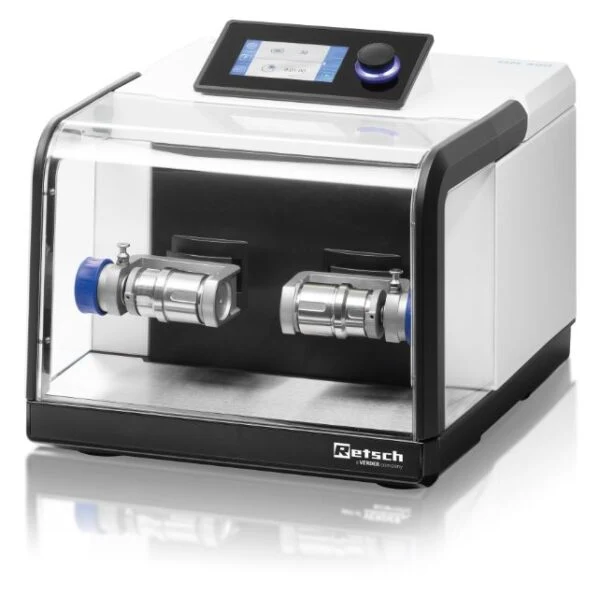
Gisela Boehle uses the RETSCH Mixer Mill MM 400 to grind wool samples
“For this we extract the DNA from the wool”, explains Dr. Bjoern Seidel, the project manager at the Institute. A difficult task as hair only contains traces of DNA. Moreover, wool is partly treated with chemicals and heated for dyeing which in turn destroys a great part of the existing DNA material. “We have to multiply the DNA which we extract from the wool millionfold before we can analyze its origin, for example, goat, sheep or even camel”, Dr. Seidel describes the procedure.
“With RETSCH’s Mixer Mill we achieve a higher final fineness which has a positive effect on the extraction.”
(Gisela Boehle, Fraunhofer-Institut)
RETSCH instruments for the preparation of wool/textiles
“Before the purchase we did some trials in RETSCH application laboratory which really helped us to make a decision.”
(Gisela Boehle, Fraunhofer-Institut)
The optimization of the extraction of animal fibers is based, among other things, on the use of RETSCH’s Mixer Mill MM 400. Gisela Boehle who manages the practical side of the project: “With RETSCH’s Mixer Mill MM 400 we grind wool reproducibly in a very short time. Before, we used scissors for size reduction which was very tiresome. Moreover, we achieve a higher final fineness with the MM 400 which has a positive effect on the extraction.”
As the Mixer Mill MM 400 has been used for many years for grinding hair as part of drug testing, it was obvious to apply this procedure to wool, too. First of all, the sample is cut with scissors into pieces of 1 – 2 cm. Then it is ground in a 35 ml steel jar with eight 10 mm steel balls for 3 minutes at 30 Hz. When grinding hair or wool, care should be taken to keep the grinding time as short as possible as otherwise the temperature inside the jar could rise to such a degree that the fibers decompose. This can be avoided by flexible parameter setting (time and frequency) which is a feature of the MM 400. The parameters can be stored and the programs can be called up any time. If the samples are very soft and sensitive, it can be helpful to embrittle them with liquid nitrogen before grinding. “Before the purchase we did some trials in RETSCH application laboratory which really helped us to make a decision.”
Mixer mill MM 400
- Feed material: soft, medium-hard, hard, brittle, elastic, fibrous ■ Material feed size*: < 8 mm ■ Final fineness*: < 5 µm ■ Dry, wet and cryogenic grinding, cell disruption ■ Grinding jars in various materials and sizes
Application example
After the wool has been ground, the DNA is extracted, amplified with PCR and classified with the T-RFLP method. The results show that it is possible to simultaneously detect all animal raw materials processed in a wool product.
Initial sample: embroidered fabric
Pre-cutting with scissors
Chromatogram A shows the analysis of a sample which consists of 100% cashmere.
In chromatogram B of another sample it can be clearly seen that it contains sheep wool as well as cashmere wool.
Chromatogram C shows the analysis of a jumper which was declared as 100% cashmere. However, the results show that 100% sheep wool have been used.
Chromatogram A – pure cashmere wool
Chromatogram B – cashmere with addition of sheep wool
Chromatogram C – pure sheep wool
Embrittlement of the sample in a stainless steel grinding jar with liquid nitrogen
The result of the grinding process is a homogeneous powder
Which wool preparation details matter for downstream identification?
The preparation task is separate from species identification. Consider how much wool is available, the suitability of the vessel and tools, and the compatibility of the ground material with extraction. Analytical controls remain important where samples contain mixed fibers or processing residues.
| Consideration | Information to provide |
|---|---|
| Fiber sample | Quantity and suspected mixtures |
| Preparation tools | Material and cleaning between samples |
| Extraction | Method compatibility and controls |
Discuss material testing with Glen Mills or Contact Glen Mills for information or a quote.