
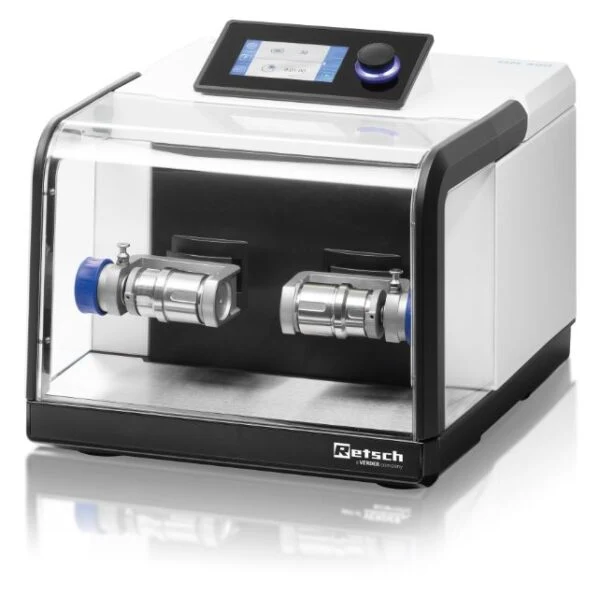
Does bead beating establish that a sample is safe or fully inactivated?
No. Disruption, analytical recovery and inactivation are different endpoints. The laboratory must validate containment and any biological safety claims independently.
Giardia and Cryptosporidia are parasites which occur in water and can cause diarrhoea in humans. They are common species and pose a problem in countries with insufficient drinking water treatment. Both parasites go through a complex development cycle. The Giardia cysts and the Cryptosporidium oocysts are persistent forms found in water and are resistant to environmental influences and disinfectants. Detection and quantitative determination of the parasites are typically performed in accordance with ISO 15553 „Water Quality – Isolation and Enumeration of Cryptosporidium oocysts and Giardia cysts from water“. This standard stipulates enrichment in various steps, immunofluorescence staining and counting below the microscope. An alternative molecular biological approach is quantitative Real-Time Polymerase Chain Reaction (RT-PCR). This method requires disruption of the persistent forms and subsequent extraction of the DNA to determine the quantity. Disruption of the fairly stable cysts and oocysts can be challenging. Various techniques can be found in the literature, for example, the use of ultrasound or repeated freezing with liquid nitrogen and thawing. A German microbiological laboratory has now tested a mechanical approach by using RETSCH’s Mixer Mill MM 400.
Cell disruption by Bead Beating
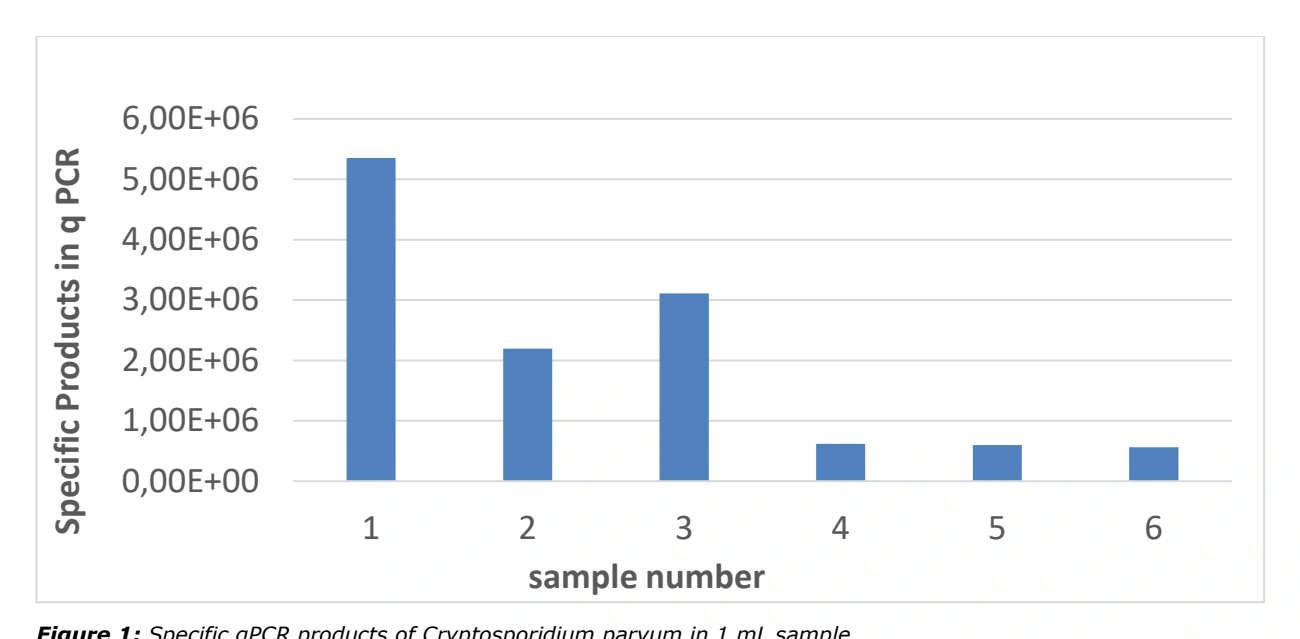
The so-called bead beating is a very efficient technique. It uses small glass beads to disrupt cell suspensions in reaction vials through mechanical effects. Typically, the reaction vial is held over a vortexer which makes the suspension and beads swirl in the vessel, and ultimately leads to disruption of the cells. However, this method is quite time-consuming and error-prone when it comes to high sample throughputs or long disruption times of up to 10 minutes. Using the RETSCH Mixer Mill MM 400 with an adapter for up to 10 x 2 ml reaction vials makes the process not only faster but also more reproducible. The microbiological laboratory produced a total of 6 approaches with 9x101 Giardia cysts and 1x10⁶ Cryptosporidium oocysts per ml. From each approach 1 ml was used for disruption. The first 3 samples were disrupted in the MM 400: 1 ml suspension was mixed with 3.2 g glass beads (sized 0.75 mm to 1 mm) in a threaded Nunc Cryo vessel, and were shaken 3 times for 10 minutes at a time at 30 Hz.
Then DNA isolation was carried out with the help of a GenUp DNA/RNA kit with a volume of 400 µm and elution of 100 µm, according to the manufacturer’s instructions. Samples 4 to 6 were used for negative control; hence, 400 µl were directly lysed and purified with the help of the kit and then subjected to qPCR. For this, 5 µl sample in 20 µl Mastermix were used; quantification was performed with a 10x dilution series of known DNA standards. Specific probes for Giada cysts and Cryptosporidium oocysts were used and were measured with the BioRad CFX96 Touch Real-Time PCR Detection System. The results clearly show that cell disruption by bead beating and cell lysis is much more efficient than by lysis alone.
2 sample number
RETSCH’s Mixer Mill MM 400 – a true allrounder
Thanks to a wide range of accessories, the Mixer Mill MM 400 is suitable for a wealth of applications, including cell disruption in disposable vials such as up to eight 50 ml Falcon tubes or various Eppendorf tubes (20 vials max. at a time; Fig. 2). Typical sample materials include plants, feathers, bones, tissue, tablets, wood, minerals or chemicals – the MM 400 is a true allrounder in sample homogenization. It generates grind sizes down to 5 microns and is suitable for hard, medium-hard and brittle as well as soft, elastic and fibrous sample materials. When used with stainless steel grinding jars, it can also be employed for cryogenic grinding. The optional CryoKit allows for cooling of the filled jars in liquid nitrogen.
Mixer Mill MM 400 with adapter for 8 x 50 ml Falcon tubes (left) and various accessories, such as adapters for Eppendorf tubes (middle), grinding jars and balls (right)
Conclusion
Parasites possess multiple cell nuclei which may lead to more than one positive qPCR-based result, i. e. more parasites are detected than cysts have been used in the first place. The best qPCR results were obtained with samples no. 1 to 3 which were subjected to cell disruption by bead beating in RETSCH’s MM 400 mixer mill. The use of this mill considerably improved the detection rate of Cryptosporidia but not of Giardia of which only a small number was detected.
Dr. Tanja Butt Product Management
Plan the configuration for your material.
The objective is sample disruption for a defined downstream test, not a general disinfection claim. Compare vessel format, bead selection and treatment conditions using suitable laboratory controls. Preserve sample identification and containment throughout the preparation sequence.
| Consideration | Information to provide |
|---|---|
| Sample format | Suspension volume and vessel |
| Mechanical treatment | Beads, duration and cycle |
| Analytical checks | Recovery and downstream compatibility |
How should the application examples be used?
The results describe the materials and configurations discussed here. Confirm equipment options, contact materials and operating conditions for your own sample before adopting a method. A demonstrated endpoint does not guarantee the same outcome for a different material.
Discuss material testing with Glen Mills or request further information or a quote.