
Can good cell disruption alone demonstrate protein preservation?
No. Disruption efficiency and protein condition need separate checks. Evaluate the preparation against the downstream method rather than visual breakage alone.
At the Ernst Ruska-Centre-3 (ER-C-3) for Microscopy and Spectroscopy with Electrons, one of the institutes of the renowned Forschungszentrum Jülich, researchers harness the power of cryo-electron microscopy and cryo-electron tomography to answer important questions regarding the structure and function of biological membranes and membrane-associated protein complexes. To this end, various cellular systems, including yeast, are used as models to study the membrane systems of interest.
The purification of membrane proteins from non-thermophilic organisms strongly depends on the temperature during the cell lysis. To ensure that the membrane proteins are not degraded or denatured during sample preparation, it is necessary to always keep the sample very cold, ideally frozen. Two scientists at the Ernst Ruska-Centre-3, Dr. Irene Vercellino and Dr. Benedikt Junglas, use RETSCH Mixer Mill MM 500 nano to lyse yeast cells and extract the protein content.
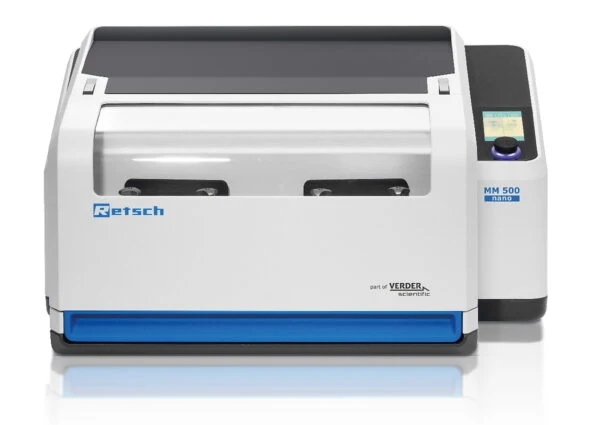
The MM 500 nano from RETSCH is an innovative mixer mill with two grinding stations for screw-lock sample vessels and a vibration frequency of up to 35 Hz. Thanks to its steel grinding jars, the machine can be used in “manual cryo mode”, where the grinding jars and balls are pre-frozen in liquid nitrogen before use. The cell pellet is pre-frozen and transferred to the grinding jar. Then the jar is closed tightly and immersed in liquid nitrogen for some minutes, until the liquid nitrogen stops boiling. It is important, that the cell pellet is frozen indirectly inside the jar as direct contact with the liquid nitrogen inside the jar would cause strong overpressure when getting warmed. After 1 minute grinding, cooling in the LN2 bath is repeated to ensure that the temperature inside the jar remains low. This is fol-
Mixer Mill MM 500 nano
lowed by another minute of grinding. While this procedure does not allow for monitoring the sample temperature in real time, it was proven in tests that it effectively keeps the sample frozen inside.
Setup: Manual cooling with liquid nitrogen For this configuration, the jars and balls are pre-cooled in a liquid nitrogen bath and re-cooled in between the milling cycles: I To be used if there is no space for using a mill which can be connected to a chiller or liquid nitrogen tank, like RETSCH MM 500 control I Suitable for milling and cooling in cycles of 1 minute each
In this configuration, the sample is kept frozen during milling by the pre-chilled surroundings, but it is not possible to control the temperature. Therefore, it is suitable when the sample has to be kept below 6 degrees, without the need to reach a defined temperature, or to continuously monitor the temperature. During grinding cycles of up to 1 minute, the jars remain cold because the very low temperature of liquid nitrogen of - 196 °C effectively counteracts the heat development. Cooling with liquid nitrogen allows to freeze the samples, or to further process frozen samples. The freezing of fatty samples, or of materials that contain a considerable amount of water, makes them brittle, so that they can be crushed by impact and friction forces in a ball mill.
The MM 500 nano offers sample processing in screw-lock vessels, which can be opened during process breaks, e. g. to check the pulverization status of the pre-frozen cell pellet. They are easily removed for re-cooling in between cycles. For optimal cold processing of a specific sample material, the screw-lock grinding jars of the MM 500 nano are available in stainless steel with jar sizes ranging from 50 ml to 125 ml. With the aid of an adapter, eighteen 2 ml plastic tubes (e. g. Eppendorf Tubes) or 9 x 2 ml metal cups can be used for simultaneous processing of small sample volumes.
Field experience
Comparison of cryogenic grinding in the MM 500 nano versus ultrasonication at the Forschungszentrum Jülich Cell disruption is a biochemical process to access proteins, RNA or other biological components of a cell. To break down the cell wall, an effective method is the so-called "bead beating". The cell suspension is placed in a single-use vial together with glass beads and shaken vigorously. The shaking is usually carried out with vibrating homogenizers or in mixer mills. The induced friction effects shear the cell walls, making the cell components accessible for analysis. Alternatively, ultrasonification or high pressure can be used, but all these methods induce heat development, causing the sample temperature to rise during the process. Even temperatures slightly above 10 °C can damage proteins within the homogenates of the cell. Accordingly, sample cooling is required during the entire process.
The following application example describes the lysis of yeast cells (S. cerevisiae) using the grinding method with manual cooling in comparison to ultrasonication. Therefore, in this discussion, not only the advantages of continuous cooling, but also the quality of cell disruption carried out in the Mixer Mill MM 500 nano are evaluated. Results are compared to those obtained with the sonicator, a device that is widely used for cell disruption.
Setup and process parameters One 125 ml and one 50 ml screw-lock grinding jar made of stainless steel are used for cryogenic cell disruption. 25 ml of frozen pellet are placed in the 125 ml jar, equipped with 8 balls of 20 mm, and 10 ml of the same sample are filled in the 50 ml jar, equipped with 1 ball of 25 mm.
adapter for 18 tx 2 ml plastic tubes (above) or 9 x 2 ml metal cups (below)
I A frequency of 30 Hz for 2 cycles of 1 minute each is set on the machine, with intermediate cooling for 1 minute I For sonication, the pellet is resuspended in TBS (20 mM Tris pH 7.5, 137 mM NaCl) at a 4-g-per-100 ml concentration Sonication protocol: 5 cycles of 5 minutes at 40% pulses, 40% output power using a
I microtip. The sample is kept on ice with 1-minute breaks between cycles to make sure that the sample remains cold.
RESULTS:
The samples were checked under the light microscope and run on SDS-PAGE
Not lysed
sonication
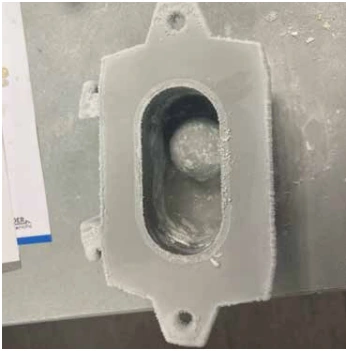
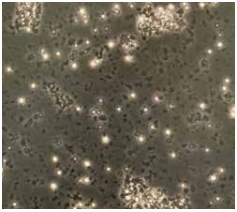
The microscope images clearly show that 25 minutes of sonication barely lyse any cells, while 2 minutes of milling lyse at least 50%. The filling of eight smaller beads in the 125 ml jar appears to be more effective than the 50 ml jar with one larger bead.
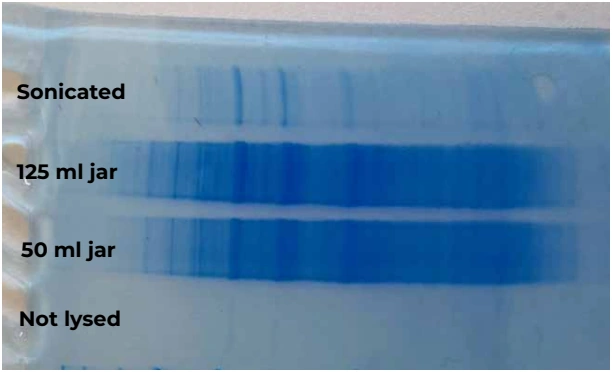
Each sample imaged under the microscope is also spun down to get rid of non lysed cells and leave only the released soluble proteins in solution: the supernatant is loaded on SDS- PAGE, then stained with Coomassie blue to detect the protein content. The sample concentration is normalized in terms of grams of frozen pellet per ml of resuspension buffer.
Sonicated
125 ml jar
50 ml jar
Not lysed
The protein content corresponding to the samples indicated above the gel. Lane 1 is the non lysed control, lanes 2 and 3 are the lysates from 50 ml and 125 ml jar respectively and lane 4 is the sonicated material.
Conclusion
The discussed application tests at the Ernst Ruska-Centre-3 (ER-C-3) for Microscopy and Spectroscopy with Electrons have proven that efficiency of yeast cell disruption in the Mixer Mill MM 500 nano is superior to the sonicator . This is also due to the fact that manual cooling keeps the sample frozen throughout the whole procedure. The screwlock sample vessels, but also the 2 ml Eppendorf reaction vials, can be used for cell disruption.
The Mixer Mill MM 500 nano is ideally suited for biochemical applications where sample cooling is required because temperature plays an important role. Moreover, the mill provides excellent process results and offers a more convenient handling of the sample material than other cell disruption methods. Another advantage is the reduced processing time when compared to other methods like sonication.
Forschungszentrum Jülich GmbH is a large institute, member of the Helmholtz Association, hosting over 7000 employees dedicated to research in the fields of life science, natural science and engineering.
Plan the configuration for your material.
Keeping material cold is part of preserving the target during lysis. Define the sample state before loading, the treatment cycle and handling after disruption. The relevant outcome is not only whether cells break, but whether the recovered material remains suitable for the intended protein investigation.
| Consideration | Information to provide |
|---|---|
| Research target | Protein or membrane preparation |
| Cold handling | Before, during and after disruption |
| Evaluation | Lysis and target-material quality |
How should the application examples be used?
The results describe the materials and configurations discussed here. Confirm equipment options, contact materials and operating conditions for your own sample before adopting a method. A demonstrated endpoint does not guarantee the same outcome for a different material.
Discuss material testing with Glen Mills or request further information or a quote.