
Does cooling alone establish RNA integrity?
No. Assess the recovered material using the molecular method's controls. Handling, disruption and extraction all influence the final analytical input.
Climate change, shifts in biodiversity and increasing travel are driving the northward spread of mosquito-borne pathogens such as West Nile, dengue, chikungunya and Zika viruses. Protecting public health therefore requires continuous monitoring of mosquito populations before an outbreak occurs. Surveillance programmes collect mosquitoes in traps, group them into pools (5–50 individuals per sample) and analyze them for viral RNA using RT-PCR (reverse transcription polymerase chain reaction). The quality of sample preparation plays a decisive role in the reliability of the results. West Nile and dengue viruses in particular have spread to new areas of Europe in recent years – a development that has prompted health authorities worldwide to intensify their surveillance programs. The earlier a virus is detected in a mosquito pool, the more precisely control measures can be targeted, ideally before human infections occur. For surveillance laboratories, this means processing thousands of samples per season under intense pressure to deliver analytical results quickly.
The challenge: maintaining RNA integrity during mechanical homogenization
RNA is considerably less stable than DNA and is highly sensitive to heat, friction and RNases. Conventional mechanical homogenization methods, such as those using standard ball mills, generate frictional heat during processing, which can damage RNA molecules or even degrade them completely. Even short grinding times can raise the sample temperature by 10–20 °C and result in inconsistent sample quality if cooling breaks are performed manually and inconsistently. In addition, conventional cooling methods, such as manually cooling adapters in an ice bath, interrupt the process and compromise both reproducibility and throughput. In high-throughput laboratories processing several hundred samples a day during the season, these breaks add up to a substantial loss of time and quality. Surveillance laboratories therefore face a fundamental dilemma: increasing sample throughput or safeguarding sample integrity – without the right technology, both cannot be achieved simultaneously.
Higher sample throughput with Mixer Mills
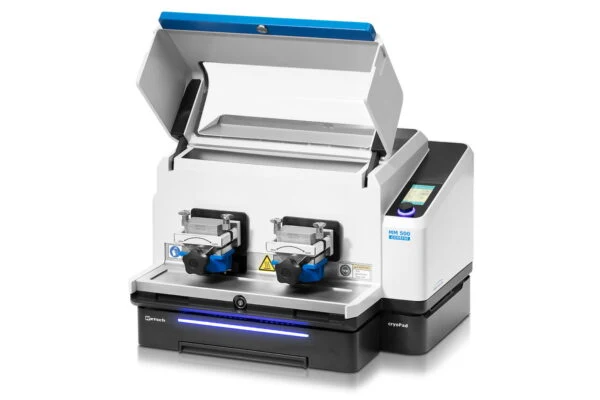
The MM 500 control mixer mill is the world’s first ball mill to actively monitor and control the temperature of the grinding process. Connecting an external cooling unit (e.g. a chiller) allows the grinding temperature to remain under continuous control throughout the process, without manual interruptions. The MM 500 control operates at frequencies of up to 30 Hz and achieves a final fineness of approximately 0.1 µm with a maximum feed size of 10 mm. In addition to temperature control, the instrument offers ergonomic grinding jar clamping, a touchscreen display with storage for up to 12 SOPs, and the option to store up to four different cycle programmes with 99 repetitions each.
How temperature control works in the MM 500 control
Thermal plates transfer heat directly from the grinding jars to the cooling medium. The grinding jars are simply placed on the thermal plates, without open liquid nitrogen baths or the use of dry ice. A hermetically sealed fluid system allows operation with water or a water– glycol mixture (via a chiller, from approximately 4 °C), thermal oil for higher temperature ranges, or liquid nitrogen via the optional cryoPad for temperatures down to −100 °C. When using liquid nitrogen, the system’s control accuracy is ensured by a patented PID (proportional–integral–derivative) control method that actively regulates the coolant flow via the cryoPad. The target temperature can be set in 10 °C increments from −100 to 0 °C and maintained at a stable level throughout the grinding cycle. Chiller operation has proved effective in mosquito surveillance: with water cooled to 4 °C, the suspension in the 2 ml reaction tubes remains at approximately 13 °C, without a single manual cooling break.
Higher sample throughput: adapter for 18 × 2 ml reaction tubes
A special aluminum adapter holds up to 18 safe-lock reaction vials (1.5 or 2.0 ml) at a time. The aluminum efficiently transfers cooling from the thermal plates to the tubes, ensuring that the sample material is cooled without delay. With two grinding stations, the MM 500 control can process up to 36 samples in a single run. For applications requiring the sample to be frozen or heated to high temperatures, Retsch recommends using 2 ml steel tubes instead of polymer reaction tubes, as they withstand extreme mechanical and thermal stresses more effectively. The aluminum adapter can accommodate 9 × 2 ml steel tubes, providing maximum flexibility for different sample materials and protocols. Disposable plastic tubes, meanwhile, are ideal for contamination-free routine operation in mosquito surveillance.
Optimal protocol for RNA extraction from mosquito pools
Samples should be frozen on dry ice or in liquid nitrogen immediately after collection, as RNA degradation begins within minutes at room temperature. Pre-cooling grinding jars and adapters to 4 °C before inserting them is recommended to make full use of the system’s cooling capacity from the outset. Proven grinding parameters for mosquito tissue are a frequency of 25–28 Hz and a grinding time of 45–60 seconds per cycle, with a cooling water temperature of 4 °C.
The MM 500 control continuously displays the thermal plate temperature on its touchscreen, making it possible to ensure at all times that the suspension remains below 15 °C and RNA integrity is preserved. Stainless steel grinding balls with a diameter of 2 or 3 mm have proved effective for mosquito tissue; zirconium oxide grinding balls may be considered for particularly sensitive RNA applications. The ability to store up to 12 SOPs on the instrument ensures standardization across multiple operators and throughout the season.
Quality assurance in routine operation
Spot checks of RNA quality are recommended at the start of each season and whenever the protocol changes, to validate the consistency of sample preparation across batches. Disposable reaction tubes (2 ml) completely eliminate the need for cleaning between batches – a decisive advantage in high-throughput surveillance, where cross-contamination between pools is unacceptable.
Biological samples – cell disruption and tissue homogenization
Beyond mosquito surveillance, the MM 500 control has proved effective in a wide range of biological applications – wherever heat-sensitive molecules and reproducible results are a priority. In virology and microbiology, the instrument is used for RNA extraction from tissue samples, cell pellets and organoids; in pharmaceutical research, it is used for temperature-controlled homogenization of tablets, capsules and biological matrices. Cryogenic grinding of materials containing volatile aroma compounds, such as coffee beans, at −20 °C is one example from food analysis that illustrates the breadth of possible applications.
Conclusion
For surveillance laboratories processing hundreds to thousands of mosquito pools every day, the Retsch Mixer Mill MM 500 control represents a decisive step towards higher data quality and greater process efficiency. Active temperature control protects RNA integrity, improves reproducibility between batches and eliminates time-consuming manual cooling breaks. Compared with conventional ball mills without temperature control, the MM 500 control offers three key advantages: first, direct, continuous cooling without process interruptions; second, full process documentation and SOP storage for GLP-compliant laboratory environments; and third, the flexibility to switch cooling media according to requirements, from a simple chiller to liquid nitrogen with the optional cryoPad.
Plan the configuration for your material.
Temperature management is relevant because the target and the mechanical treatment have different requirements. Specify the specimen format, extraction method and supported cooling arrangement. Evaluate RNA suitability after preparation rather than treating either a cold setting or visible disruption as sufficient evidence.
| Consideration | Information to provide |
|---|---|
| Specimen format | Individual or pooled sample |
| Thermal handling | Supported configuration and cycle |
| RNA evaluation | Extraction controls and assay requirements |
How should the application examples be used?
The results describe the materials and configurations discussed here. Confirm equipment options, contact materials and operating conditions for your own sample before adopting a method. A demonstrated endpoint does not guarantee the same outcome for a different material.
Discuss material testing with Glen Mills or request further information or a quote.