
Why can an apparently well-ground food still be unrepresentative?
Some ingredients may remain unevenly distributed or be preferentially lost. Assess composition and portion uniformity rather than relying on appearance alone.
Food occurs in a great variety of consistencies and is often inhomogeneous. Food testing labs require representative samples to produce meaningful and reproducible analysis results. Therefore, food samples must be homogenized and pulverized to the required analytical fineness, ideally with as little time and effort as possible. Furthermore, reliable analytical results can only be obtained if the entire sample preparation process is carried out reproducibly. This means that the prepared part sample, from which usually only a few grams or milligrams are required for analysis, needs to represent the laboratory sample as well as the original sample from which the laboratory sample was extracted. An inhomogeneous sample does not represent the original material because some components may be overrepresented or missing altogether. Consequently, a homogeneous sample is the basis for reliable and representative analytical results.
A good example to understand the importance of sample homogeneity is fat analysis of pizza. Only a few milligrams of pizza are required for analysis. Random sampling might result in a piece of mushroom or salami or cheese which would falsify the total fat content in the subsequent analysis . However, if the pizza is first reduced to coarse particles < 5 mm and then pulverized to fine particles < 0.5 mm, a homogeneous, representative analysis sample is obtained.
The standard deviation of any subsequent analysis can be minimized drastically by particle size reduction and homogenization of the analytical sample. In the pizza example the fat content was measured . The fat content varies in the pizza samples with particle sizes around 5 mm, whereas it is much more consistent in the homogenized samples. The standard deviation SD is reduced from 0.21% to 0.03% (relative SD from 2.10% to 0.35%).
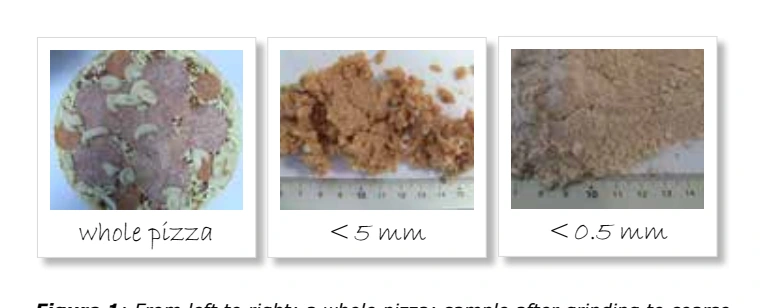
whole pizza
Fat content in Pizza
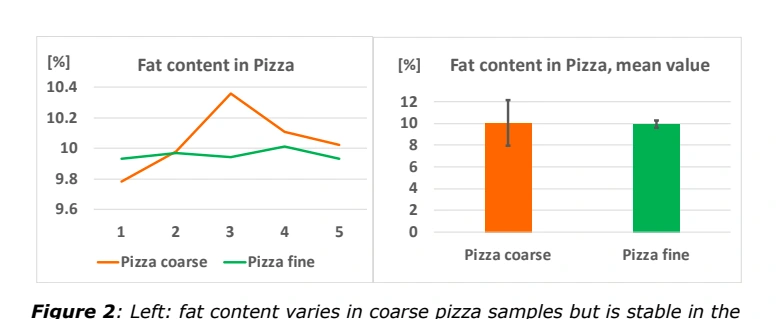
Fat content in Pizza, mean value
Pizza coarse
Pizza fine
Pizza coarse
Pizza fine
1. How to select a suitable laboratory mill and
accessories
When searching for a suitable mill and grinding tools, one should keep in mind that the sample properties to be determined, like moisture or heavy metal content, must not be altered in any way during the process. To find the best suited mill for a specific application, some aspects should be considered in advance, for example the size of the sample. It makes a great difference whether large samples, like a whole fish, or small particles, such as crop grains, are to be homogenized. The mills that accept bigger initial particle sizes are mostly not suitable for producing very fine particles which are small enough for subsequent analysis. Another essential aspect relates to the sample properties: to produce a size reduction effect, the comminution principle of the mill should match the breaking behavior of the sample. Properties such as density, hardness, consistency, residual moisture, or fat content must be considered. Other characteristics which may influence the success of the grinding process are temperature stability or tendency of the sample to agglomerate.
Laboratory mills work with different size reduction principles. Pressure, impact, and friction effects, for example, are best suited to pulverize hard and brittle materials. These size reduction principles, however, have only limited effect on fibrous, soft, elastic samples. Homogenizing e. g. a freeze-dried fish is not possible by using pressure or impact; cutting and shearing are suited much better. The capacity of a mill and the sample throughput are another important point. Grinding some kilograms of wheat in a rotor mill is carried out much quicker than grinding the same amount in a mixer mill with a maximum jar volume of 50 ml. Finally, the choice of grinding tool material can have great influence on the grinding efficiency. The material of the grinding set should be harder than the sample to avoid excessive wear. In the case of food samples, this is true for most of the grinding materials used. Mechanical size reduction always leads to a certain degree of abrasion which may influence the subsequent analysis. Consequently, traces of materials like steel or zirconium oxide may be found in the
Ultra Centrifugal Mill ZM 200 with cyclone
sample. Anyhow, the amount is usually below detection limit for most analyses and can therefore be neglected. Regardless of the grinding tool material, the choice of suitable accessories can have substantial influence on the grinding efficiency.
1.1. Drying or embrittlement of the sample
Only knife mills can handle moist or even wet sample materials without undesired side effects like blockage of the machine or sample loss. Consequently, material is lost and much time must be spent on cleaning the mill. Therefore, it is advisable to dry the material before further processing. When choosing the drying method and temperature, care must be taken that the properties of the sample to be determined are not altered in any way. That is especially important with regards to temperaturesensitive or volatile components. Usually, these types of sample can only be air-dried at room temperature. The Fluid Bed Dryer TG 200 is suitable for gentle and quick drying of many products.
Some types of soft, tough, sticky, or fatty food samples should be cooled before they can be subjected to preliminary or fine size reduction. Chocolate or raisins, for example, may be pulverized easily by cryogenic grinding whereas at room temperature, it is only possible to produce a paste with a low homogeneity. One way is to embrittle the sample in liquid nitrogen (LN2) before grinding. At a temperature of -196 °C even soft jelly bears become so hard and brittle that they are pulverized without problems. Another possibility is to mix the sample with dry ice (solid CO2). If the sample contains volatile substances, cryogenic grinding is also the method of choice. Materials which must not become moist should not directly be treated with cooling agents, because the humidity of the air is condensing on the cold sample.
2. Overview of mills commonly used for food sample
preparation
Obviously, more than one mill type may be suitable for grinding a particular sample. As mentioned before, the choice of the most suitable mill for a certain sample depends on the sample volume, the required final fineness, the throughput, the material properties, and the subsequent analysis. Knowledge of the basics and working principles of different mill types helps to make the optimum choice for a specific application.
Ultra Centrifugal Mill ZM 200
Typical applications: seeds, corn, maize, wheat, dried algae, salt, sugar, dried fish, peas, nuts, almonds, coconut, coffee, tea, roots, gelatin, dried leaves, rice, spices, herbs, soya meal, etc.
The Ultra Centrifugal Mill ZM 200 is used for the rapid fine size reduction of soft, medium-hard, brittle, and fibrous materials. Size reduction is effected through impact and shearing forces between ring sieve and horizontal rotor. The maximum feed size is 10 mm. Especially with maximum speed, but depending on the material, a final fineness of 40 μm (d90) and below may be achieved. Amongst the rotor mills, this is the highest achievable fineness. The aperture sizes of the exchangeable ring sieves, ranging from 0.08 mm to 10 mm, determine the grind size. The revolution speed of the ZM 200 ranges from 6,000 to 18,000 min-1. The cassette principle guarantees 100 % sample recovery and easy cleaning. It is recommendable to use a Vibratory Feeder DR 100 for automatic and uniform feeding of large amounts of freeflowing materials. If large quantities or temperature-sensitive materials are processed, the use of a cyclone, e. g. with a 3-liter or 5-liter collector, is recommended. The frictional heat that is generated during the grinding process is partly discharged through the cyclone, so it helps to cool the sample.
Rotor Beater Mill SR 300
Typical applications: seeds, corn, maize, wheat, dried algae, salt, sugar, dried fish, peas, nuts, almonds, coconut, coffee, tea, roots, gelatin, dried leaves, rice, spices, herbs, soya meal, etc.
The Rotor Beater Mill SR 300 is used for preliminary and fine size reduction of soft, medium-hard, and brittle materials with a maximum feed size of 25 mm. The final fineness is determined by the aperture size of the exchangeable ring sieves (0.08 – 10 mm). A fineness down to 50 μm and below, depending on the properties of the sample material, may be achieved. Size reduction in the SR 300 is effected by impact and shearing forces. The revolution speed is adjustable between 3,000 and 10,000 min-1. For larger sample quantities, the Vibratory Feeder DR 100 can be used for automated feeding. In contrast to other rotor mills, the SR 300 is suitable for grinding large sample amounts up to 30 liters in one step.
Rotor Beater Mill SR 300
Cyclone Mill Twister
Typical applications: seeds, corn, maize, wheat, peas, tea, dried leaves, rice, spices, herbs, etc.
The Twister is specially designed for the processing of non-fatty food and feedstuff for subsequent Near Infrared Spectroscopy (NIR analysis). It processes fibrous and soft products quickly and gently to the required analytical fineness of about 0.5 m. It is equipped with a rotor and grinding ring with sieve insert. The high revolution speed of up to 14,000 min-1 and the grinding geometry of the rotor and grinding chamber generate an air stream which carries the sample through the integrated cyclone into the sample bottle. This helps to avoid cross contaminations. The cyclone provides additional cooling of the sample and the grinding tools. This prevents loss of moisture and thermal degradation ensuring preservation of the sample properties to be determined. The ground material is separated in the cyclone and collected in a sample bottle for complete recovery. The rotor speed can be adjusted in three steps allowing for perfect adaptation to sample requirements.
Cyclone Mill Twister
2.2. Knife Mills GRINDOMIX GM 200 and GM 300
Typical applications: fresh meat, herbs, milk powder, fresh bacon, convenience food, cereal bars, soy beans, cakes, fresh fish, salad, raisins, tomatoes, fresh vegetables, sweets, jelly bears, bread, cheese, liver, fruits, chocolate, salami, soups, potatoes, cookies, ground meat, berries, nuts, seeds, boiled eggs, etc.
Knife Mills are suitable for the size reduction and homogenization of samples with a high fat, oil or water content. The GM 300 homogenizes sample amounts up to 4,500 ml, and is therefore the only mill which can homogenize a whole pizza or loaf of bread in one batch. The speed range of the Knife Mills is flexible and allows for optimum adaption to the specific sample properties. When the mills are operated in reverse mode, the blunt edge of the blades hits the sample with impact and crushes it (instead of cutting in forward mode). A wide range of accessories is available: different knives and lids, containers of polypropylene, polycarbonate, stainless steel, and glass. Except for the polypropylene grinding container, all containers can be autoclaved. For heavy-metal-free grinding processes neutral-to-analysis knives are available. By using a gravity lid the volume of the container is reduced and automatically adapted to the sample amount.
Knife Mills GRINDOMIX GM 300 and GM 200
2.3. Mixer Mill MM 400 and CryoMill
Typical applications: chocolate cream, spices, herbs, tea, olive pulp, lactose powder, egg shells, jelly bears, liver, vanilla pods, berries, cookies, tobacco, chewing gum, wheat, waffles, frozen fish, seeds, etc.
The MM 400 is suitable for grinding small sample quantities up to 20 ml. The grinding jars perform radial oscillations in a horizontal position with a maximum frequency of 30 Hz. Size reduction is effected through impact forces, allowing for a final fineness down to 5 µm (d90), depending on the sample properties. The grinding
Mixer Mill MM 400
The cutting mill series
jars have a size range from 1.5 to 50 ml and are suitable for wet grinding. Jars and balls are available in various sizes and materials, e.g. agate or ceramics such as zirconium oxide. Another option is the use of different adapters which hold up to 20 x 2 ml or 10 x 5 ml reaction vials or 8 x 50 ml conical centrifuge tubes. The CryoMill is specially designed for cryogenic grinding and will be discussed later in the sub-chapter of cryogenic grinding.
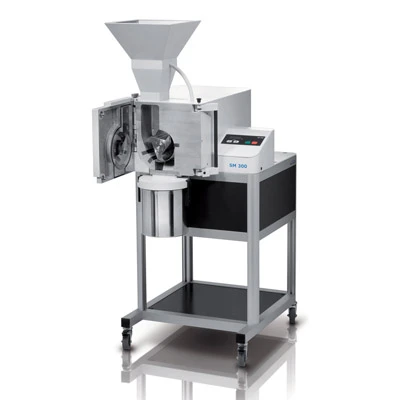
2.4. Cutting Mills SM 100, SM 200, SM 300
Typical applications: roots, tea, corn, freeze dried fish, bones, mushrooms, spices, orange peel, sugar beet pellets, shea nuts, sugar cane, herbs, potatoes, lumps of cocoa butter, etc.
Cutting Mills are used for preliminary size reduction of soft, medium-hard, or fibrous materials such as roots, nut shells or bones. Depending on the model, the revolution speed of the cutting mill is fixed or variable up to 3,000 min-1. The achievable grind size depends on the aperture size of the exchangeable bottom sieve (ranging from 0.25 mm – 20 mm) and the breaking properties of the sample material. Three types of rotors are available to find the best way to crush a specific sample. The use of a cyclone helps to discharge the sample from the grinding chamber much quicker and leads to a cooling effect thanks to the generated air stream.
3.1. Fat content in sausages (GM 300)
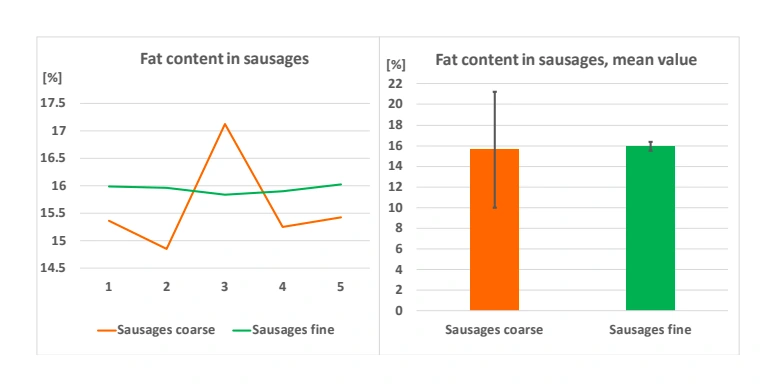
Sausages often contain large fatty particles. They need to be thoroughly homogenized to ensure reliable analysis results. If the few grams required for fat content analysis were picked randomly from the sample this would result in increased standard deviations of the analysis results.
400 g of sausages were cut manually into pieces of approximately 20 mm and then ground in the GM 300 in two steps. The first grinding cycle was carried out at a revolution speed of 4,000 min-1 using a knife with serrated blades. The sample was cut to pieces smaller than 5 mm in only 25 seconds. The serrated blades help to tear the fibrous meat. A part sample was taken directly for fat analysis. The remaining sample was pulverized under cryogenic conditions. For this purpose, the sample was mixed with dry ice snow (with a ratio of 1:2) after the first grinding step and the mixture was then filled into the grinding container of stainless steel. Using the full metal knife and a lid specifically designed for cryogenic grinding, the sample was pulverized at 4,000 min-1 for 3 x 20 seconds .
sausages
Both the coarse and the homogenized sample were analyzed for their fat content five times by microwave-induced drying with a Smart 6 (CEM GmbH, Germany) combined with NMR spectroscopy in an Oracle fat analyzer (CEM GmbH, Germany). For each measurement, 4 g sample were dried in 2.5 min and analyzed within 1 min. The fat content of the independent samples of the coarse sausage vary more than that of the finely ground samples. The fat content of the coarser fraction was measured in a range from 14.85% to 17.12% with a standard deviation (SD) of 0.88%. The SD was reduced more than 10-fold to 0.07% in the homogenized sample , with a fat content ranging from 15.84% to 16.02% (relative SD reduced from 5.63% to 0.45%).
Fat content in sausages, mean value
Fat content in sausages
3.2. NIR analysis of wheat samples (Twister)
NIR (Near Infrared Spectroscopy) is a common analytical method for the determination of protein content, moisture, fat and ash in one run. Therefore, it is used whenever high sample throughput and great flexibility are required. A much-discussed issue is the necessity of sample preparation. What are the advantages of sample preparation before NIR analysis? The penetration depth of NIR radiation is 1 mm max., so everything that lies beneath cannot be detected. That is not a problem if the sample is completely homogeneous, but if a sample consists of different layers, like grains or seeds, then only the layers down to 1 mm are analyzed and are consequently overrepresented in the measurement results. To demonstrate this effect, the different properties of ground and unground wheat samples were analyzed with NIR. The samples were analyzed 10 times, the spectrometer was refilled for every measurement. The samples were pulverized in the Twister at a revolution speed of 14,000 min-1. The results for wheat show a large discrepancy between ground and unground sample, especially regarding the ash and fiber content (Table 1). As explained above, only the surface of the unground wheat is analyzed resulting in an overrepresentation of the kernel shell. Only sample homogenization guarantees meaningful and reliable analysis results.
Different ash and fiber contents in ground and unground samples
| Sample / statistic | Ash [%] | Moisture [%] | Fiber [%] | Fat [%] | Protein [%] |
|---|---|---|---|---|---|
| Ground wheat: average | 2.80 | 9.68 | 1.10 | 1.17 | 9.02 |
| Ground wheat: standard deviation | 0.03 | 0.09 | 0.05 | 0.03 | 0.07 |
| Unground wheat: average | 0.10 | 9.80 | 6.90 | 1.38 | 8.46 |
| Unground wheat: standard deviation | 0.10 | 0.25 | 0.62 | 0.16 | 0.45 |
3.3. Detection of mycotoxins in nuts (SM 300 and ZM 200)
Some types of food show an increased risk of mycotoxin release due to fungal infestation, especially when food is stored too long and in an unsuitable way. Fungal infestation usually occurs in nests, so a random sample taken from the bulk must be sufficiently large to allow for the detection of contaminants. The first step is the preliminary size reduction of a representative amount of 1 – 2 kg per ton of nuts in the cutting mill SM 300 to particles < 3 mm by using the bottom sieve of 4 mm. It is important to use the 6-disc rotor, as the shells of the nuts are too hard for the cutting effect of the other rotors. The subsequent fine size reduction is ideally carried out with the ZM 200. For the processing of hazelnuts, the use of distance sieves is recommended. As mycotoxins are lipophilic, the grinding process should be as gentle as possible to avoid the release of fat from the sample. A fineness of 300 μm is sufficient for the subsequent extraction of the mycotoxins and for HPLC analysis.
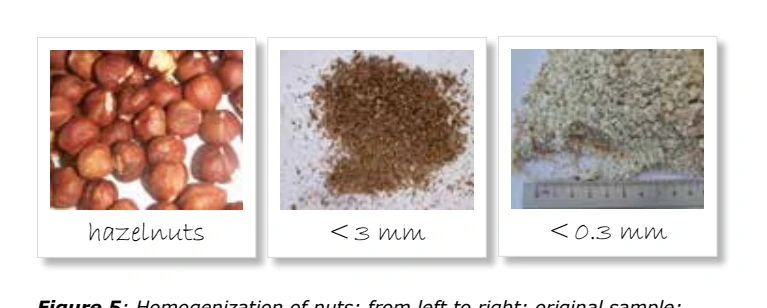
hazelnuts
3.4. Detection of polychlorinated biphenyls in fish (SM 300)
The homogenization of fish is a challenge; scales, skin and bones are fairly resistant to size reduction so that the sample still contains larger pieces after grinding in most mills (e. g. fresh fish in Knife Mills). A high fat content of the fish makes the process more difficult, as fatty particles stick together to form large lumps which block the mill and keep the sample inhomogeneous. Freeze drying of the fish and further milling in the SM 300 help to solve the problem. 125 g (4 fishes, pre-cut once) of carp or turbot were pulverized in the SM 300 at a revolution speed of 3,000 min-1, using a V-rotor which also cuts the scarp and fish bones. The use of a cyclone cools the sample. After 2 min of grinding with a 1 mm bottom sieve, the fish is ground to 1 mm particles without significant heat-built-up .
carp
3.5. Pyrrolizidine alkaloids in tea (ZM 200)
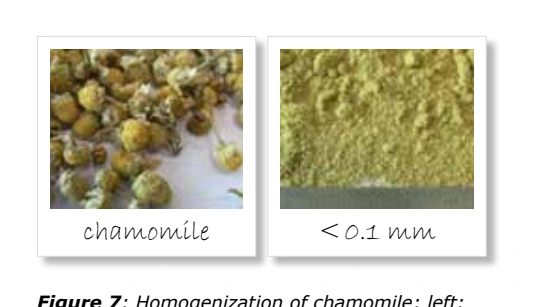
The group of pyrrolizidine alkaloids comprises 500 chemical compounds which are mostly found in composite flowers, borage family and leguminous plants. Dried chamomile flowers were processed with the following parameters: 25 g sample with a maximum particle size of 5 mm were pulverized at a revolution speed of 18,000 min-1 in the ZM 200 using a 0.2 mm ring sieve. After 2 min the complete sample was ground to a final fineness < 100 µm . The use of a cyclone ensures continuous material discharge and cooling of the sample. Thus, the characteristics of the heatsensitive pyrrolizidine alkaloids are preserved.
chamomile
3.6. Ginsenoide in ginseng (MM 400)
Ginseng has been known for many years in traditional Chinese medicine to have beneficial health effects such as boosting immune reaction and supporting the cardiovascular system. A bunch of chemical substances, like ginseng saponins, seems to be responsible for the beneficial effects. Small amounts of ginseng roots can be pulverized in the MM 400 provided they are smaller than 8 mm. Larger sample pieces must be cut first, for example by using a Cutting Mill with a parallel section rotor. 17 ml of pre-cut ginseng particles were pulverized in the MM 400 in a 50 ml stainless steel grinding jar. 15 grinding balls with 10 mm diameter were used. After 4 min at a frequency of 30 Hz, a final fineness < 100 µm was achieved .
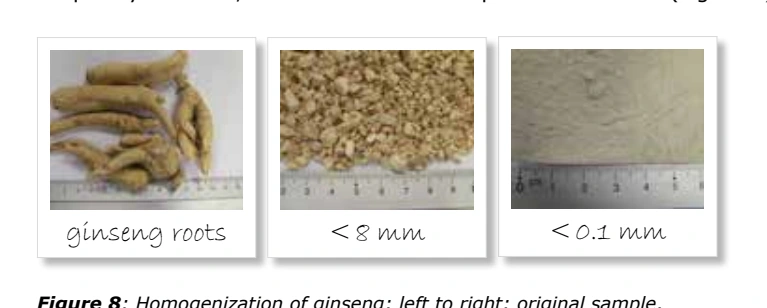
ginseng roots
3.7. Pulverizing large quantities of salt (SR 300)
Rock salt and sea salt not only consist of sodium chloride but may also contain other minerals and silicates, depending on the mining area and method. The element concentrations in salt are usually very low so that it is frequently necessary to process amounts in the kilogram range. In principle, a Cutting Mill could cope with large quantities but the wear would be much greater than in the SR 300, as the cutting bars of the Cutting Mill are not designed to process abrasive materials like salt. With the SR 300 charges of several kilograms can be pulverized easily. The distance rotor is used to reduce frictional heat. Thanks to a 5-liter collecting vessel, 5 kg of sample with a feed size up to 10 mm are pulverized in one run at a revolution speed of 10,000 min-1. The complete sample is pulverized to less than 200 µm in 6 minutes .
rock salt
3.8. Vitamin C analysis in hard candy (GM 200)
Confectionery occurs in very different textures: it can be hard, sticky, greasy, or moist and is frequently inhomogeneous. For HPLC analysis, which is used to detect the content of vitamin C e. g. in hard candy, a particle size distribution between 0.5 and 0.75 mm is ideal. A typical homogenization process in the GM 200 involves 100 g of hard candy which is first roughly ground for a few seconds in reverse mode with the blunt side of the knife. The following step involves operation in forward mode with intervals for another 15 seconds at a revolution speed of 4,000 min-1. Further pulverization to a size below 0.5 mm is achieved by grinding for 6 to 12 seconds at a revolution speed of 6,000 min-1 . This step-by-step procedure prevents the sample – which has a high sugar and starch syrup content - from sticking to the knife as is often the case in household mixers.
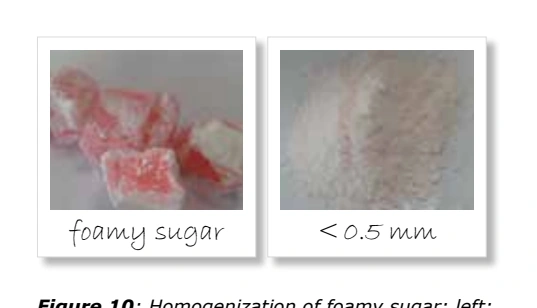
foamy sugar
3.9. Detection of GMO in soy beans (GM 200)
Polymerase chain reaction (PCR) is used to detect genetical modified organism (GMO) in food. Prior to PCR, the sample must be homogenized. Attention should be paid to sampling and obtaining a representative part-sample to ensure meaningful and sensitive GMO testing. From a 20 t bulk of soy beans, a laboratory sample of about 2.5 kg is extracted. For the detection of GMO, a smaller analysis sample, approx. 1000 g in case of corn or soy beans, is extracted from the laboratory sample and thoroughly homogenized in the GM 200. For PCR analysis, only 2 mg of sample material are required. The homogenization step ensures that these 2 mg are representative of the whole sample. Grainy food like soy beans is processed in a steel container at a revolution speed of 10,000 min-1. With batches of 4 x 250 g grind sizes below 0.5 mm are obtained within 30 seconds .
soy beans
3.10. Further applications: food homogenized at room temperatures
In the following, more application examples for homogenization of food samples at room temperature are given.
Application examples of food homogenized at room temperature
| Sample | Mill | Parameters and accessories | Size reduction | Remarks |
|---|---|---|---|---|
| 200 g lemons | Knife mill GRINDOMIX | 8000 min-1, 10 s; gravitiy lid with overflow channels | 80 mm (paste) | High water content and large particle size: milling only possible in a Knife Mill |
| 280 g lasagna | Knife mill GRINDOMIX | 10 s at 4000 min-1, 20 s at 8000 min-1 | 80 mm (paste) | Starting with short intervals helps to avoid material sticking on grinding container |
| 500 g bread | Knife mill GRINDOMIX | 1 min at 4000 min-1, knife with titaniumniob coated blades | 160 mm to 1.5 mm | Heavy metal determination: knife with titaniumniob coated blades was used |
| 100 g dried pear | Knife mill GRINDOMIX | 15 s at 4000 min-1, 15 s at 7000 min-1 | 50 mm to 1 mm | Homogenization of sticky material |
| 800 g soup | Knife mill GRINDOMIX | 30 s at 4000 min-1 with interval | 50 mm to paste | Double sealed lid for liquid samples, interval mode improves sample mixing |
| 5 eggs | Knife mill GRINDOMIX | 10 s at 10,000 min-1 | 70 mm to paste | Very fast homogenization |
| 100 g field beans | Ultra Centrifugal Mill ZM 200 | 12 tooth rotor, distance sieve 1 mm, 60 s, 18,000 min-1 | 15 mm to 0.5 mm | To avoid warming, the sample is filled into the mill slowly but continuously. The distance sieve reduces heat. |
| 150 g gelatine | Ultra Centrifugal Mill ZM 200 | 12 tooth rotor, distance sieve 1 mm and 0.35 mm, 45 and 120 s, 18,000 min-1, cyclone | 70 mm to 0.5 mm | Distance sieve to avoid warming, slow feeding required, cyclone helps to cool sample and improve sample discharge |
| 50 g green coffee | Ultra Centrifugal Mill ZM 200 | 12 tooth rotor, distance sieve 0.75 mm, 3 min, 18,000 min-1, cyclone | 15 mm to 0.75 mm | Distance sieve and cyclone reduce heat and fat release. Fat release may block sieves with small aperture sizes. |
| 150 g corncob | Ultra Centrifugal Mill ZM 200 | 1. Parallel section rotor, bottom sieve 4 mm, 1500 min-1; 20 s; 2. 12 tooth rotor, ring sieve 0.5 mm, 20 s, 18000 min-1 | 150 mm to 400 µm | Grinding in two steps as initial sample is too big for direct feeding into the ZM 200; required final fineness achieved efficiently in the ZM 200 |
| 50 g viola roots | Ultra Centrifugal Mill ZM 200 | 1. 6-disc rotor, bottom sieve 4 mm, 1500 min-1, 20 s; 2. 12 tooth rotor, ring sieve 0.5 mm, 15 s, 18000 min-1 | 100 mm to 200 µm | Sample is too hard for manual pre-crushing, fine grinding in the ZM 200 as second step yields very fine material |
| 5 kg tea | Cutting Mill SM 300 | V-rotor, 0.25 mm bottom sieve, 3000 min-1, 25 min | 6 cm to 200 µm | Less warming of the sample compared to the ZM 200, but same fineness & time |
| 10 gelatin blocks | Cutting Mill SM 300 | V-rotor, 6 mm bottom sieve, 3000 min-1, 10 s, cyclone | 80 mm to 6 mm | The cyclone is used to increase sample discharge (very light material) |
| 10 kg oats | Cutting Mill SM 300 | Parallel section rotor, 6 mm bottom sieve, 700 min-1, 60 s, cyclone | 6 mm to 3 mm | Reduction of speed increases required particles size, fine fraction is reduced |
| 50 g mushrooms | Cutting Mill SM 300 | Parallel section rotor, 6 mm bottom sieve, 1500 min-1, 10 s | 30 mm to 4 mm | Sample was ground piece by piece, high coarse particle content required |
| Sample | Mill | Parameters and accessories | Size reduction | Remarks |
|---|---|---|---|---|
| 2 L manioc | Rotor Beater Mill SR 300 | 0.25 mm 360° sieve, cyclone, feeder, 10,000 min-1, 11 min | 2 mm to 200 µm | Vibratory feeder for uniform feeding of large quantities |
| 20 kg roasted milk with sugar | Rotor Beater Mill SR 300 | 2 mm 360° sieve, cyclone and feeder, 30 l receptacle, 10,000 min-1, 38 min | 3 mm to 1 mm | Distance sieve reduces sticking of sample; 30 l receptacle required for large sample quantity |
| 2 kg herbs | Rotor Beater Mill SR 300 | 0.08 mm 360° sieve, cyclone, feeder, 30 l receptacle, 10,000 min-1, 80 min | 15 mm to 120 µm | Vibratory feeder for uniform feeding of large quantities; 80 min processing time for 2 kg |
| 30 g corn | Cyclone Mill TWISTER | 0.5 mm sieve, 14,000 min-1, 15 s | 10 mm to 0.3 mm | Quick and contamination-free grinding of nonfatty samples, high sample throughput |
| 100 g barley | Cyclone Mill TWISTER | 1 mm sieve, 14,000 min-1, 10 s | 10 mm to 1 mm | Quick and contamination-free grinding of nonfatty samples, high sample throughput |
| 50 g dry noodles | Cyclone Mill TWISTER | 2 mm sieve, 14,000 min-1, 20 s | 15 mm to 0.75 mm | Quick and contamination-free grinding of nonfatty samples, high sample throughput |
4. Special application: cryogenic grinding of food samples
Most sample materials can be ground to the required analytical fineness at room temperature. However, there are limits, for example when even a small temperature increase affects the sample in a negative way; or when the material is very elastic and will only be deformed. Moreover, food samples which are fatty or sticky may block the mill. Cryogenic grinding is the best way to pulverize food samples when they are sticky, fatty, semi-liquid samples (e. g. cheese, raisins, wine gum or marzipan) and simply clump together when ground at room temperature. In a cryogenic grinding process the samples don’t clump and are effectively homogenized. Under cryogenic conditions, the loss of volatile ingredients like alcohol can be limited or residues of softeners, which migrate from plastic wrappings into the food, are preserved. Such ingredients would escape when the sample is warmed during grinding. Furthermore, cold milling preserves the original structures of vitamins or proteins. Cryogenic grinding is carried out with grinding aids such as liquid nitrogen LN2 (-196 °C) or dry ice (solid CO2; -78 °C) which embrittle the sample and make it break more easily. In this section the special requirements for cryogenic grinding in different mills will be discussed. Basically, all rules and recommendations described for grinding at room temperature must be observed for cryogenic grinding, too.
4.1. Cryogenic grinding in the Mixer Mill MM 400 or in the CryoMill
It is important to fill the MM 400 jar first with the grinding ball(s) and with the sample and close it tightly before embrittling. Care must be taken that no LN2 is enclosed in the grinding jars because the evaporation of the LN2 would result in a considerable pressure increase inside the grinding jar. The closed grinding jars, and thus the sample, are embrittled in a LN2 bath for 2-3 minutes. Suitable grinding jars for cryogenic grinding are made of steel or PTFE; it is not recommended to use jars made of different materials. This is important, as two different materials may react differently to extreme temperatures of -196°C which may lead to damages of the jar. Single-use vials of 1.5, 2 and 5 ml are also available for cryogenic grinding. Due to the high-energy input and the resulting frictional heat, the grinding process should not take longer than 2 minutes to prevent the sample from warming up and to preserve its breaking properties. If longer grinding times are required, intermediate cooling of the closed grinding jars should interrupt these. The CryoMill offers the advantage of continuous cooling of the grinding jar with LN2. Thus, a consistent temperature of -196 °C is guaranteed even for long grinding times without the need for intermediate cooling breaks. Moreover, the user does not come into contact with LN2 at no point. An automatic pre-cooling function
CryoMill with 50 l dewar
ensures that the grinding process does not start before a temperature of -196 °C is reached and maintained. For heavy-metal-free grinding a zirconium oxide grinding jar can be used.
4.2. Cryogenic grinding in the ZM 200 or in a Cutting Mill
The ZM 200 and the Cutting Mills accept larger sample volumes than Mixer Mills. The sample is directly immersed into a container filled with LN2 before being continuously but slowly fed to the hopper of the mill with a steel spoon or tongues. When using dry ice as grinding aid, this needs to be mixed with the sample (1 part sample, 2 parts dry ice) and the entire mixture is then pulverized in the mill. Using a cassette in combination with a cyclone is recommended for cryogenic grinding in the ZM 200 to ensure that the evaporating cooling agent is completely discharged during the grinding process. The use of dry ice rather than LN2 should be preferred if the sample is already smaller than 1 mm, as the transfer of a dry ice-sample mixture to the mill is much easier than fishing the sample with a spoon from the LN2 bath. Also, if the sample has a low thermal capacity, dry ice is also preferable as it cools the sample during grinding. As the embrittled sample material is rather hard, the use of the 6-disc rotor for the Cutting Mills is recommended.
4.3. Cryogenic grinding in Knife Mills
Sticky and tough food samples such as cheese, raisins, wine gum or marzipan are perfectly homogenized in a knife mill. Even chocolate, which simply becomes paste-like when processed at room temperature, can be successfully pulverized cryogenically. The use of LN2 is not recommended as the knife mills are not designed for temperatures as low as -196 °C. The sample is mixed with dry ice in a ratio of 1:2; after a few minutes, it is thoroughly cooled and the grinding process starts. The dry ice keeps the sample cool all the time. Care should be taken not to use any plastic accessories when carrying out cryogenic grinding in the knife mills as these could be damaged during the process. Suitable accessories include a grinding container of stainless steel, a full metal knife and a lid with aperture to allow evaporation of the gaseous carbon dioxide.
Application examples of cryogenic grinding of food
| Sample | Mill | Parameters and accessories | Size reduction | Remarks |
|---|---|---|---|---|
| 10 jelly bears | Mixer Mill MM 400 | 1 min, 30 Hz | 20 mm to 300 µm | Grinding in 50 ml grinding jar + grinding ball 25 mm (both stainless steel) |
| 20 g chewing gum | Mixer Mill MM 400 | 30 s, 30 Hz | 15 mm to 500 µm | Grinding in 50 ml grinding jar + grinding ball 25 mm (both stainless steel) |
| 10 g liver | Mixer Mill MM 400 | 2 min, 30 Hz | 6 mm to 400 µm | Grinding in 50 ml grinding jar + grinding ball 25 mm (both stainless steel) |
| 3 g vanilla pod | Mixer Mill MM 400 | 20 s, 30 Hz | 10 mm to 500 µm | Grinding in 50 ml grinding jar + grinding ball 25 mm (both stainless steel) |
| 2 g cherries | CryoMill | 10 s, 30 Hz | 15 mm to 600 µm | Pre-cooling of approx. 5 min is typical. Grinding in 50 ml grinding jar + grinding ball 25 mm (both stainless steel) |
| 6 g licorice | CryoMill | 2 min, 30 Hz | 10 mm to 300 µm | Pre-cooling of approx. 5 min is typical. Grinding in 50 ml grinding jar + grinding ball 25 mm (both stainless steel) |
| 9 g coffee | CryoMill | 15 min, 30 Hz | 10 mm to 150 µm | Pre-cooling of approx. 5 min is typical. Grinding in 50 ml grinding jar + grinding ball 25 mm (both stainless steel) |
| 5 g cheese | CryoMill | 2 min, 30 Hz | 8 mm to 300 µm | Pre-cooling of approx. 5 min is typical. Grinding in 50 ml grinding jar + grinding ball 25 mm (both stainless steel) |
| 1 praline | CryoMill | 2 min, 30 Hz | 10 mm to 400 µm | Pre-cooling of approx. 5 min is typical. Grinding in 50 ml grinding jar + grinding ball 25 mm (both stainless steel) |
| Sample | Mill | Parameters and accessories | Size reduction | Remarks |
|---|---|---|---|---|
| 500 g wine gum | Knife mill GRINDOMIX | 40 s at 2000 min- 1 reverse; 20 s at 4000 min-1 forward | 20 mm to 0.8 mm | Grinding container stainless steel, full metal knife, cryo lid with aperture; dry ice. |
| 300 g block of marzipan | Knife mill GRINDOMIX | 20 s at 2000 min- 1 reverse; 20 s at 4000 min-1 forward | 40 mm to 800 µm | Grinding container stainless steel, full metal knife, cryo lid with aperture; dry ice. |
| 400 g pure bacon | Knife mill GRINDOMIX | 45 s at 2000 min- 1 reverse; 30 s at 4000 min-1 forward | 30 mm to 1 mm | Grinding container stainless steel, full metal knife, cryo lid with aperture; dry ice. |
| 800 g raisins | Knife mill GRINDOMIX | 45 s at 2000 min-1 reverse | 15 mm to 0.5 mm | Grinding container stainless steel, full metal knife, cryo lid with aperture; dry ice. |
| 100 g cereals | Ultra Centrifugal Mill ZM 200 | 12 tooth rotor, ring sieve 0.5 mm, 3 min, 18,000 min-1 | 8 mm to 250 µm | Use of cyclone and LN 2 |
| 100 g dried apples | Ultra Centrifugal Mill ZM 200 | 12 tooth rotor, ring sieve 0.5 mm, 1 min, 18,000 min-1 | 5 mm to 250 µm | Use of cyclone and dry ice. |
| 15 g toffee candy | Ultra Centrifugal Mill ZM 200 | 12 tooth rotor, ring sieve 2 mm and 0.5 mm, 1 min, 18,000 min-1 | 10 mm to 500 µm | Use of cyclone and dry ice. |
| 1 kg trout | Cutting Mill SM 300 | 6-disc rotor, 20 mm bottom sieve, 700 min-1, 60 s | 200 mm to 20 mm | Use of cyclone and LN; reduced speed leads to 2 less heat built-up |
| 500 g lump of cocoa butter | Cutting Mill SM 300 | 6-disc rotor, 6 mm bottom sieve, 700 min-1, 90 s | 100 mm to 6 mm | Use of cyclone and LN; reduced speed leads to 2 less heat built-up |
| 20 kg sweet potatoes | Cutting Mill SM 300 | 6-disc rotor, 20 mm bottom sieve, 1500 min-1, 15 min | 100 mm to 20 mm | Use of cyclone and dry ice |
Conclusion
In this discussion it was demonstrated by a wealth of application examples that sample preparation prior to any food analysis is an essential step of the quality control process as only fully homogenized samples provide reliable and reproducible analysis results. Due to the wide range of laboratory mills and accessories available it is important to consider all aspects of the sample preparation process before selecting a suitable device. Only then will this important step prior to sample analysis be carried out in the most efficient and reliable way. Both the knowledge of the sample characteristics and the available types of mills and accessories enables the user to process his samples with a minimum of time and effort but with best possible results.
Plan the configuration for your material.
Map the preparation from the laboratory sample to the final test amount. Choose a mechanism that addresses the complete matrix, then evaluate the uniformity of prepared portions. Reduction in visible particle size is helpful only when the resulting material remains appropriate for the planned measurement.
| Consideration | Information to provide |
|---|---|
| Food mixture | Ingredients and physical contrasts |
| Quantity reduction | Stages from sample to portion |
| Evaluation | Uniformity and analytical compatibility |
How should the application examples be used?
The results describe the materials and configurations discussed here. Confirm equipment options, contact materials and operating conditions for your own sample before adopting a method. A demonstrated endpoint does not guarantee the same outcome for a different material.
Discuss material testing with Glen Mills or request further information or a quote.
Explore the equipment discussed
- RETSCH SM 300 Cutting Mill
- RETSCH MM 400 Mixer Mill
- RETSCH SR 300 Rotor Beater Mill
- RETSCH CryoMill Cryogenic Mixer Mill