
Why not maximize grinding energy before every XRD test?
The analysis depends on structural information that preparation can affect. Select and evaluate the method around the diffraction objective, not fineness alone.
sample
With resources becoming increasingly scarce, innovative technologies allowing for sustainable use of raw materials are much sought after. The mineralogist Dr. Robert Moeckel is researching mineral and metallic raw materials at the Helmholtz-Institute for Technology of Resources in Freiburg, Germany which is part of the Helmholtz-Center Dresden- Rossendorf.
Dr. Moeckel´s research projects involve pulverization and homogenization of mineral samples prior to x-ray diffraction (XRD) analysis. This analytical method uses the fact that the wavelength of x-rays is similar to the atomic spacing in a crystal. The x-rays are diffracted at the atomic structures in specific angles (Bragg´s Law) which provide information on the atomic spaces in the crystals. XRD allows to determine the order of different atoms towards each other which makes it possible to distinguish, for example, between coal and diamond which both consist of pure carbon. The main difference lies in their crystal lattice. The samples are pulverized to homogeneous powder before XRD analysis, and the individual crystalline phases are identified with the help of a data base. Quantification is done, for example, by Rietveld-Analysis which matches theoretical diffraction diagrams to the measured data. In recent years, XRD has been more widely used for research and development and quality control in industries like construction materials, minerals, cement or mining.
Sample homogenization in the XRD-Mill McCrone
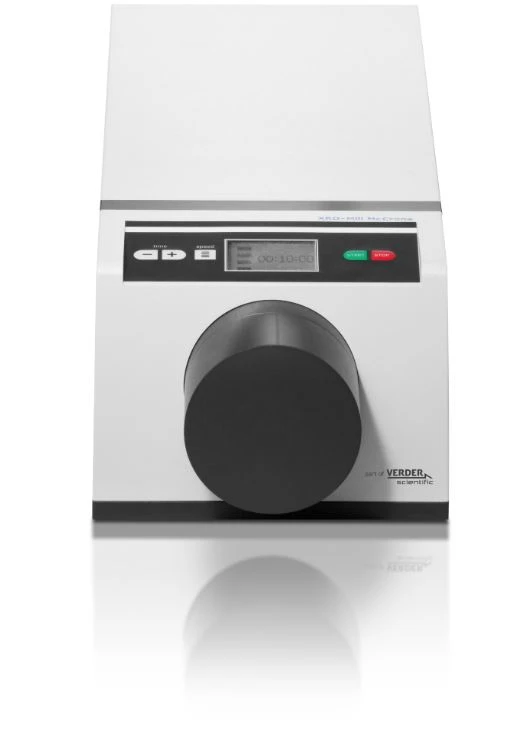
RETSCH´s XRD-Mill McCrone was specifically designed for X-ray diffraction and is mainly used for applications related to mineralogy, cement industry, chemistry, geology, or material sciences, both in R&D and quality control. The unique grinding principle uses cylindric grinding elements and homogenizes the sample gently with friction while the crystal structure is preserved, an important premise for obtaining reliable X-ray diffractograms. The McCrone Micronizing Mill, which is the previous version of the XRD-Mill McCrone, is mentioned in many publications [e. g. 1-4]. The 125-ml polypropylene grinding jar is filled with 48 identical grinding elements, made of agate, zirconium oxide or corundum. After 3 to 30 minutes of grinding
volumes of typically 2 to 4 ml, the sample is perfectly homogeneous. Dr. Moeckel tested different types of mills for sample preparation to XRD analysis. He used a mixture of fluorite, barite, and quartz in a known ratio for the tests. The best results were achieved with the XRD-Mill McCrone (Table 1).
Testing sample mixtures for comparison of mills
The XRD-Mill McCrone is characterized by a gentle grinding mechanism with low energy input based on friction. In contrast, the Planetary Ball Mill PM 100 or the Mixer Mill MM 400 (both RETSCH mills) work with friction and impact, thus generating a higher energy input. The particle size distribution of samples ground in the XRD- Mill McCrone is very narrow and their crystal lattice structure remains intact which is ideal for x-ray diffraction. A mixture of minerals with 50 % fluorite, 43
XRD-Mill McCrone oo RETSCH
% barite and 7 % quartz (w/w) with particle sizes suitable for the XRD-Mill McCrone (barite and quartz: 100 - 200 µm, fluorite < 400 µm) was ground to a fineness < 10 µm with the XRD-Mill McCrone, the Planetary Ball Mill PM 100 and the Mixer Mill MM 400. The samples were then analyzed (Rietveld analysis) with the x-ray diffractometer PANalytical Empyrean (Co-Kα-rays; Detector: PIXcel3D-Medipix3 1x1, 35kV/35mA, angle 5-80°2θ, increment 0.0131°2θ, total time of measurement 2.5h). Due to the high contrast difference for the applied x- rays between barite with high absorption and quartz or fluorite with low absorption, the particle size and particle size distribution have great influence on the results. Consequently, ingredients with higher absorption are underrated if the particle size is too big. Moreover, some sample materials react with partial glass formation on the particle surface if too much energy is applied during grinding. Hence, those parts cannot be detected by x-ray diffraction and are consequently underrated (like quartz in this case). As shown in figure 2, the height and the width of the peaks of those samples vary greatly due to the described physical effects. On the one hand, the particle sizes are too large for analysis by x-ray diffraction; on the other hand, glass formation has started on the surfaces (Table 1). The analysis results of the samples ground in different mills under different conditions show variations as well.
Results of grinding tests with a sample 50 % fluorite, 43 % barite
and 7 % quartz (w/w)
| Mill | Sample quantity | Configuration | Fineness d90 | Fluorite [wt.%] | Barite [wt.%] | Quartz [wt.%] |
|---|---|---|---|---|---|---|
| XRD-Mill McCrone | 2.5 mL + 10 mL ethanol | 48 zirconium oxide grinding elements; 12 min; step 4 | 9.51 µm | 50.5 ±0.4 | 42.7 ±0.3 | 6.8 ±0.2 |
| MM 400 | 15 g + 6 mL ethanol | 25 mL zirconium oxide jar; 40 g of 2 mm zirconium oxide balls; 30 min; 30 Hz | 4.37 µm | 51.7 ±0.3 | 40.4 ±0.3 | 7.9 ±0.2 |
| MM 400 | 10 g + 4 mL ethanol | 25 mL zirconium oxide jar; nine 10 mm zirconium oxide balls; 30 min; 30 Hz | 11.42 µm | 52.4 ±0.3 | 42.5 ±0.4 | 5.1 ±0.2 |
| PM 100 | 28 g + 9 mL ethanol | 50 mL zirconium oxide jar; 110 g of 2 mm zirconium oxide balls; 5 min; 650 rpm | 4.47 µm | 49.0 ±0.3 | 45.8 ±0.3 | 5.2 ±0.1 |
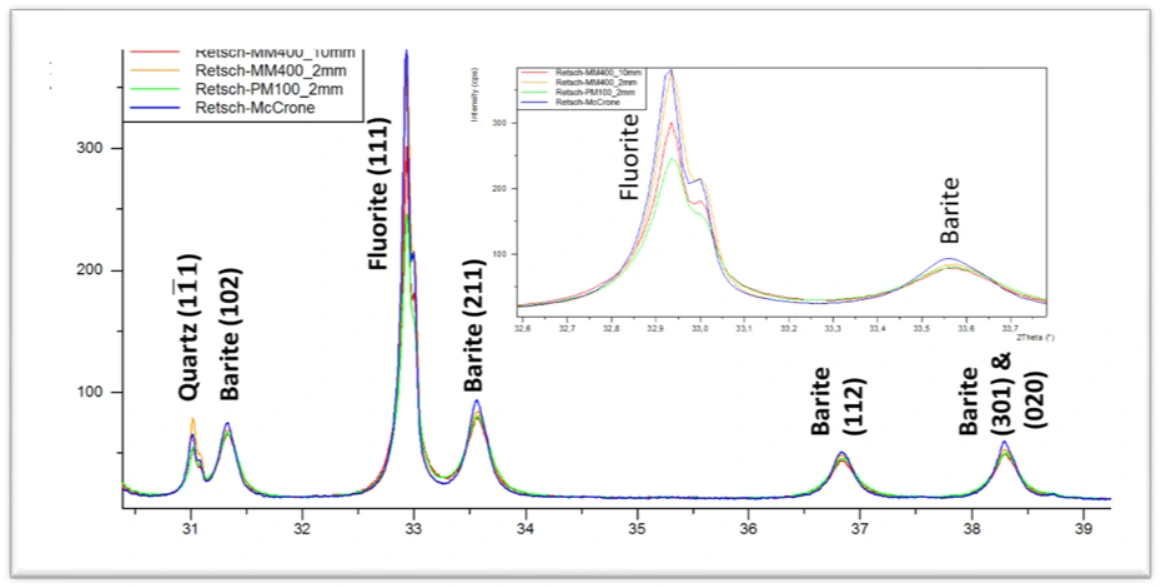
Partial result of the diffraction analysis of the test mixture. The height and the width of the peaks differ clearly, depending on the previous sample preparation. Also, the integral intensities, which are used for quantification, vary.
Conclusion
The gentle homogenization of samples which are analyzed by XRD, is an important prerequisite to ensure accurate results. RETSCH’s XRD-Mill McCrone has been used for many decades for sample preparation to x-ray diffraction analysis. The unique grinding principle helps to preserve the crystal lattice of the sample much better than that of other mills, for example ball mills.
Authors Dr. rer. nat. Robert Moeckel
Helmholtz Institut Freiberg fuer Ressourcentechnologie Helmholtz-Zentrum Dresden-Rossendorf Chemnitzer Str. 40 | 09599 Freiberg, Germany Tel.: +49 (0) 351 260 4444
Plan the configuration for your material.
Distinguish the goal of reducing particle effects from mechanically changing the crystalline material. Define the sample, media and preparation conditions with the diffraction method in mind. Evaluate prepared reference and unknown materials consistently so that preparation does not obscure the phase information of interest.
| Consideration | Information to provide |
|---|---|
| Diffraction goal | Phases or structural information |
| Preparation setup | Media and sample handling |
| Comparison | Consistent reference and unknown treatment |
How should the application examples be used?
The results describe the materials and configurations discussed here. Confirm equipment options, contact materials and operating conditions for your own sample before adopting a method. A demonstrated endpoint does not guarantee the same outcome for a different material.
Discuss material testing with Glen Mills or request further information or a quote.