
Should the larger preparation always replace the smaller one?
Not solely on capacity. Assess whether its prepared portion and analytical results meet the method's needs for the material being tested.
X-Ray fluorescence is one of the most versatile methods to determine element concentrations in a solid sample. The material is exposed to high-energy X-rays that cause each element to emit its own characteristic fluorescent X-ray. The analysis of the results is based on comparisons to standard samples with given chemical composition. Sample preparation has become an increasingly important issue because the detection limit of XRF analyzers has shifted to trace level in the past few years. Moreover, accurate analysis of major light elements is only possible with finely ground, homogeneous samples.
Robust and reliable instruments with sophisticated software deliver precise and reproducible results in a short time. As instrument errors are negligible, the accuracy of results depends on calibration and on the preparation of both standard and analysis sample. Knowledge of the particle size is crucial as it can strongly influence the results. Only if the sample is both representative and homogeneous will potential sources of error be successfully eliminated.
Sources of error The overall procedure of X-ray fluorescence analysis may be divided into three different stages: sampling, sample preparation and the actual spectrometric analysis itself. Of these three, it is usually the mechanical sample preparation that takes up most of the time and will therefore be discussed in this discussion. For XRF analysis, the laboratory sample consisting of a few grams often has to represent a total amount of several tons. Producing a homogeneous and representative pulverized sample from a bulk means that a fair amount of work is involved in the way of crushing and sample division, and it is here that accidental errors and errors attributable to system inadequacies may be expected to occur most frequently. As XRF measurements are not difficult to execute, the importance of reliable sample preparation is often neglected. This can lead to insufficient reproducibility and thus to incorrect analysis results. Beside the quality of the spectrometer, the quality of the sample preparation process has a decisive influence on the precision and reproducibility of the analysis results.
Required fineness and homogeneity The deeper the X-ray enters the sample, the more it is absorbed by it so that above a defined thickness the X-ray light can no longer penetrate the sample. This also applies to the fluorescent light which leaves the sample and is then detected. The lowest sample layer from which detectable fluorescent X-rays are emitted is called saturation depth. It depends on the intensity of the X-rays, the type of detected atoms and the density of the sample’s surroundings (the matrix). If different elements are analyzed in the same matrix, the saturation depth increases with increasing atomic number of the element. Conversely, this means that elements with small atomic numbers are more difficult to detect. This also affects the reproducibility of the analysis. That is the reason why a fineness of at least 80 microns is required, e.g. for dolomite, to ensure reliable results when analyzing elements lighter than potassium. Another factor influencing the quality of analysis results is the degree of homogenization, particularly when dealing with coated or inhomogeneous samples. Only if the sample is thoroughly homogenized, can it be assured that also the inner core of e. g. a coated particle has been measured.
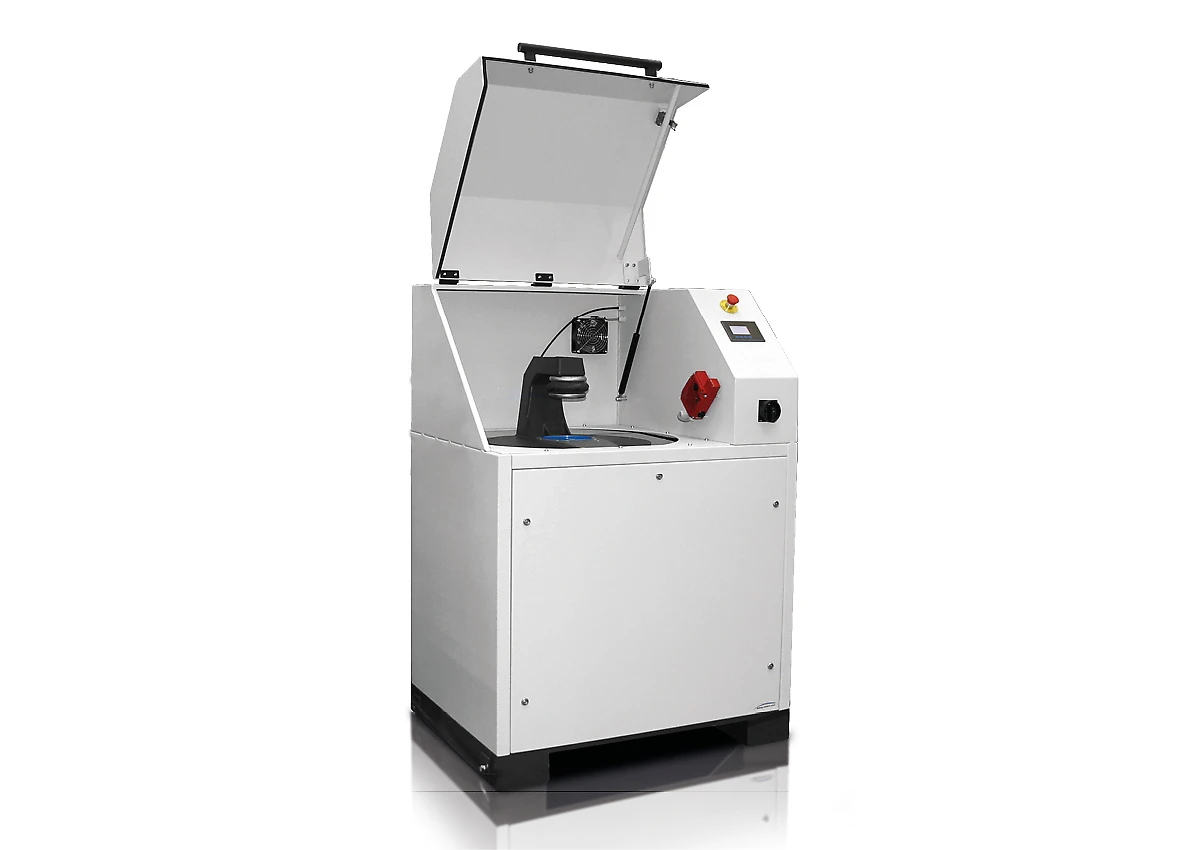
Vibratory Disc Mills Vibratory Disc Mills such as the RS 200 or RS 300 XL from RETSCH are the mills of choice for processing hard and brittle samples prior to XRF analyses. Due to centrifugal forces the grinding ring and disc act with high impact and friction on the sample, allowing both mills to produce a final fineness down to 20 µm, depending on the sample material. With this size reduction principle, the required analytical fineness is usually achieved within seconds. This is advantageous for quality control processes where the analysis results are needed quickly, e.g. for a product approval.
- RS 200: The grinding sets up to 250 ml accept maximum initial particle sizes of 15 mm and perform circular oscillations with 700 to 1500 rpm which lead to extremely quick particle crushing. For this model the grinding sets are available in different materials such as hardened steel, steel 1.1740 for heavy metal-free milling, zirconium oxide, tungsten carbide and agate allowing for neutral-to-analysis grinding processes. The mill recognizes tungsten carbide or agate grinding sets and automatically limits the maximum speed to 1200 rpm or 700 rpm respectively to reduce wear. Operating the mill is very ergonomic with carry handles for the grinding sets, a quick action clamping system and a new rail into which the sets easily slide into the correct position.
Vibratory Disc Mill RS 200
Vibratory Disc Mill RS 300 XL with AutoLifter
- RS 300 XL: This mill is used for the same applications as the RS 200 but accepts initial particle sizes of up to 20 mm. A maximum of 4 samples may be processed simultaneously, depending on the particular equipment. The high degree of homogenization is achieved by the highly effective 3-D grinding principle of this mill. The RS 300 XL accepts grinding set weights of up to 30 kg and sample volumes up to 2000 ml. The closed grinding system guarantees complete processing of the sample. The auto-reverse function helps to decrease caking of the sample; a selection of grinding set materials is available for neutralto-analysis milling. The pneumatic grinding-jar clamping and the optional AutoLifter for heavy grinding sets ensure convenient and safe handling.
Degree of homogenization and reproducibility The degree of homogenization of both Vibratory Disc Mills was compared by grinding a mixture of two different materials in the RS 200 and the RS 300 XL. In the RS 300 XL, 950 g quartz and 50 g tantalum pentoxide (Ta2O5) were milled for 4 min at 912 rpm in a 2000 ml grinding set of hardened steel. Samples were then taken from different locations in the grinding jar, one at 120°, one at 240° and one at 360° with different depths (surface, center and bottom). The same sampling was done after grinding 118.75 g quartz and 6.25 g Ta2O5 for 1 min at 1500 rpm in a 250 ml grinding set of hardened steel in the RS 200. The achieved fineness of D97 = 100 µm was identical in both the RS 300 XL and the RS 200. The pulverized samples were then mixed with Licowax® and pressed in 40 mm aluminum cups with the Pellet Press PP 40. The settings were 20 t pressure and 20 secs for increasing, holding and releasing the pressure respectively.
Analysis The analysis was carried out with a SPECTRO XEPOS ED-XRF spectrometer for multi-elemental analysis of major, minor, and trace element concentrations. The device allows for analysis of 25 samples in one step so that elements ranging from sodium to uranium can be measured rapidly. The SPECTRO XEPOS P delivers up to three different excitation modes, consisting of an adaptive direct excitation system with optimized filters, a HAPG polarizer and a bandpass filter. For the detection of fluorescence X-rays a high-resolution large area silicon drift detector with Peltier cooling is used. The used measurement parameters, which are displayed in Table 1, can be (de)selected and modified according to the expected accuracy and required elements of interest.
| Element range | kV | Mode | Measurement time | Atmosphere |
|---|---|---|---|---|
| Na – Cl | 22.5 kV | Polarization | 150 s | Helium |
| K – Mn, Pr – Sm | 22.5 kV | Co-band pass filter | 150 s | Helium |
| Fe – Nb, Yb – U | 45.0 kV | Direct excitation | 150 s | Air |
| Mo – Ce | 50.0 kV | Direct excitation | 150 s | Air |
Measurement parameters of the SPECTRO XEPOS P
The pellets were analyzed using the Spectro Xepos P spectrometer. The main focus was on the concentration of Tantalum in the pellets taken from the different locations in the grinding jar. To represent the original quartz-tantalum mixture each pellet should contain 50 mg Ta2O5 per g or 41 mg Ta per g. All samples showed values very close to this calculated value. Very good homogeneity was observed, all samples showed comparable negligible variations of the tantalum content, independent of the location of sampling or the mill used (table 2). The relative standard deviation with a maximum of ±0.54 mg/g was very low and the overlay spectra of all measurements showed very good matching
| Sampling position | RS 200 / grind 1 [mg/g] | RS 200 / grind 2 [mg/g] | RS 300 XL / grind 1 [mg/g] | RS 300 XL / grind 2 [mg/g] |
|---|---|---|---|---|
| Surface 120° | 41.15 | 41.23 | 41.79 | 41.19 |
| Surface 240° | 40.39 | 41.49 | 41.43 | 40.70 |
| Surface 360° | 40.79 | 40.41 | 41.12 | 41.43 |
| Center 120° | 41.09 | 40.19 | 40.72 | 41.41 |
| Center 240° | 41.24 | 40.46 | 40.59 | 41.03 |
| Center 360° | 40.38 | 41.15 | 41.47 | 41.49 |
| Bottom 120° | 41.61 | 40.29 | 40.93 | 40.64 |
| Bottom 240° | 40.90 | 40.34 | 40.05 | 41.10 |
| Bottom 360° | 41.15 | 40.71 | 40.65 | 41.22 |
| Mean value | 40.96 | 40.69 | 40.97 | 41.13 |
| Standard deviation | 0.40 | 0.47 | 0.54 | 0.31 |
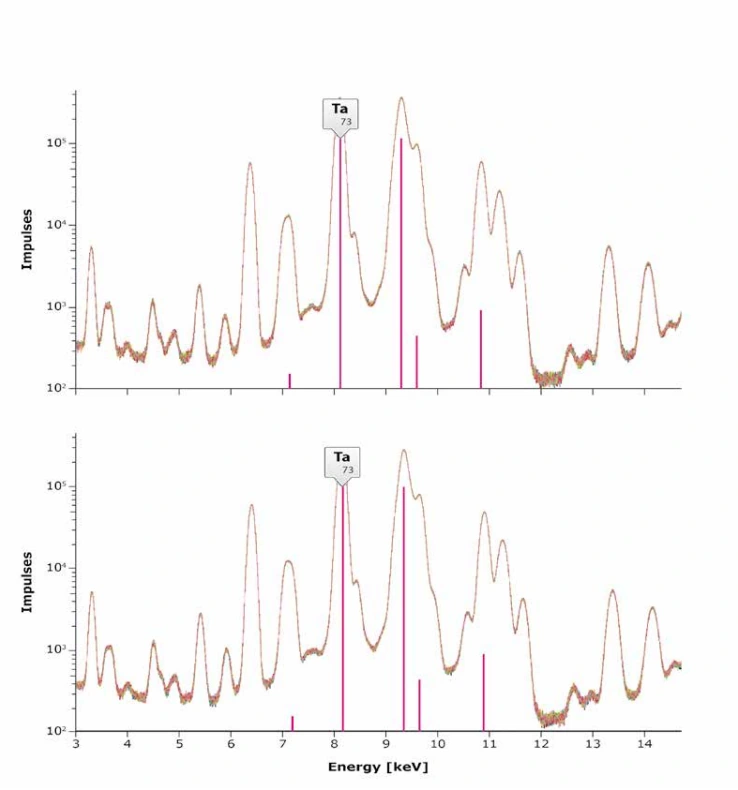
Measurement of tantalum after different test grindings
Overlay spectra of all samples derived from milling in RS 200 (above) and RS 300 XL (below) with Ta L alpha and Ta L beta lines (in red) at the positions 7.177; 8.133; 9.337; 9.646 and 10.888.
Conclusion
XRF is a powerful technique but one that requires a fully representative sample with suitable particle sizes. The sample preparation process should neither change the characteristics of the material nor add unwanted trace elements. RETSCH Vibratory Disc Mills allow users to produce precise, reproducible and contaminationfree samples for XRF with a minimum or time and effort. Both mills produce completely homogeneous samples, therefore, the standard deviations resulting from sampling at different locations in the grinding jar are negligible.
Plan the configuration for your material.
A larger preparation volume is not automatically equivalent to a smaller one. Compare the material, batch loading, grinding set and analytical endpoint under documented conditions. For XRF work, preparation of reference and unknown materials should be considered together so that handling differences do not obscure the comparison.
| Consideration | Information to provide |
|---|---|
| Sample loading | Mass and preparation volume |
| Tool configuration | Grinding set and operating conditions |
| Comparison | Fineness and analytical repeatability |
How should the application examples be used?
The results describe the materials and configurations discussed here. Confirm equipment options, contact materials and operating conditions for your own sample before adopting a method. A demonstrated endpoint does not guarantee the same outcome for a different material.
Discuss material testing with Glen Mills or request further information or a quote.