

Does smaller particle size prove better drug performance?
No. A preparation result needs the appropriate formulation and analytical evaluation. Particle size is one variable, not proof of bioavailability or clinical effectiveness.
The discovery of new drugs (drug discovery) is a complex process that ranges from basic research to preclinical testing and clinical trials. In each of these phases, you benefit from precise and reproducible sample preparation, which has a significant impact on the success of your research. With RETSCH customized solutions, you can specifically increase the efficiency and quality of your processes – from the initial sample to the market-ready formulation.
Targeted particle size control – Maximize bioavailability and efficacy
With Retsch mills, you can grind active pharmaceutical ingredients (APIs) and excipients to exactly the desired particle size. This allows to optimize bioavailability, improve solubility, and ensure even distribution of the medication in the body. Mixing is just as reliable: create the perfect basis for tablets, capsules, or solutions.
With the new sieving machines from Retsch, you can now perform particle size analyses even more easily and precisely. This allows you to determine the finest particle distributions and meet even the most stringent regulatory requirements, such as tight specifications for clinical trials or approval procedures.
State-of-the-art methods for your drug development
With Retsch equipment, you can open up new fields of research, for example:: | Mechanochemistry and co-crystal screening: Develop new forms of active ingredients without solvents, increase solubility, and precisely control reaction pathways through temperature control. Nanotechnology: Create highly effective substances with optimized cell penetration and benefit from precise control of particle size. Homogenization and cell disruption: Efficiently extract DNA, RNA, and proteins from tissue samples, essential for the development of biopharmaceuticals and vaccines.
Mechanochemistry and Co-Cristall-Screening – Practical Solutions for your Research
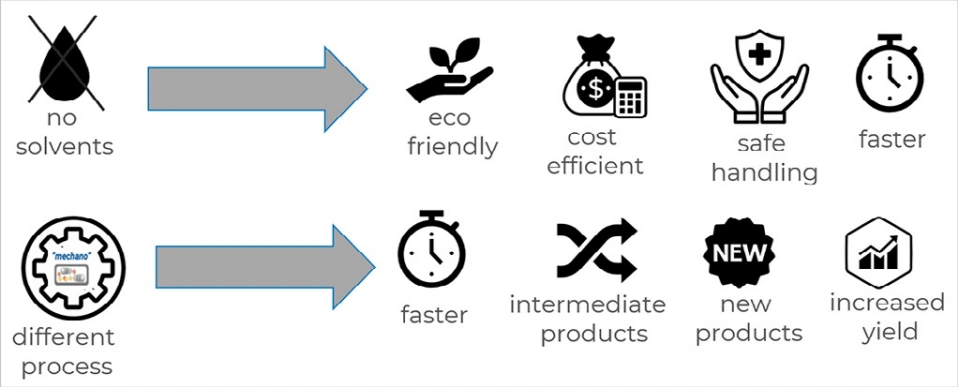
Generate mechanochemical reactions with Retsch ball mills, to make your research environmentally friendly and time-saving. Achieve faster results, save resources, and control reaction pathways in a targeted manner via temperature. For example, metastable intermediates in mechanochemical reactions could be stabilized and recovered when temperatures of approx. -5 °C were maintained in the MM 500 control.
Co-crystal screening offers maximum efficiency: with a special adapter, screen up to 64 samples simultaneously in the PM 400 planetary ball mill – this process can also be carried out with the PM 100 and PM 300. Co-crystals can also be reliably produced in mixer mills such as the MM 400. In one study, theophylline and benzamide were processed into co-crystals in a 1:1 ratio in 2 ml steel tubes with 6 mm steel balls at 30 Hz for 60 minutes. The X-ray powder diffraction patterns showed precise agreement with the reference pattern – you obtain your target product reliably and reproducibly.
Nano-grinding and mixing – precision and flexibility for your formulations
Produce nanoparticles < 100 nm and benefit from a narrow particle size distribution for innovative drug forms with high-performance ball mills such as the Emax, the PM series, or the MM 500 nano/control. An example: 12 g API (15 µm particles) were ground with 26 ml heptane and 110 g 0.5 mm zirconium oxide grinding balls in the Emax at 2000 rpm for 2.5 hours. The result: a very narrow particle size distribution with a D90 value of 80 nm. The integrated water cooling and optional chillers protect temperature-sensitive samples, allowing to work continuously without unnecessary grinding breaks.
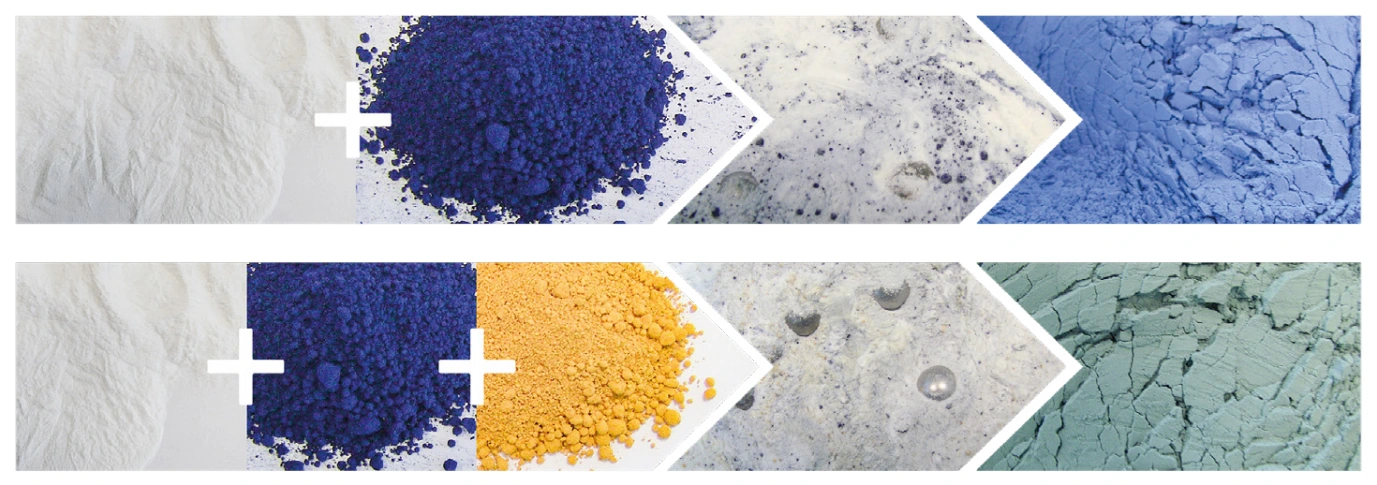
Mixing active ingredients with excipients is also efficient: In the PM 400, 196 g of starch and 4 g of pigment were perfectly mixed in a 500 ml grinding jar with 200 grinding balls (10 mm) in just 5 minutes at 200 rpm – without any particle size reduction.
Efficient cell disruption and tissue homogenization – your basis for biopharmaceuticals
With Retsch mills, you can release DNA, RNA, and proteins directly from your samples - efficiently, reproducibly, and without cross-contamination. The bead beating method allows you to quickly break down a wide variety of cell types in parallel: from bacteria and yeast to fungi and algae. You can work flexibly on a small scale with 2 ml Safe-lock reaction vessels or on a larger scale with 50 ml conical centrifuge tubes. With the MM 400 and MM 500 vario, you can also homogenize tissue samples such as liver or lung.
For temperature-sensitive samples, use the CryoMill: cooling with liquid nitrogen to -196°C optimally preserves the integrity of your biomolecules. With the MM 500 control, you can process up to 2 x 20 ml of cell suspension cryogenically (temperature range from 0 °C to -100 °C) or cooled, e.g., at 10 °C.
Innovation in sieving – Reliable particle size analysis and GMP conform
With the AS 200 jet pharma air jet sieving machine, you can perform particle size analyses precisely, automatically, and even according to GMP. It combines sieving, weighing, and evaluation in a single device and offers the benefits of integrated wizards, audit trails, and e-signatures. Your results are fully documented and can be exported directly to LIMS.
Conclusion – Your advantage in pharmaceutical active ingredient research with Retsch
With Retsch technologies, you can increase the efficiency and reproducibility of your processes - from sample preparation to particle size analysis. You can integrate the latest methods directly into your research, benefit from practical solutions, and ensure reproducible results. With Retsch as your partner, you can achieve your drug development goals faster, more precisely, and more reliably.
Reaktionsschema und Durchführung der Experimente: Dominik Al-Sabbagh, Chemielabortechniker, Abteilung 6.3 – Strukturanalyse, Bundesanstalt für Materialforschung und -prüfung (BAM), Berlin.
Plan the configuration for your material.
For active ingredients and excipients, distinguish reducing particle size from forming a new solid phase. Screening many small preparations and preparing a larger analytical sample can require different vessels and operating conditions. Record both the physical preparation and the subsequent test rather than treating mill settings alone as a formulation specification.
| Consideration | Information to provide |
|---|---|
| Development stage | Screening, formulation or quality control |
| Material quantity | Available mass and permitted losses |
| Evaluation | Particle size, solid form or analytical endpoint |
How should the application examples be used?
The results describe the materials and configurations discussed here. Confirm equipment options, contact materials and operating conditions for your own sample before adopting a method. A demonstrated endpoint does not guarantee the same outcome for a different material.
Discuss material testing with Glen Mills or request further information or a quote.
Explore the equipment discussed
- RETSCH Emax High Energy Ball Mill
- RETSCH PM 400 Planetary Ball Mill
- RETSCH MM 400 Mixer Mill
- RETSCH MM 500 control Mixer Mill