

Does a laboratory mill establish pharmaceutical compliance?
No. Compliance concerns the complete quality system and method. Equipment selection is one part of that assessment, not a substitute for it.
In pharmaceutical research and production, precision, reproducibility, and regulatory compliance are crucial to your success. Precise control of particle size has a significant impact on drug distribution, tableting, and quality assurance. With advanced laboratory solutions from Retsch, you can enable your team to confidently master these challenges and maintain the highest level of product quality.
All-in-one solutions for maximum efficiency
The AS 200 jet pro and AS 200 jet pharma air jet sieving machines from Retsch combine sieving, weighing, and evaluation in one compact device. You benefit from an integrated, highprecision balance, intuitive software operation, and intelligent assistants such as the Weighing Assistant or the Sieve-Check barcode verification. This not only makes your laboratory processes faster and safer, but also more traceable – a clear advantage for GMP-conform procedures.
Grinding: Efficient sample preparation and quality control
Retsch mills are used in various pharmaceutical applications and offer decisive competitive advantages: Research & Development: Achieve the desired particle size distributions of active ingredients and excipients to optimize the bioavailability and efficacy of your preparations. Temperaturecontrolled grinding processes also enable the gentle processing of sensitive substances.
Formulation development: Mix APIs and excipients reliably and homogeneously, ensure the consistency and stability of dosage forms, and efficiently discover new formulations through effective co-crystal screening with mixer mills or planetary ball mills.
1. Sieving: Precise sieving for maximum product safety
With Retsch air jet sieving machines, you can control the finest sample material directly in the device. You benefit from an efficient and safe workflow: weighing, sieving, and evaluation are carried out in a single step, sample losses are avoided, and sources of error are eliminated. Your laboratory staff works more productively and achieves consistently reliable results.
The intuitive user interface, internal PC, and calibratable scale (reading accuracy 0.01 g) make the AS 200 jet pro a stand-alone particle size measuring device. It saves working time, and the software guides step by step through individual or standardized methods. All results can be saved directly or exported to LIMS.
The AS 200 jet pharma also meets comprehensive GMP requirements: user administration, password management, audit trail, and e-signature ensure security and traceability. Individual access rights enable flexible team structures. Optional IQ/OQ/risk analyses support rapid device qualification and process validation.
AS 200 jet pharma: New features – for even greater process reliability
Sieve-check: Prevent operating errors with barcodesupported sieve testing. Plausibility test: Automated weight control detects missing sieves or lids. Filter function for sieve series: Automatic adjustment of recommended sieves from Renard series when changing mesh sizes. Weighing-Assistant: Ensuring standard-compliant sieve loading for reproducible results.
Weigh-in-Tolerance: Individual weighing with tolerance limits for your samples. Backweigh-Tolerance: Immediate response to deviations through setpoint adjustment. Trend analysis of sieves: Early detection of worn sieves, consistent quality results. Trend analysis of sieve analyses: Process monitoring through batch comparison.
Co-crystals – from screening to production on a kilogram scale with Retsch
As an innovative pharmaceutical application, co-crystals offer direct access to improved physicochemical properties of active ingredients. They are formed from an active pharmaceutical ingredient (API) and a coformer, which together form a new crystalline structure. This structure specifically increases solubility and dissolution rate – particularly relevant for poorly soluble substances. This allows an increase of the bioavailability and efficacy of drugs without changing the molecular structure of the active ingredient. With Retsch mills, you can design the entire co-crystallization process efficiently and reproducibly – from screening on a laboratory scale to production on a kilogram scale:
1. Efficient screening with planetary ball mills:
With a special adapter for planetary ball mills (compatible with with PM 100, PM 300, and PM 400), you can use disposable GC glass vials (e.g., 1.5 ml) for parallel screening experiments. The adapter offers space for 24 jars, allowing to test up to 64 samples simultaneously with the PM 400 and thus investigate numerous co-crystal combinations in a short time.
2. Mixer mills for precise analysis:
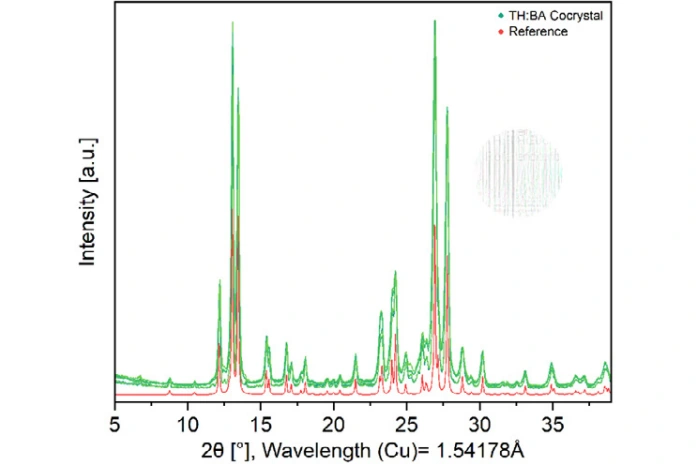
Co-crystal screening is also extremely effective in mixer mills. In a study with the MM 400 2 ml steel tubes and the appropriate PTFE adapter were used to process theophylline and benzamide (1:1) into co-crystals under the following conditions:
Grinding time: 60 min Frequency: 30 Hz 8 steel tubes, each containing 1 grinding ball (Ø 6 mm) made of stainless steel Four tests without solvent and four with 20 µl ethanol
The X-ray powder diffraction patterns of the samples match the simulated reference pattern, and all signals correspond to the desired product – proof of the reliability and reproducibility of the process. Both the MM 400 and MM 500 series can reliably implement these screening protocols using 2 ml steel tubes.
3. Upscaling to kilograms:
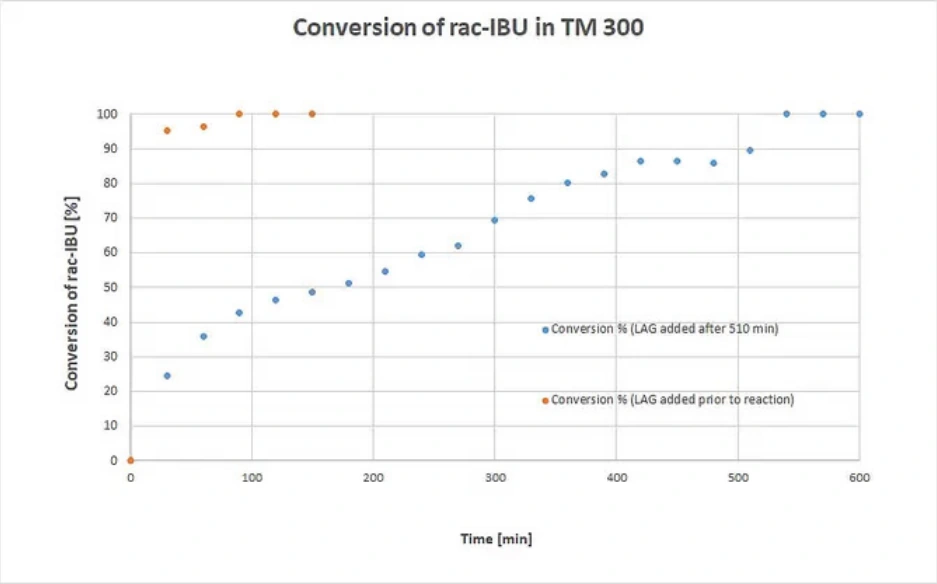
For the synthesis of larger quantities, the TM 300 drum mill enables efficient and sustainable production. The example of the production of rac-ibuprofen:nicotinamide cocrystals shows:
In just 90 minutes production of 3.2 kg of co-crystals is possible, a 99% yield. The LAG process requires only minimal amounts of ethanol, making it particularly environmentally friendly. The TM 300 offers a sustainable alternative to traditional solvent-based methods.
A key advantage is the extremely low metal abrasion of the TM 300. The measured values are well below critical limits and significantly lower than those of conventional eccentric vibration mills. This ensures maximum product purity and effortlessly meets regulatory requirements.
| Sample | Al [ppm] | Cr [ppm] | Co [ppm] | Fe [ppm] | Ni [ppm] |
|---|---|---|---|---|---|
| Raw material IBU | 11.3 | 39.0 | 25.7 | 71.9 | 34.9 |
| Raw material Nicotinamid | 8.9 | 33.3 | 26.7 | 40.0 | 33.3 |
| Co-crystals after 30 min | 10.8 | 35.9 | 30.8 | 51.3 | 38.5 |
| After 60 min | 11.0 | 37.0 | 31.7 | 63.4 | 39.6 |
| After 90 min | 17.2 | 43.8 | 35.9 | 64.6 | 45.3 |
Conclusion:
Solutions from Retsch ensure the highest standards in pharmaceutical production. In addition to the well-known mills for homogenization for quality control, Retsch offers a number of innovations.
The AS 200 jet pharma combines sieving, weighing, and evaluation in one device, increasing efficiency and guaranteeing reproducible results through software-supported wizards and check functions. Your laboratory teams benefit from maximum process reliability, reliable particle separation, and a robust, precise balance. The devices meet all GMP requirements and provide optimal support in quality and production control.
In the field of co-crystal technology, Retsch mills enable fast screening and scalable synthesis on a kilogram scale. This allows designing manufacturing processes to be efficient, safe, and future-proof.
Reaktionsschema und Durchführung der Experimente: Dominik Al-Sabbagh, Chemielabortechniker, Abteilung 6.3 – Strukturanalyse, Bundesanstalt für Materialforschung und -prüfung (BAM), Berlin.
Jan-Hendrik Schöbel, Frederik Winkelmann, Joel Bicker, and Michael Felderhoff; Mechanochemical kilogram-scale synthesis of rac:ibuprofen:nicotinamide co-crystals using a drum mill; RSC Mechanochemistry, 2025, DOI: 10.1039/D4MR00096J
Plan the configuration for your material.
Specify what the prepared material must demonstrate, and keep that endpoint linked to the operating record. Particle-size analysis, fine grinding and material mixing are not interchangeable operations. Equipment capability should be assessed within the documented method rather than treated as a claim of regulatory compliance.
| Consideration | Information to provide |
|---|---|
| Method purpose | Development or routine control |
| Critical attributes | Size, mixture or composition |
| Documentation | Configuration and preparation record |
How should the application examples be used?
The results describe the materials and configurations discussed here. Confirm equipment options, contact materials and operating conditions for your own sample before adopting a method. A demonstrated endpoint does not guarantee the same outcome for a different material.
Discuss material testing with Glen Mills or request further information or a quote.
Explore the equipment discussed
- RETSCH AS 200 jet pharma Air Jet Sieving Machine
- RETSCH TM 300 Drum Mill
- RETSCH PM 400 Planetary Ball Mill
- RETSCH MM 400 Mixer Mill