
Does faster milling prove a better pharmaceutical formulation?
No. Speed is a process consideration. The material and formulation must be evaluated against the intended development criteria.
Technical article.
in Pharmaceutical Research: Sample
The development of drugs with poorly soluble to insoluble active ingredients is a big challenge for the pharmaceutical industry. The bioavailability of orally taken active ingredients, which means to what extent and in which period of time the substance is ingested by the body and is available at the place of action, strongly depends on the percentage dissolved in the gastrointestinal tract. One way to improve the solubility and thus the bioavailability of active ingredients is the pulverization of these substances. By minimizing the particle size to the micron and submicron range the surface-volume-ratio is increased and the solubility of the particles is improved. The pulverized particles are suitable for use in a variety of dosage forms, for example classic tablets or capsules.
Pulverized particles are also beneficial for semi-solid formulations. Beside better bioavailability they provide a smoother feeling on the skin than products containing coarse or even sharp-edged crystals. Small particles are much more evenly distributed in a suspension and, depending on the actual particle size and density, show no or only little sedimentation.
Therefore, size reduction down to the nanoscale is an important pre-requisite for research on the properties of active ingredients in various dosage forms. A potential obstacle for the size reduction of active ingredients down to the micron or sub-micron range is the high energy input required for the grinding process. Thermally unstable substances cannot be ground in conventional ball mills or only with long cooling breaks due to the heat that is generated in the process.
Technical article.
Emax – faster, finer, cooler
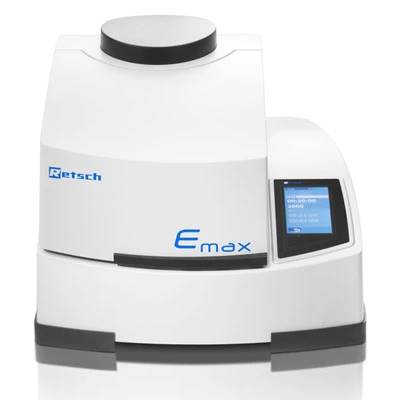
With the new High Energy Ball Mill Emax from RETSCH the time needed to produce pharmaceutical substances in the micron and nanometer range is drastically reduced. The innovative size reduction mechanism with a maximum speed of 2,000 rpm allows substantially faster and more efficient grinding than with any other
type of ball mill.
Moreover,
the unique
liquid cooling
system of the Emax makes cooling breaks obsolete and increases the time savings even more. To further reduce the temperature it is possible to attach a chiller or connect the Emax to the tap. Thanks to the cooling system excessive
High Energy Ball Mill Emax
heat is effectively discharged so that neither the mill nor the sample are overheated, not even during long grinding periods with high energy input. The following application example of a derivate of cortisone shows impressively that the Emax produces the required final fineness in a fraction of the time needed by conventional ball mills.
Application Example Cortisone Derivative – Comparison of Different Mill Types
The superior performance of the Emax compared to a planetary ball mill is demonstrated with the example of grinding a cortisone derivative. 2.5 g of the cortisone derivative were mixed with 26 g aqueous, anionic surfactant and 110 g of zirconium oxide grinding beads (diameter 0.5 mm) and processed in a 50 ml zirconium oxide grinding jar at 500 rpm, 1000 rpm and 1500 rpm in the Emax. Fig. 2 shows the best result which was obtained at 1500 rpm (50% of the maximum energy input). The grinding process had not been interrupted by cooling breaks. After only 5 minutes of grinding the particles with the original size of 6 microns were reduced to the desired fineness below 300 nm. Thanks to the water cooling system there was only a slight temperature rise after 60 minutes of grinding.
Technical article.
The analog grinding process was carried out in a planetary ball mill, adapted to the respective grinding jar volume. After 30 minutes net grinding time (i. e. without counting the required cooling breaks) 90% of the particles were smaller than 300 nm . The whole process was about 6 times faster in the Emax than in the planetary ball mill due to the higher grinding efficiency. In addition, the planetary ball mill - unlike the Emax - requires cooling breaks to ensure that a temperature of 45 °C is not exceeded. As a result, the grinding process was interrupted every 30 seconds for 2.5 minutes. Hence the total processing time to achieve the required particle size added up to 180 minutes in the conventional ball mill. Thus the Emax helped to save almost 3 working hours thanks to the higher grinding efficiency and uninterrupted processing.
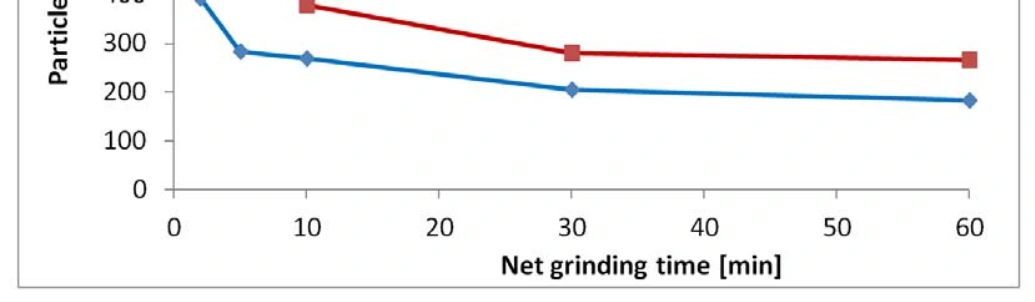
Particle size reduction of a cortisone derivative in the High Energy Ball Mill Emax compared to a Planetary Ball Mill
Technical article.
No trial and error thanks to temperature control mode
The Emax allows the user to define a temperature range with a minimum and maximum temperature for each grinding process. On reaching the maximum temperature the grinding process is automatically interrupted and resumed when the minimum temperature is reached. The cooling system in combination with the temperature control mode is particularly beneficial for grinding heat-sensitive sample materials; in contrast, when using conventional ball mills the only way to find out about suitable cycles of grinding and cooling is by trial and error. If the cooling break is not long enough, the sample may overheat. The Emax allows to vary grinding times and cooling breaks by means of the defined temperature limits; the grinding process itself, however, is always reproducible.
Summary
Thanks to the high energy input and temperature reduction by water cooling the High Energy Ball Mill Emax is ideally suited for grinding pharmaceutical substances and active ingredients down to the nanometer range. This not only means a substantial time saving in pharmaceutical research but also permits size reduction of thermally unstable active ingredients which cannot be processed in conventional ball mills.
Plan the configuration for your material.
A time comparison should include the endpoint and complete configuration, not only minutes of milling. Record formulation, liquid phase where used, tool materials and the measurement method. Particle preparation needs subsequent pharmaceutical evaluation before any conclusion about formulation behavior or biological performance.
| Consideration | Information to provide |
|---|---|
| Ingredient system | Composition and preparation mode |
| Comparison endpoint | Distribution and measurement basis |
| Process record | Tools and full treatment cycle |
How should the application examples be used?
The results describe the materials and configurations discussed here. Confirm equipment options, contact materials and operating conditions for your own sample before adopting a method. A demonstrated endpoint does not guarantee the same outcome for a different material.
Discuss material testing with Glen Mills or request further information or a quote.