
Does co-grinding necessarily create a pharmaceutical cocrystal?
No. The resulting material must be characterized. Mechanical treatment alone does not establish phase identity, stability or improved pharmaceutical performance.
Different crystalline forms of a drug, known as polymorphs play a crucial role in the pharmaceutical industry, as they can significantly impact the physical and chemical properties of a drug, such as solubility, stability, and bioavailability, These polymorphs can exhibit varying characteristics, which can influence the drug's performance and effectiveness. Polymorph screening is an essential process in drug development, as it helps identify stable forms of a drug with desirable properties, ultimately improving drug formulation and performance.
In the context of pharmaceutical manufacturing, polymorphs are often explored through techniques such as co-grinding and cocrystal formation. These methods involve the simultaneous grinding of an active pharmaceutical ingredient (API) with excipients or coformers to enhance the drug's solubility, stability, and bioavailability. The use of ball mills and other specialized equipment can aid in the production of pharmaceutical cocrystals, which can improve drug properties without altering the molecular structure of the API. Overall, understanding and utilizing polymorphs in pharmaceutical research and development is vital for creating effective and stable drug formulations that meet the desired therapeutic outcomes.
Cocrystals and Co-grinding
1) Cocrystals consist of two or more crystalline components, typically an active pharmaceutical ingredient (API) and a coformer, in a definite stoichiometric ratio, held together by non-covalent bonds. Ball mills are used to produce pharmaceutical cocrystals, which can improve drug solubility, stability, and bioavailability without altering the molecular structure of the API. 2 ) Co-grinding often refers to simultaneous grinding of an API and a (amorphous) excipients. Co-grinding can improve the solubility, stability, and bioavailability of drugs by creating fine and uniform particles and improved fluidity. The excipient can be another API, an amino acid or a polymer like cellulose or starch. Excipients as binders help hold the ingredients of a tablet together. Common fillers include lactose, mannitol, and dibasic calcium phosphate. Other excipients act as lubricants, preservatives, colouring or flavouring agents.
Screening of Cocrystals in Retsch Planetary Ball Mills
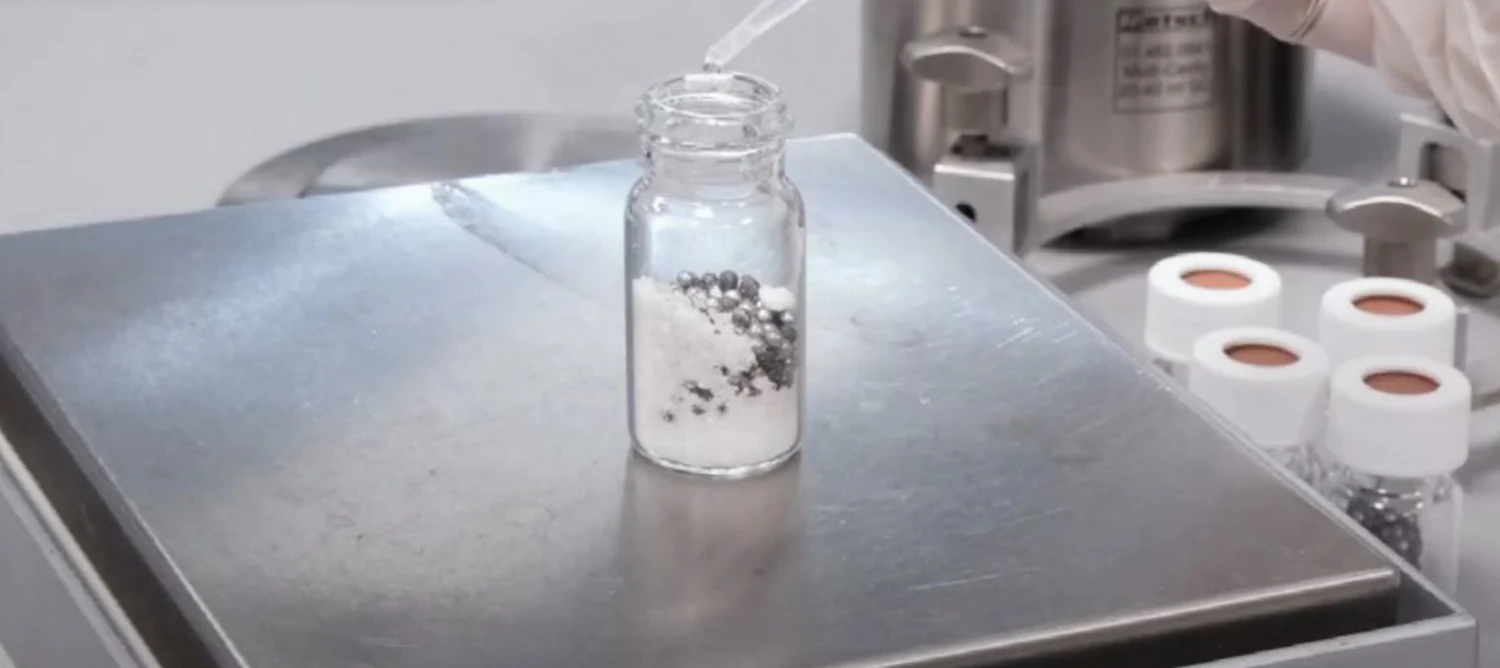
To find the optimal coformer or excipient for an API and a specific purpose, a screening approach is typically required. Different ratios of the API and the other substance need to be investigated, resulting in numerous combination options. Since substances can be very expensive, the screening is usually performed on a small scale. The special screening adapter for planetary ball mills can significantly support this process by using disposable vials, such as 2 ml gas chromatography glass vials. The adapter features 24 positions arranged in an outer ring with 16 positions and an inner ring with 8 positions. In total, 96 samples can be screened in one batch if a PM 400 is used, capable of clamping 4 adapters simultaneously. There are already scientific publications describing to start the screening with 2 or 3 grinding balls made of stainless steel, each with a size of of 3 mm. About 20 µl substance,(the AP) are required per vial. Depending on the different stoichiometries (like 1:1, 1:2, 2:1, … ), also a very small amount of the second substance, the conformer or excipient, is added. It is very important to add a few µl liquid to allow the co-crystallisation effects.
For cocrystallization effects, only medium speed and energy input are necessary. This is why steel balls can be used in a small glass vial without causing damage. The Planetary Ball Mills from Retsch have different sun wheel diameters, resulting in three distinct speed limits for safe operation: PM 100 at 550 rpm, PM 300 at 500 rpm and PM 400 at 400 rpm. Generally, a speed range of 200 - 400 rpm is sufficient. Typical process times of cocrystallization experiments lie between 30 minutes and several hours.
After the first screening trials, there might be some substance combination which promise good results – and thus more material might be required. For this purpose, Retsch offers another adapter for Planetary Ball Mills, which keeps 7 x 20 ml gas chromatography glass vials. Here the best filling for starting experiments is about 5 ml of 3 mm steel balls, API and coformer (or excipient) and liquid added up to about 10 ml filling level in each vial. Here, a viscosity similar to ketchup should be achieved. The maximum speed levels for the three suitable mills PM 100, PM 300 and PM 400 are 350 rpm, 300 rpm and 240 rpm. Again, process times of 30 min to several hours are required
Upscaling options by Retsch – Planetary Ball Mills and Drum Mill TM 300
Drum Mill TM 300
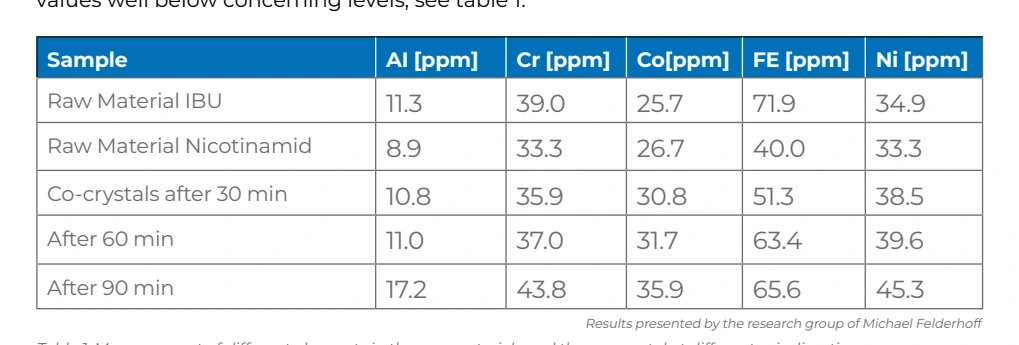
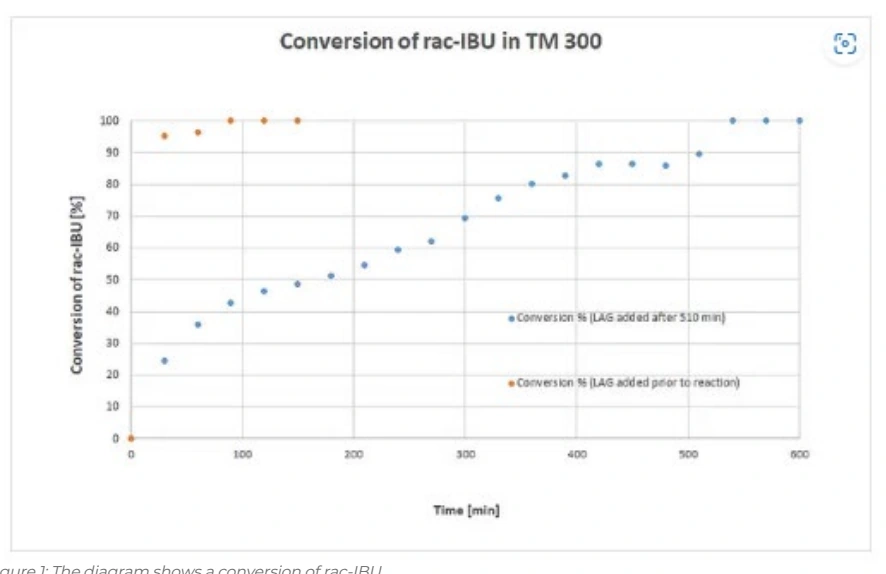
The next level of upscaling trials can be conducted using the steel or zirconium oxide jars of the Planetary Ball Mills, which offer volumes from 12 to 500 ml. In a PM 400, the maximum volume is approximately 200 ml of te API-coformer mixture in a 500 ml jar, allowing for four different approaches to be tested simultaneously. least, upscaling the cocrystal Last but not formation to a kg-scale is the next step. For that, Retsch offers systems such as the Drum Mill TM 300. This mill meets the demands of modern pharmaceutical manufacturing, as demonstrated by he mechanochemical synthesis of rac-Ibuprofen: Nicotinamide co-crystals. In just 90 minutes, 3.2 kg of co-crystals were produced with a 99% yield, using minimal amounts of ethanol in the LAG (Liquid assisted grinding) process. Notably, the metal abrasion was minimal, with measured values well below concerning levels, see table 1.
Sample
AI [ppm]
Cr [ppm] Co[ppm] FE [ppm] Ni [ppm]
Raw Material IBU
Raw Material Nicotinamid
Co-crystals after 30 min
After 60 min
After 90 min
References Stephen R. Bysouth, Joanna A. Bis, David Igo; Cocrystallization via planetary milling: Enhancing throughput of solid-state screening methods; 2011, DOI: 10.1016/j. ijpharm.2011.03.03 Jan-Hendrik Schöbel, Frederik Winkelmann, Joel Bicker, and Michael Felderhoff; Mechanochemical kilogram-scale synthesis of rac:ibuprofen:nicotinamide co-crystals using a drum mill; RSC Mechanochemistry, 2025, DOI: 10.1039/D4MR00096J
Plan the configuration for your material.
A screening result should include the composition, vessel and mechanical treatment as well as the characterization method. Scaling the quantity changes the physical arrangement, so a successful small preparation needs confirmation at the next scale. Do not infer a new solid form from milling conditions alone.
| Consideration | Information to provide |
|---|---|
| Formulation | Components and proportions |
| Preparation scale | Vessel, loading and treatment |
| Characterization | Solid-form identification and stability |
How should the application examples be used?
The results describe the materials and configurations discussed here. Confirm equipment options, contact materials and operating conditions for your own sample before adopting a method. A demonstrated endpoint does not guarantee the same outcome for a different material.
Discuss material testing with Glen Mills or request further information or a quote.
Explore the equipment discussed
- RETSCH PM 400 Planetary Ball Mill
- RETSCH TM 300 Drum Mill
- RETSCH PM 100 Planetary Ball Mill
- RETSCH PM 300 Planetary Ball Mill