
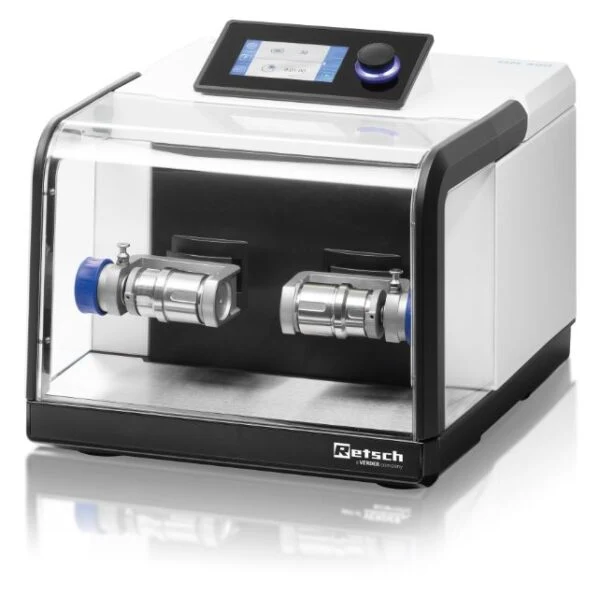
Does a larger tube always simplify biological preparation?
Only if it fits the equipment and the method. Capacity, mechanical treatment, containment and the amount recoverable for analysis must be considered together.
biological secretions or tissue pieces in 5 ml single-use vials with the Mixer
Sometimes the preparation and homogenization of biological samples can be as tough as the material itself. The widely used 2 ml single-use Eppendorf tubes are often not large enough to accommodate the whole sample volume; hence, the sample needs to be divided and reunited after the homogenization process which means an additional time-consuming working step in the lab routine. While it is true that usually larger sized grinding jars, e. g. of stainless steel, are available which accommodate the complete sample volume, these have the drawback of requiring cleaning after use.
The perfect solution for this situation comes in the form of new 5 ml single-use tubes by Eppendorf which have a larger capacity and don’t require cleaning. RETSCH now offers a new adapter for the MM 400 which accepts 3 of the 5 ml tubes, thus permitting simultaneous preparation of 6 x 5 ml of sample. The nature of biological samples can vary considerably, for example, very tough sputum of cystic fibrosis patients or tissue samples like liver, lung or tumors. In the following we describe the use of the MM 400 with the new adapter for 5 ml single-use tubes for homogenizing these samples.
The new adapter for 5 ml reaction vials substantially facilitates the preparation of biological samples in the Mixer Mill MM 400
Homogenization of very tough sputum of cystic fibrosis patients
The sputum coughed up by cystic fibrosis patients is usually homogenized for routine diagnostics but also for research. It can be easily homogenized in the Mixer Mill MM 400; however, more than 1 ml sputum per sample could not be satisfactorily processed in the past. Though the 2 ml Eppendorf tubes used had the advantage of minimum contamination risk, the drawback was the limited volume. Therefore, many research labs divided the tough and viscous sputum into portions for homogenization and reunited them afterwards which is not a suitable procedure for partly infectious material. Another option was to use 5 ml stainless steel grinding jars which accommodate the whole sputum sample; however, after the process the jars required thorough cleaning.
Professor Kahl and Mrs Deiwick of the university hospital Muenster/Germany examine sputum of cystic fibrosis patients who suffer from chronically recurring acute respiratory disease. Professor Kahl’s focus of research is on examining the persistence and adaptation of the human pathogenic agent Staphylococcus aureus which is detected in the respiratory system of the patients. The sputum is homogenized and aliquoted for routine diagnostics and further examinations like microbiota, proteome and metabolo-
me analyses. Therefore, the sputum sample needs to be as homogeneous as possible to enable researchers to carry out all analyses with comparable samples. In Muenster the samples are homogenized with the Mixer Mill MM 400, using the adapter for 5 ml reaction vials. Depending on the viscosity of the sputum 500 to 3,000 microliters are homogenized with 2 to 3 zirconium oxide grinding balls with 5 mm diameter at 30 Hz for a minimum of 1 min 30 sec up to a maximum of 2 min 30 sec. Subsequently the sputum is divided for the various examinations. The fact that the complete sample can now be processed in the 5 ml tubes in one step means a substantial ease of work; it also reduces dealing with potentially infectious material to a minimum.
Homogenization of liver tissue
Tissue samples like lung, liver or tumors are routinely examined in biological basic research, toxicology, biomedicine, pharmacology, molecular diagnostics and many more areas. The problems the user has to face here are similar to those of homogenizing sputum. The sample volume is often too large for the classic 2 ml reaction vials, consequently the sample needs to be divided and reunited later or larger grinding jars are employed which need to be cleaned and decontaminated after the process. The new 5 ml single-use Eppendorf tubes in combination with the Mixer Mill MM 400 are
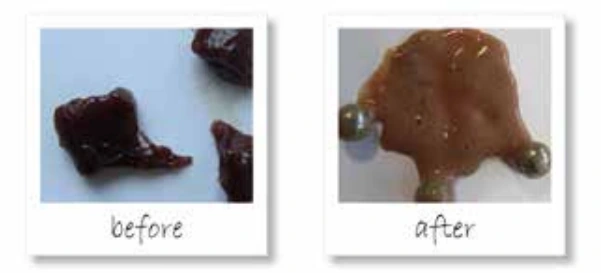
Liver sample before and after homogenization in the MM 400
MM 400 accessories like adapters for 2 ml Eppendorf tubes, grinding jars and beads (left), MM 400 with adapter for 8 x 50 ml conical centrifuge tubes (right)
the ideal alternative for this application. Up to 6 liver samples are thoroughly homogenized in this way.
Various combinations of grinding ball sizes and numbers as well as sample volumes were tested for the homogenization of liver with the result that a few 10 mm balls had a much better size reduction effect on the tissue structure than many smaller balls. For the complete homogenization of 3 to 5 g of fresh liver tissue the use of three 10 mm stainless steel grinding balls provided the best results. The reaction vial was filled up with aqueous buffer up to the maximum filling line. The sample was then homogenized for 5 minutes at 30 Hz and no tissue residues were visible after the process.
A true „all-rounder“ – RETSCH’s Mixer Mill MM 400 RETSCH’s Mixer Mill MM 400 is very versatile in use thanks to a wide selection of accessories. Cell disruption with glass beads, for example in single-use vials like the conical 50 ml centrifugal tubes or various Eppendorf tubes (max. 20 samples simultaneously), is another application for which the mill is ideally suited. Of course it is also possible to grind hard materials in grinding jars of stainless steel or other materials. The MM 400 is a true multipurpose mill for size reduction and pulverization of medium-hard, hard, brittle, soft, elastic or fibrous samples down to a particle size of 5 microns. Applications include plants, pine needles, feathers, bones, tissue, drugs, wood, minerals or chemical substances. The mill is also used for cell disruption. The grinding jars are available in 6 different materials to avoid cross contamination; the stainless steel jars are suitable for cryogenic grinding using liquid nitrogen.
Conclusion
The new adapter for 5 ml Eppendorf tubes has further extended the range of applications of the Mixer Mill MM 400. Sample volumes of up to 3 ml can now be homogenized in single-use vials in one step without previous division. Extractions from the pulverized sample directly inside the grinding jar are another new possibility. Thanks to the new adapter routine processes have been further optimized while maintaining high-quality sample preparation.
Plan the configuration for your material.
Dividing and recombining a specimen adds handling steps. Compare that approach with a compatible larger-vessel arrangement, including recovery, containment and cleaning needs. Select the preparation endpoint around the biological assay rather than choosing a vessel solely by nominal volume.
| Consideration | Information to provide |
|---|---|
| Specimen quantity | Total sample and liquid phase |
| Vessel choice | Supported format and closure |
| After preparation | Recovery and assay compatibility |
How should the application examples be used?
The results describe the materials and configurations discussed here. Confirm equipment options, contact materials and operating conditions for your own sample before adopting a method. A demonstrated endpoint does not guarantee the same outcome for a different material.
Discuss material testing with Glen Mills or request further information or a quote.