
Is the smallest available sieve always the best choice?
No. Select the tool and conditions around the desired size band. Maximum size reduction may conflict with an application that needs fewer fines.
reduced fines
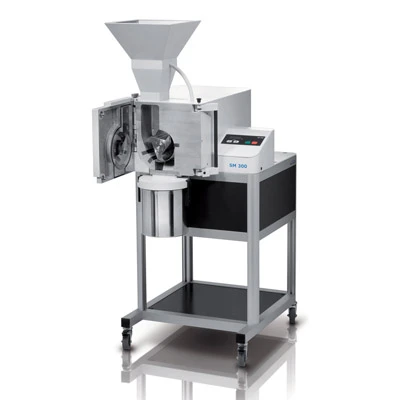
Cutting mills are the first choice when it comes to size reduction of heterogeneous, soft, medium-hard, fibrous, elastic or tough sample materials such as wood, twigs, electronic scrap or refuse-derived fuels. They are mostly used for preliminary grinding followed by fine grinding, carried out for example in an ultra centrifugal mill like the ZM 200. For some applications, it is desirable to have as much as possible of the sample within a specific size range with the fines being reduced to a minimum. Cutting mills can do the job for bulky samples with the abovementioned properties. The SM 300 model is particularly suitable due to the variety of accessories (rotors, bottom sieves, etc.) and flexible speed. The latter was extended from 700 min-1 - 3,000 min-1 to 100 min-1 - 3,000 min-1. By selecting the lowest speed when grinding brittle samples which break easily, it is possible to reduce the fines. The low speed also has a positive effect on temperaturesensitive samples.
Correlation between speed and fines
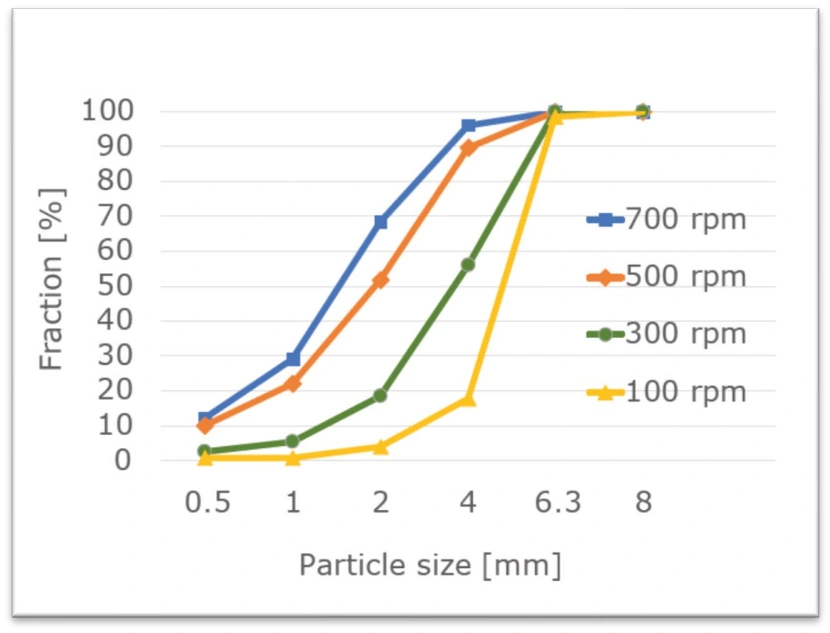
Application example I: 150 g brittle resin pieces with a maximum size of 10 mm were milled in the SM 300 for 2 minutes, using the parallel section rotor and 8 mm bottom sieve. The desired particle size range lay between 2 and 6.3 mm. Starting with 700 min-1, the speed was reduced to 100 min-1 in steps of 200 min-1. Fig. 1 shows that the fine fraction is reduced with decreasing speed. With 700 min-1, only 30% of the sample had a particle size between 2 and 6.3 mm. With 100 min-1, however, 95% of the sample possessed the desired particle size and only 0.5% were too fine (<0.5 mm).
Correlation between speed of the cutting mill and resulting fine fraction of the sample
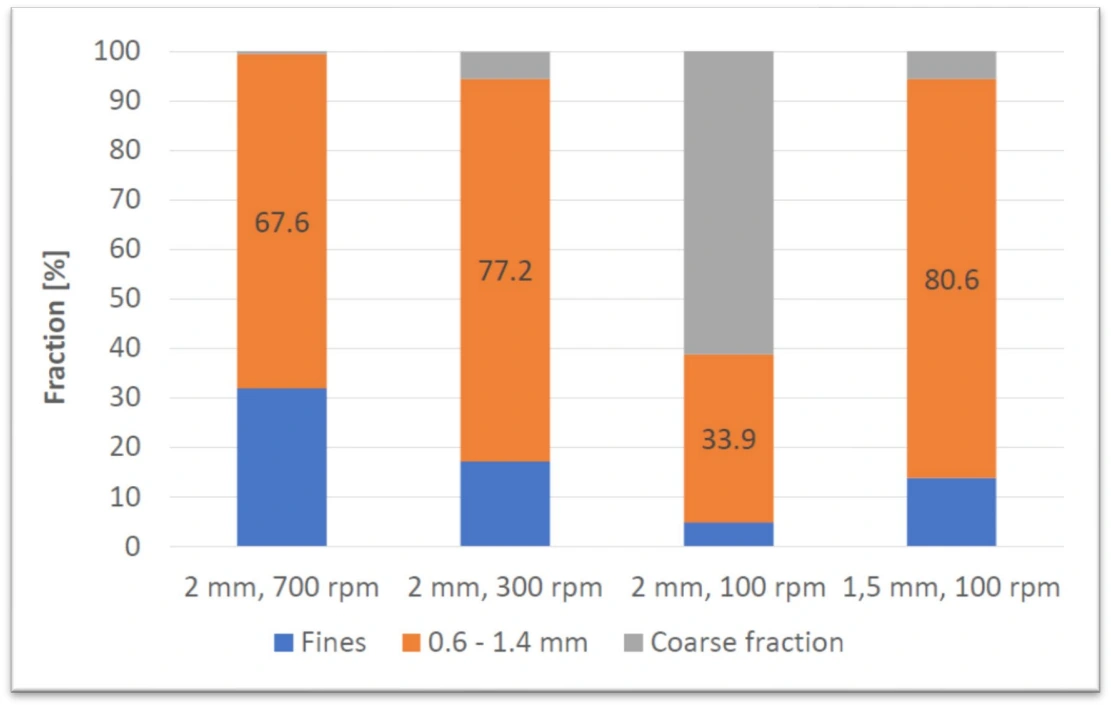
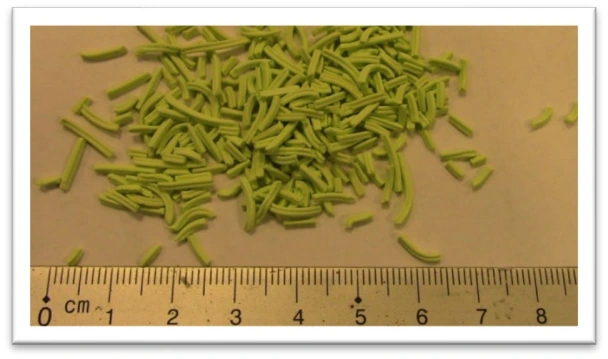
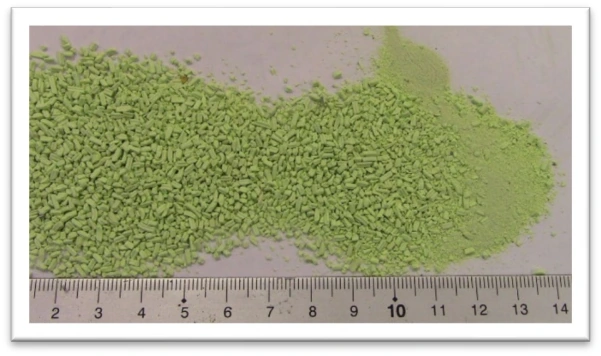
Application example II: 130 ml of a brittle NiMo-Al2O3 catalyst with initial particle size of 10 mm were ground within 3.5 min by using the 6-disc rotor and various bottom sieves. By selecting appropriate aperture sizes of the sieves and a suitable speed, major part of the sample was reduced to a particle size within the desired range from 0.6 to 1.4 mm . For the catalyst sample, 80% were obtained in the desired fraction when a 1.5 mm bottom sieve and a speed of 100 min-1 were used . An additional sieve with smaller aperture sizes was not employed because the sample would then have to be fed very slowly to the hopper to avoid blockages.
Catalyst before and after grinding in the SM 300; the smallest fine fraction was obtained with a 1.5 mm bottom sieve at 100 min-1
Cutting Mill SM 300
The Cutting Mill SM 300 used for these trials is equipped with a 3kW drive with a high torque and RES technology (additional flywheel mass) which allow for particularly effective preliminary size reduction of heterogeneous material mixes. Analytical fineness is usually achieved in one working run. The mill is employed for cutting a large variety of materials. The sample is only slightly warmed during the process, making the SM 300 suitable for grinding heat-sensitive materials. The wide, freely selectable speed range from 100 min-1 to 3000 min-1 helps to substantially reduce the fine fraction. If very light sample material or small amounts are to be processed, the SM 300 can optionally be equipped with the cyclone-suction-combination for optimum results which accepts collecting vessels from 500 ml to 30 l. The wide selection of bottom sieves, hoppers and collecting vessels allows for adaptation to individual application tasks. RETSCH’s product portfolio comprises a range of cutting mills, from the economic basic model to the large SM 400 which is suitable for grinding sample pieces with a maximum size of 170 x 220 mm.
Cutting Mill SM 300 (left) and Cutting Mill SM 400 XL (right)
Plan the configuration for your material.
Define both the desired fraction and the amount of fines that can be tolerated. Evaluate the full output distribution instead of a single top-size value. Repeatedly processing material that is already small enough may change the balance of useful product and unwanted fines.
| Consideration | Information to provide |
|---|---|
| Required fraction | Upper and lower size limits |
| Feed condition | Shape and breaking behavior |
| Evaluation | Usable fraction and fines content |
How should the application examples be used?
The results describe the materials and configurations discussed here. Confirm equipment options, contact materials and operating conditions for your own sample before adopting a method. A demonstrated endpoint does not guarantee the same outcome for a different material.
Discuss material testing with Glen Mills or request further information or a quote.