
Should ceramic raw materials and intermediates use identical preparation?
Not automatically. Physical form and analytical purpose can change between stages, even when the materials belong to the same production line.
Crushers and grinders are essential tools in the ceramic production process, not only in the first steps where raw materials are homogenized and mixed but also for subsequent steps like forming green bodies or sintering. The intermediate products need to be analyzed with regards to their mineralogical and chemical composition to optimize the manufacturing steps. At each stage of the production, samples must be taken, homogenized and analyzed to ensure gapless quality control.
RETSCH offers a range of instruments suitable for sample preparation. The typical sample preparation process involves preliminary size reduction and fine size reduction before the sample can be submitted to further analyses. RETSCH sample dividers are used to take a representative part of a large sample taken out of the production process or to reduce the sample volume after pre-crushing.
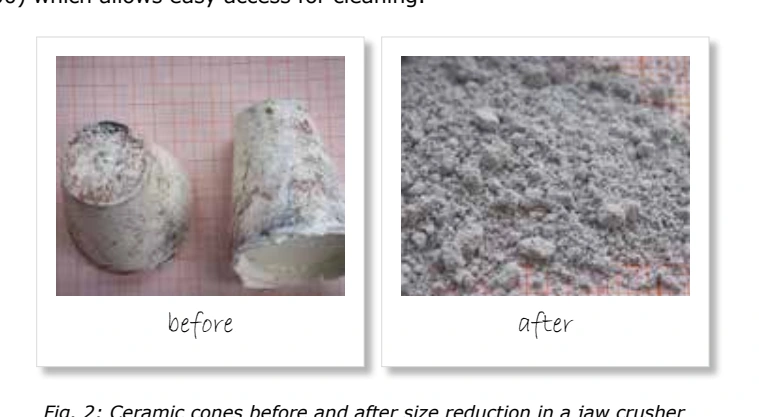
Primary size reduction Depending on the initial sample size, the raw materials or intermediate products must be pre-ground prior to full homogenization by fine-grinding. RETSCH offers a broad range of jaw crushers for this important step. The jaw crushers are used for rapid, powerful crushing and pre-crushing of medium-hard, hard, brittle and tough materials which are typical for the ceramic industry. The throughput and final fineness depend on the crusher type, selected gap width and breaking properties of the sample material.
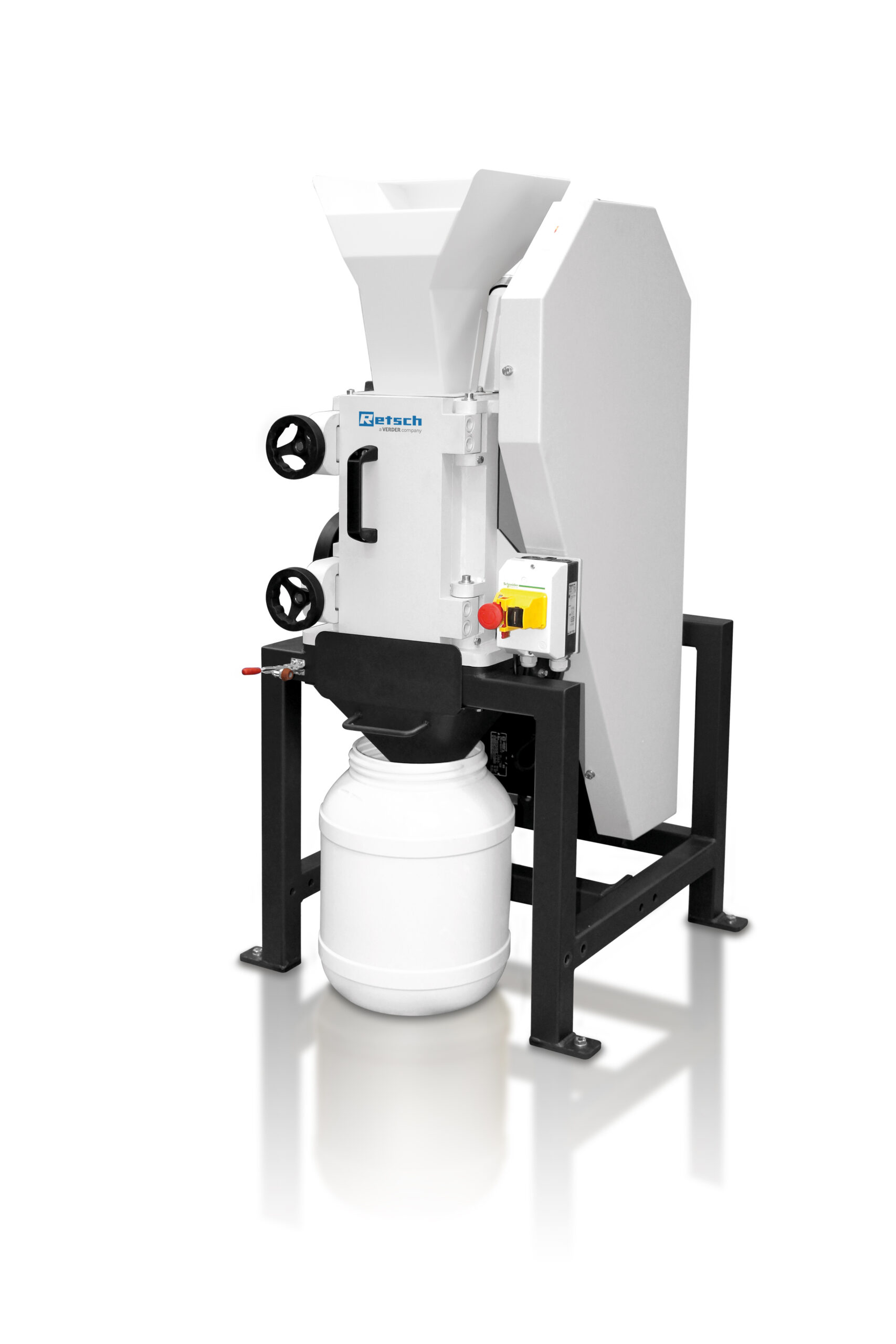
The feed sizes of the eight different jaw crusher models range from 40 mm to 350 mm. The final size also differs, BB 50 and BB 500 are suitable to crush samples down to 500 µm (depending on the sample breaking properties), whereas the largest crusher BB 600 produces sample particles sized approx. 6 mm. Sometimes it is advisable to crush large lumps in a first step with large gap width followed by a second step with reduced gap width. The overall time required is usually shorter with two grinding steps than forcing the sample directly through the narrower gap width in one step. Some raw materials like calcium magnesium oxide tend to be sticky when being crushed. For this application the use of a jaw crusher equipped with a front door is recommended (e. g. BB 250, Fig. 1, BB 400) which allows easy access for cleaning.
Jaw Crusher BB 250
before
after
Pre-crushing of raw materials and intermediate products in jaw crushers
| Sample | Sample amount | Feed size | Model | Parameters Accessories | Final size D 90 | Time |
|---|---|---|---|---|---|---|
| Ceramic with SiC | 1 kg | 40 mm | BB 50 | • Gap setting 1 mm • jaws and wearing plates: tungsten carbide | <5 mm | 4 min |
| Mixed ceramic: BN and TiB₂ | 3 kg | 250 x 80 mm plates | BB 500 | • Gap setting 0 mm • jaws and wearing plates: tungsten carbide | <2 mm | 2 min |
| WC | 3.5 kg | 100 mm | BB 300 | • Gap setting 2 mm • jaws and wearing plates: stainless steel | <10 mm | 1 min |
| Al₂O₃ | 20 kg | 50 mm | BB 500 | • Gap setting 2 mm • jaws and wearing plates: manganese steel and hardened steel | <0.7 mm | 5 min |
| Tiles | 10 kg | 240 x 115 mm plate | BB 300 | • Gap setting 1 mm • jaws and wearing plates: manganese steel and hardened steel | <15 mm | 7 min |
| Refractory material | 20 kg | 300 x 155 mm | BB 600 | • Gap setting 6 mm • jaws and wearing plates: manganese steel | <6 mm | 2 min |
| CaMgO₂ | 15 kg | 120 mm | BB 250 | • Gap setting 20 & 2 mm • jaws and wearing plates: manganese steel & hardened steel | <4 mm | 2 min + 7 min |
| Fireproof rock of MgO, AlO, C 2 3 | 2 kg | 110 mm | BB 250 | • Gap setting 0 mm • jaws and wearing plates: manganese steel & hardened steel | <3 mm | 1 min |
Pulverization For fine grinding of hard and brittle sample materials after pre-crushing, ball mills are usually a suitable option. With 12 different ball mill types, RETSCH boasts the largest offering worldwide. Depending on the sample amount, sample throughput, initial particle size, required fineness and subsequent analysis, RETSCH is able to provide a suitable solution for the specific requirements in the ceramic industry. When it comes to long-term grindings of several hours with high energy input to obtain particles sizes <1 µm in wet grinding mode, planetary ball mills have been the instruments of choice so far. Depending on the model, sample volumes up to 4 x 220 ml can be processed in one step; eight different grinding tool materials are available to ensure neutral-to-analysis sample preparation. Despite their benefits, planetary ball mills often have the drawback of requiring cooling breaks and not being as easy to handle as mixer mills. These compact versatile bench-top units for dry, wet and cryogenic grinding of small sample amounts mix and homogenize powders in only a few seconds and are easy to handle. RETSCH has now introduced the Mixer Mill MM 500 nano which features a maximum frequency of 35 Hz and is the first mixer mill in the market with sufficient crushing power to produce particles in the nanometer range. It accommodates 2 grinding jars sized 50 ml, 80 ml or 125 ml and with its suitability for long-term grinding processes up to 99 hours, it is a real alternative to planetary ball mills – with all the benefits a mixer mills offers, like high impact grinding, comfortable handling and less warming effects.
Pulverization of ceramic samples in Ball Mills
| Sample | Sample quantity | Feed size | Model | Parameters and accessories | Final size D90 | Time |
|---|---|---|---|---|---|---|
| Vitroceramic | 4 x 250 g | 2 mm | PM 400 | • Revolution speed 280 rpm • 4 x 500 ml grinding jars & 4 x 25 balls 20 mm, zirconium oxide | <20 µm | 20 min |
| Zeolite | 1 x 30 g | 1 mm | PM 100 | • Revolution speed 600 rpm • 1 x 500 ml grinding jar & 300 ml balls 0.5 mm, zirconium oxide • 200 ml isopropanol | <0.35 µm | 90 min |
| SiC | 2x 10 g | 5 mm | MM 400 | • Frequency 30 Hz • 2 x 25 ml grinding jars & 2 x 4 balls 12 mm, tungsten carbide | <12 µm | 2 min |
| 30 % SiO₂ 40 % CaO 30 % Al₂O₃ | 8 g in tot al | 0.2 mm | PM 100 CM | • Revolution speed 400 rpm • 1 x 125 ml grinding jar & 30 x balls 10 mm, agate | <10 µm | 150 min |
| Dental ceramic | 30 g | 50 µm | PM 100 | • Revolution speed 420 rpm • 1 x 125 ml grinding jar & 275 g balls 2 mm, zirconium oxide • 25 ml isopropanol | <2 µm | 90 min |
| Bricks | 2x 11 g | 4 mm | MM 400 | • Frequency 30 Hz • 2 x 50 ml grinding jars & 2 x balls 25 mm, stainless steel | <100 µm | 40 sec |
| Al₂O₃ | 2 × 62 mL suspension (1 g sample per 1 g phosphate buffer) | 5 µm | MM 500 nano | • Frequency 35 Hz • 2 x 125 ml grinding jars & 2 x 275 g balls 0.1 mm, zirconium oxide | <0.14 µm | 2 h |
before
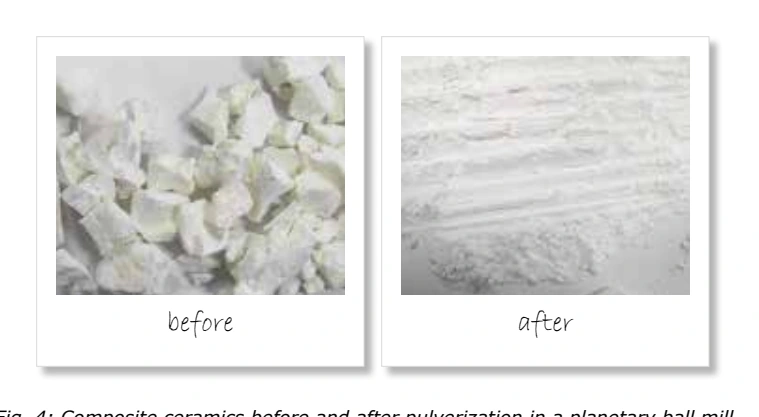
after
Planetary Ball Mill PM 400
Conclusion
Quality control is an important aspect of ceramic production. Sample preparation is an essential part of it, because only a representative and reproducible processing of the sample material ensures reliable and meaningful analysis results. RETSCH offers a range of instruments for dividing, crushing and pulverizing all materials which are involved in the production process of ceramics. To ensure the right choice of instrument for the right sample material, RETSCH offers free-of-charge sample testing in application laboratories all over the world.
Plan the configuration for your material.
Define whether the immediate task is coarse reduction, homogenization or preparation for a particular measurement. Hardness and abrasive behavior influence tool selection. Keep sample identity and preparation history clear as material moves through several size-reduction stages.
| Consideration | Information to provide |
|---|---|
| Material stage | Raw feed or intermediate product |
| Mechanical need | Coarse reduction or fine preparation |
| Analytical requirement | Composition or mineralogical information |
How should the application examples be used?
The results describe the materials and configurations discussed here. Confirm equipment options, contact materials and operating conditions for your own sample before adopting a method. A demonstrated endpoint does not guarantee the same outcome for a different material.
Discuss material testing with Glen Mills or request further information or a quote.
Explore the equipment discussed
- RETSCH BB 250 Jaw Crusher
- RETSCH PM 100 Planetary Ball Mill
- RETSCH BB 500 Jaw Crusher
- RETSCH PM 400 Planetary Ball Mill