
Is there a single aerospace-material preparation method?
No. Different material systems and analytical objectives require different mechanisms, tools and handling arrangements.
The materials used in the aerospace industry have changed over the last 40 years. While aluminum was most common in the past, it has been increasingly replaced by lightweight composite materials, aerogels, new al-loys and fiber-reinforced polymer materials. Those materials are superior to aluminium with regards to their behavior in forming processes, with joints becoming more and more redundant, and especially the composite materials can be used to pre-form parts which require fewer assemblies (trend towards one-piece design). Materials which are resistant against high temperatures >2000°C are very sought-after and subject of current research. Here, the so-called superalloys or technical ceramics come into focus and are investigated as to how far they fulfill the requirements.
Laboratory crushers and mills are essential tools to homogenize all these materials for both, quality control purposes and research procedures. Raw materials, intermediate and final products need to be analyzed with regards to their chemical composition to optimize the manufacturing steps. With regards to developing new materials such as superalloys, mechanical alloying has become an import method.
RETSCH offers a range of instruments suitable for sample preparation. The typical sample preparation process involves preliminary size reduction and fine size reduction before the sample can be submitted to further analyses. For mechanical alloying processes, ball mills are the instruments of choice. Finally, the particle size analysis of, e. g., metal powders is also required – here, RETSCH sieve shakers provide reliable and standard-compliant results.
Primary size reduction
Depending on the initial sample size, the raw materials or intermediate products must be reduced in size prior to full homogenization by fine grinding. RETSCH offers 8 different jaw crusher models for this important step. The jaw crushers are used for rapid, powerful crushing and pre-crushing of medium-hard, hard, brittle and tough materials such as ceramics or silicon. The throughput and final fineness depend on the crusher type, selected gap width and breaking properties of the sample material. With regards to sample purity after the crushing process, especially for silicon samples, jaws of tungsten carbide or NiHard 4 are the best choice – as these are highly wear-resistant and abra-sion can be reduced to a negligible level.
The feed sizes of the jaw crusher models range from 40 mm to 350 mm. The achievable final fineness also differs. BB 50 and BB 500 are suitable to crush samples down to 500 µm (depending on the sample’s breaking properties), whereas the largest crusher BB 600 produces sample particles sized approx. 6 mm. Sometimes it is advisable to crush large lumps in a first step with large gap width followed by a second step with reduced gap width. The overall time required is usually shorter with two grinding steps than forcing the sample directly through the narrower gap in one step. Some raw materials, like calcium magnesium oxide, tend to be sticky when being crushed. For this application the use of a jaw crusher BB 250 or BB 400 is recommended as these are equipped with a front door which provides easy access for cleaning.
Jaw Crusher BB 500
Application examples pre-crushing
| Sample | Sample amount | Feed size | Model | Parameters Accessories | Final size D 90 | Time |
|---|---|---|---|---|---|---|
| Ceramic with SiC | 1 kg | 40 mm | BB 50 | • Gap setting 1 mm • jaws and wearing plates: tungsten carbide | <5 mm | 4 min |
| Mixed ceramic: BN and TiB₂ | 3 kg | 250 x 80 mm plates | BB 500 | • Gap setting 0 mm • jaws and wearing plates: tungsten carbide | <2 mm | 2 min |
| Tungsten carbide | 3.5 kg | 100 mm | BB 300 | • Gap setting 2 mm • jaws and wearing plates: stainless steel | <10 mm | 1 min |
| Al₂O₃ | 20 kg | 50 mm | BB 500 | • Gap setting 2 mm • jaws and wearing plates: manganese steel and hardened steel | <0.7 mm | 5 min |
| CaMgO₂ | 15 kg | 120 mm | BB 250 | • Gap setting 20 & 2 mm • jaws and wearing plates: manganese steel & hardened steel | <4 mm | 2 min + 7 min |
| Silicon | 100 kg | 120 mm | BB 500 | • Gap setting 0 mm jaws and wearing plates: NiHard and 4 hardened steel; the sample is processed twice with a gap of zero | <3.2 mm | 2 x 30 sec |
| Silicon | 330 g | 40 mm | BB 50 | • Gap setting 5 mm jaws and wearing plates: tungsten carbide | <15mm | 15 sec |
Pre-crushing of raw materials and intermediate products in jaw crushers
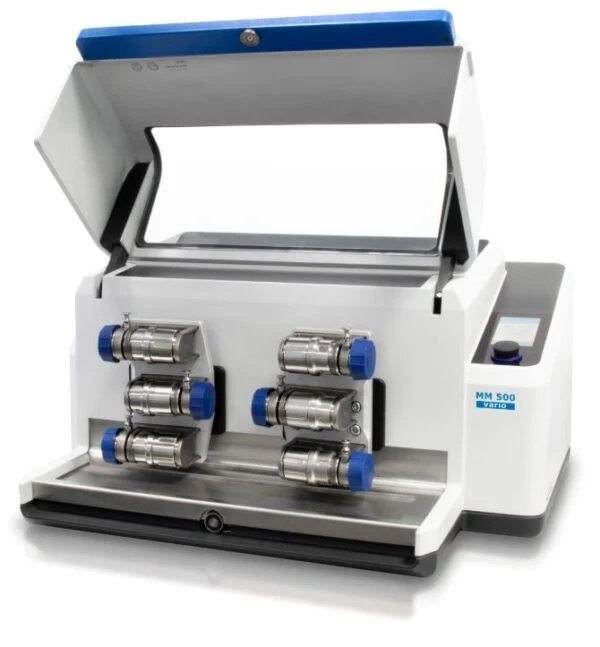
Mixer Mill MM 500 vario
before
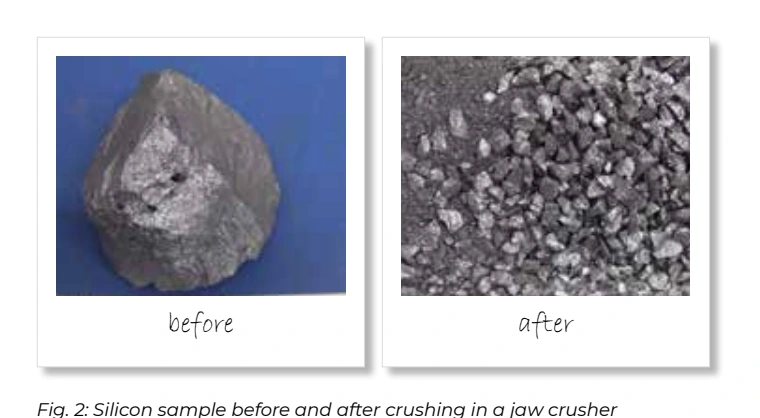
after
Pulverization
For fine grinding of hard and brittle sample materials after pre-crushing, ball mills are usually the best option. With 15 different ball mill types, RETSCH boasts the largest offering worldwide. Depending on the sample amount, sample throughput, initial particle size, required fineness and subsequent analysis, RETSCH provides adequate solutions for the specific requirements in the aerospace industry.
When it comes to long-term grindings of several hours with high energy input to obtain particles sizes <1 µm in wet grinding mode, planetary ball mills have been the instruments of choice so far. Depending on the model, sample volumes up to 4 x 220 ml can be processed in one step; eight different grinding tool materials are available to ensure neutral-to-analysis sample preparation. Despite their benefits, planetary ball mills often have the drawback of requiring cooling breaks and not being as easy to handle as mixer mills. These compact versatile bench-top units for dry, wet and cryogenic grinding of small sample amounts mix and homogenize powders in only a few seconds and are easy to handle. RETSCH has now introduced the Mixer Mills MM 500 vario and MM 500 nano which operate with a maximum frequency of 35 Hz. The MM 500 vario works like the wellknown MM 400 model but accommodates 6 grinding jars of up to 50 ml each, thus increasing the sample throughput and speed-ing up e. g. research processes. The MM 500 nano is the first mixer mill in the market with sufficient crushing power to produce particles in the nanometer range. It accommodates 2 grinding jars sized 50 ml, 80 ml or 125 ml and with its suitability for long-term grinding processes up to 99 hours, it is a real alternative to planetary ball mills – with all the benefits a mixer mills offers, like high impact grinding, comfortable handling and less warming effects. The High Energy Ball Mill Emax, which can be cooled with water and allows a maximum speed of 2000 rpm, is another very useful machine to achieve nanometer scale samples in a very short time.
For mechanical alloying processes, the Emax, the MM 500 nano or MM 500 vario or the Planetary Ball Mills PM 400 MA (MA = Mechanical Alloying, with increased energy input thanks to sun wheel/grinding jar ratio 1:-2.5 or 1:-3) are the instruments of choice - as all of them provide high energy input which is a prerequisite to fuse different metals together via ball milling to find new alloys.
Fine grinding of samples like fiber-reinforced polymers or aerogels can be easily done in rotor mills such as the Ultra Centrifugal Mill ZM 200 or the Rotor Beater Mill SR 300. A grind size down to 0.08 µm is possible, or, if large sample quantities are to be processed, the use of a cyclone allows for grinding of up to 26 l material per batch, depending on the model and sample properties. The particle size distribution can be influenced by choosing an adequate sieve size, for example, if the fine particle fraction should be reduced.
Application examples fine grinding
| Sample | Sample amount | Feed size | Model | Parameters Accessories | Final size D 90 | Time | Purpose |
|---|---|---|---|---|---|---|---|
| SiC | 1 x 250 g | 20 mm | PM 100 | • Revolution speed 450 rpm 1 x 125 ml grinding jars & 7 x 20 balls tungsten carbide | <150 µm | 4 min | Pulverization |
| Carbon and natural fiberreinforced duroplast | 1 x 10 g | 10 mm | ZM 200 | • Revolution speed 18000 rpm 12-tooth rotor 0.08 mm sieve | < 0.08 mm | 1 min | Pulverization |
| C-Aerogel | 1 x 500 g | 10 mm | SR 300 | • Revolution speed 3000 rpm 1 mm sieve cyclone with 26 l receptacle | 670 µm, avoid fine fraction <10µm | 5 min | Pulverization, particle size large scale |
| Silicon | 2 x 10 g | 15 mm | MM 500 vario | • Frequency 35 Hz 6 x 25 ml grinding jars & 6 x 15 balls 15 mm tungsten carbide | <300 µm | 0.5 min | High sample throughput |
| SiC | 6 x 10 g | 5 mm | MM 500 vario | • Frequency 35 Hz 2 x 25 ml grinding jars & 2 x 4 balls 12 mm tungsten carbide | <12 µm | 1 min | High sample throughput |
| Vitroceramic | 4 x 250 g | 2 mm | PM 400 | • Revolution speed 280 rpm 4 x 500 ml grinding jars & 4 x 25 balls 20 mm zirconium oxide | <20 µm | 20 min | High sample throughput, large sample amount |
| Silicondioxide | 1 x 30 g | 200 µm | PM 100 | • Revolution speed 600 rpm 1 x 250 ml grinding jar & 550 g balls 2 mm zirconium oxide 70 ml NaPo3 h | <0.2 µm | 6 h in total, including 4 breaks to keep temperature below 80°C | Nano grinding |
| Al₂O₃ | 2x 62 ml suspension (1 g sample per 1 g phosphate buffer) | 5 µm | MM 500 | • Frequency 35 Hz • 2 x 125 ml grinding jars & 2 x 275 g balls 0.1 mm, zirconium oxide | <0.14 µm | 2 h | Nano grinding |
| 50 %Si + 50 % Al | 2 x 7.75 g sample for a sample to ball ratio 1:10 | 2 mm | Emax | • Revolution speed 1200 rpm 2 x 50 ml grinding jars & 20 x 10 mm balls tungsten carbide | Fused | 2 h | Mechanical alloying |
Pulverization of samples in laboratory mills
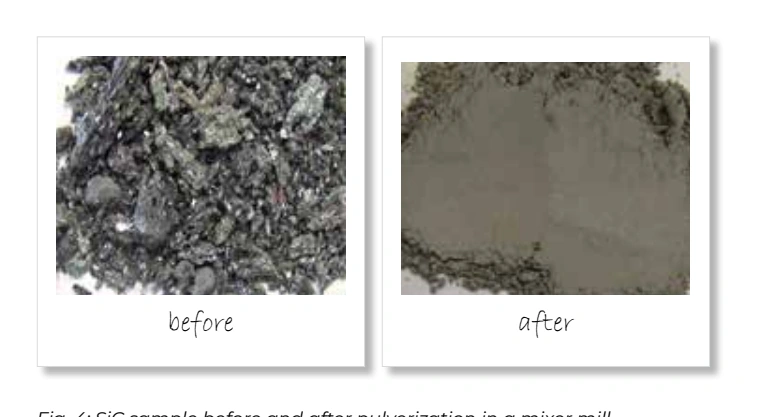
before
after
Application examples sieve analysis
| Sample | Sample amount | Feed size | Model | Parameters Accessories | Remarks | Time |
|---|---|---|---|---|---|---|
| Aluminum | 30 g | 1-45 µm | AS 200 control | • Amplitude 1.2 mm Interval 10 s Sieves:200 mm x 50 mm: 20 /38 / 45 / 63 / 90 µm | Use of steatite balls for improved sieving effects | 10 min |
| Cu-Zn alloy | 40 g | < 315 µm | AS 200 control | • Amplitude 1.2 mm, Interval 10 s Sieves 200 mm x 50 mm: 45 / 53 / 106 / 125 µm | 10 min | |
| Silica gel | 280 g | 2-5 mm | AS 200 control | • Amplitude 1.2 mm, Interval 10 s Sieves 200 mm x 50 mm: 2.8 / 3.15 / 3.35 / 3.55 / 4 mm | 10 min | |
| Tungsten | 3 kg | 10-50 µm | AS 450 basic | • Amplitude 1.3 mm, Interval 10 s 6 sieves 400 mm x 65 mm, 36 µm, and 5 intermediate pans | 500 g sample load per sieve | 1.5 min |
Sieving of metal powders
Sieve analysis
Sieve shakers are used to determine the particle size distribution of bulk materials and fractionize the sample or, in case of a so-called sieve cut, to separate the particles which are smaller than a defined size.
RETSCH vibratory sieve shakers are used in research & development, for quality control of raw materials, intermediate and end products as well as for production control. The drive produces a three-dimensional throwing motion which lets the sample move uniformly over the complete sieve surface. The shakers provide high separation efficiency in a size range from 20 μm to 125 mm, even with short sieving times. It is possible to use different sieve diameters (from 100 mm to 450 mm). Sieve stacks up to 450 mm height allow for separation of up to 17 fractions in one analysis.
The “control” series provides digital setting of amplitude, time, sieve acceleration and intervals. Once a sieving process has been opti-mized, it can be easily repeated thanks to the memory for 9 programs. The optional software EasySieve® helps to evaluate and document sieve analyses in accordance with relevant standards.
Conclusion
Research for new materials as well as quality control of raw materials, intermediate and end products are important aspects in the aerospace industry. Sample preparation guarantees a representative and reproducible processing of the sample material and ensures reliable and meaningful analysis results. Nano grinding or mechanical alloying are important processes in R&D and are best conducted in ball mills. RETSCH offers a range of instruments for crushing and pulverizing of materials like ceramics, polymers, metals, alloys or aerogel, all important in the aerospace industry. A range of sieving machines completes the portfolio offered to this market. To ensure the right choice of instrument for the right sample material, RETSCH provides free-of-charge sample testing in application laboratories all over the world.
Sieve Shaker AS 450 basic
Plan the configuration for your material.
Separate chemical sample preparation, particle analysis and material development. A composite may need controlled reduction of several constituents, while an alloying investigation has a different endpoint. Define what properties must be preserved before deciding on crushing, cutting or ball milling.
| Consideration | Information to provide |
|---|---|
| Material system | Alloy, polymer or composite |
| Laboratory objective | Analysis or development |
| Preparation limits | Contamination and preserved properties |
How should the application examples be used?
The results describe the materials and configurations discussed here. Confirm equipment options, contact materials and operating conditions for your own sample before adopting a method. A demonstrated endpoint does not guarantee the same outcome for a different material.
Discuss material testing with Glen Mills or request further information or a quote.