
How should clay activation be distinguished from size reduction?
Use an evaluation that addresses the intended reactive behavior. A smaller particle distribution alone does not show that the relevant structural change occurred.
traditional thermal calcination. While calcination requires high temperatures and kaolinitic clay resources, the mechanochemical method uses only mechanical energy to change the crystal structure of all clay minerals such as kaolinite, smectite, or illite and prepare them for use as reactive replacements of cement.
The benefits of mechanochemical activation of clays for use in cement blends include:
- CO₂ savings
- Energy efficiency
- Targeted control of reactivity through process parameters
- Use of local clay deposits without time-consuming processing
The research group at the University of Bath (Department of Architectural and Civil Engineering) is one of the leading experts in the field of sustainable cement technologies and develops innovative activation processes for clay minerals that do not require thermal activation (calcination).
Mechanochemical activation in a ball mill Ball mills are used for mechanochemical processes. Through targeted energy input, reactive phases can be generated in ball mills that serve as pozzolanic components in the cement – without any CO₂-intensive firing processes. The ball mill portfolio from Retsch provides optimal conditions for this application by enabling high energy input, offering a variety of jar materials and sizes, allowing precise adjustment of grinding parameters, ensuring easy handling, and supporting scalability at the laboratory scale to prepare for upscaling.
The mechanochemical activation of kaolinitic, smectitic or illitic clays can be implemented, for example, in a PM 100 planetary ball mill (Milling Parameters and experimental setup are given in Figur 1). Research shows that mechanochemical activation is an extremely effective method: It causes profound structural changes, results in finer particles and increases chemical reactivity compared to calcination at 800 °C.
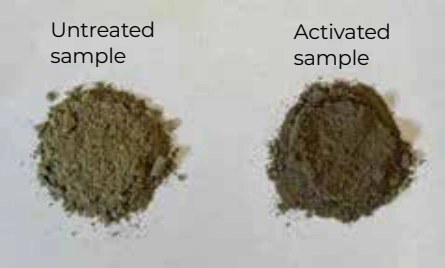
Milling parameters: Speed: 500 rpm Grinding Jar: 500 ml, Stainless Steel Grinding Balls: 12 × 20 mm, Stainless Steel Ball-Powder-Ratio: 25:1 Process Time: 20 minutes
Untreated sample
Activated sample
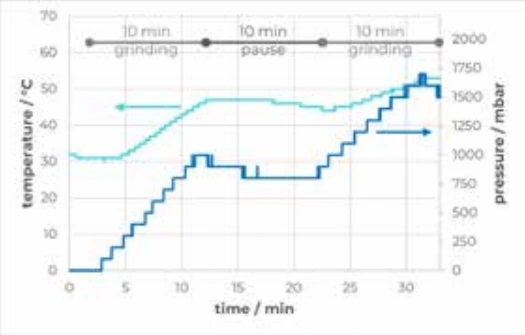
Temperature and pressure monitoring with GrindControl A central aspect of process stability in mechanochemical clay activation is temperature control. The simultaneous recording of the pressure development provides additional information about chemical processes taking place, such as gas releases due to carbonate decomposition and/or volatile components. RETSCH GrindControl system enables continuous measurement and documentation of the temperature and pressure inside the grinding jar. The GrindControl consists of a jar-lid with integrated sensors (accuracy: 1 mbar and 0.1 °C) and data transmitting technology and is available for all jars from 50 – 500 ml size. Thanks to the modular lid insert, the system can be flexibly adapted to different jar materials. The measurement data is transmitted to the computer via Bluetooth and can be recorded, managed and exported as raw data with the GrindControl software.
GrindControl system for measuring temperature and pressure development during a ball milling process. The system is available for various jar sizes and materials, such as zirconium oxide and stainless steel, and is operated in conjunction with GrindControl software.
The GrindControl measurement of the clay activation process shows that both temperature and pressure in the jar increase significantly during mechanochemical activation . After 20 minutes, temperatures of up to 55 °C and pressures of about 1700 mbar are reached – an indication of gas release, possibly due to the decomposition of carbonates and/or other volatile components. Monitoring these parameters is essential to prevent overheating and to precisely analyze and control the reactivity of the mechanochemical process.
Result:
Mechanochemical activation opens up new avenues for sustainable cement formulations. It offers a high degree of flexibility in process design and can be possibly integrated into existing grinding processes – thus holding enormous potential for a greener future. The basic engineering investigations are based on laboratory ball mills. Retsch offers
comprehensive range of mills and accessories for this purpose, including tools such as the GrindControl system for pressure and temperature monitoring, enabling thorough exploration of this forward-looking topic and its practical implementation in manufacturing.
Tole, I., Delogu, F., Qoku, E., Habermehl-Cwirzen, K., & Cwirzen, A. (2022). Enhancement of the pozzolanic activity of natural clays by mechanochemical activation. Construction and Building Materials, 352, 128739.
Plan the configuration for your material.
Compare milling treatments on an identified clay and evaluate the product using a suitable characterization method. Tool contact, energy input and loading should be recorded with the result. A grinding condition that works for one mineral mixture is not automatically transferable to another.
| Consideration | Information to provide |
|---|---|
| Clay preparation | Mineral identity and starting state |
| Treatment record | Vessel, media and loading |
| Activation assessment | Structural and reactivity tests |
How should the application examples be used?
The results describe the materials and configurations discussed here. Confirm equipment options, contact materials and operating conditions for your own sample before adopting a method. A demonstrated endpoint does not guarantee the same outcome for a different material.
Discuss material testing with Glen Mills or request further information or a quote.