
Does processing several specimens together establish diagnostic accuracy?
No. Parallel preparation is an equipment workflow. Diagnostic performance must be established for the complete validated laboratory method.
Joint replacements, especially of hip and knee joints, rank among the most frequent surgical interventions in industrialized countries. In Germany, specialists implant approximately 210,000 artificial hips and 165,000 artificial knees every year. Growing life expectancy as well as higher demands on the quality of life have led to a clear trend in endoprosthetics. Since 2007, an increase of 20% in the frequency of first implants of knee joints has been noted, with rising tendency.
One of the major risks of a joint replacement is prosthetic joint infection (PIJ), a bacterial infection at the interface of implant, tissue, and bone. In <1% of the cases, an infection occurs within the first 2 years after the initial hip replacement; for knee implants, it is <2% and for elbows even <7%. However, it is assumed that some infections are classified as aseptic revisions, resulting in a higher percentage of PIJ.
A variety of microorganisms contribute to the septic revision: staphylococci, streptococci, enterococci, gram-negative corynebacteria, propionibacteria, pathogens, and even yeasts such as Candida. Accurate diagnosis of the involved microbes is essential to select a targeted treatment. The classification of different microorganisms which cause PIJ with conventional methods is in many cases limited.
In 2010, A.-L. Roux et al. published an article titled „Diagnosis of prosthetic joint infection by beadmill processing of a periprosthetic specimen.“ It describes a new diagnosis method of involved microbes, with an impressive documentation rate of more than 83% and, at the same time, a very low contamination rate of 8.7%. The method involves washing the microbes off the tissue samples with 20 ml sterile water and 5 ml glass beads of 1 mm diameter at 30 Hz in a RETSCH mixer mill within 210 seconds. For this procedure, sterile 30 ml single-use bottles were used which were clamped directly to the mixer mill. The supernatant was then either spread on plates for incubation or was cultivated directly in a liquid medium. Diagnosis by PCR (Polymerase Chain Reaction) was also possible.
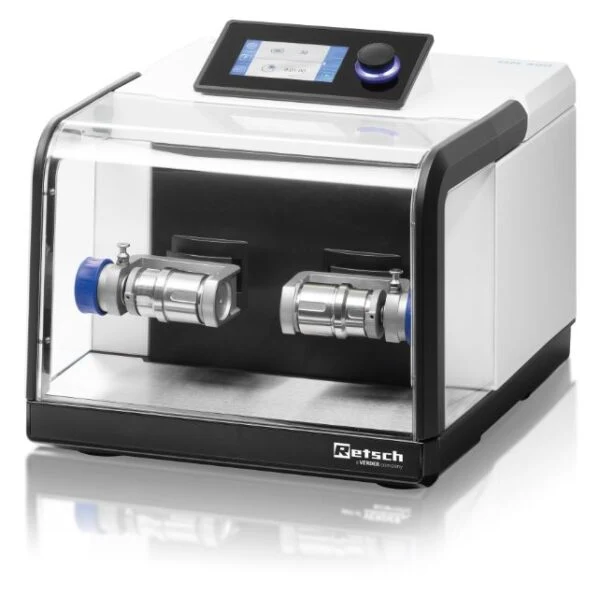
RETSCH Mixer Mill MM 400 with adapters for 30 ml single-use bottles
The New Adapter
RETSCH has developed a new adapter for the Mixer Mill MM 400 which accommodates 4 x 30 ml single-use sample bottles. Hence, up to 8 samples may be simultaneously treated with this simple and effective method. For applications on a smaller scale, adapters for 5 x 5 ml reaction vials are available allowing for processing of up to 10 samples in one go.
Mixer Mill MM 400 – a true „all-rounder“ in the lab
The MM 400 is a well-proven multi-purpose mill for fine and ultrafine grinding of hard, medium-hard, brittle as well as soft, elastic, or fibrous materials down to 5 microns. Typical samples include plants, fir needles, feathers, bones, tissue, tablets, wood, minerals, or chemicals. The mixer mill is also suitable for cell disruption of bacteria or yeast cells. The grinding jars are available in 6 different materials; the stainless steel version can be used for cryogenic grinding. For this application, RETSCH offers the KryoKit, consisting of insulated boxes, tongs, and goggles, to embrittle the sample in liquid nitrogen at -196 °C.
Plan the configuration for your material.
Parallel vessel handling should preserve sample identity and apply the intended treatment consistently. Confirm the supported accessories and specimen format, then assess recovery within the laboratory's full method. Published experimental outcomes cannot be assumed for another patient population or procedure.
| Consideration | Information to provide |
|---|---|
| Parallel handling | Vessel identification and sequence |
| Treatment setup | Supported accessories and sample volume |
| Method controls | Recovery and contamination checks |
How should the application examples be used?
The results describe the materials and configurations discussed here. Confirm equipment options, contact materials and operating conditions for your own sample before adopting a method. A demonstrated endpoint does not guarantee the same outcome for a different material.
Discuss material testing with Glen Mills or request further information or a quote.