Particles and process stage
A finely mixed nickel-phosphate precursor is not necessarily LiNiPO4. The starting phases, lithium source and subsequent reaction conditions need to be specified before milling is treated as a synthesis method.

JET-MILLING SUITABILITY
Plan experimental LiNiPO4 precursor preparation with a defined reaction sequence, tool-compatibility review and phase verification after the required synthesis steps.
Lithium nickel phosphate, LiNiPO4, is an olivine phosphate investigated for high-voltage cathode research. It is an experimental material context here, not a promise of a production-ready electrode or a one-step milling synthesis.
A finely mixed nickel-phosphate precursor is not necessarily LiNiPO4. The starting phases, lithium source and subsequent reaction conditions need to be specified before milling is treated as a synthesis method.
Review nickel-containing reagents, solvent compatibility where relevant and the cleaning protocol. Do not infer pressure-reactor capability from a grinding jar or transfer hydrothermal conditions to standard milling hardware.
Technical background: Mechano-chemical precursor synthesis and transformation to LiNiPO4. See the source limits below before applying a published method to this powder.
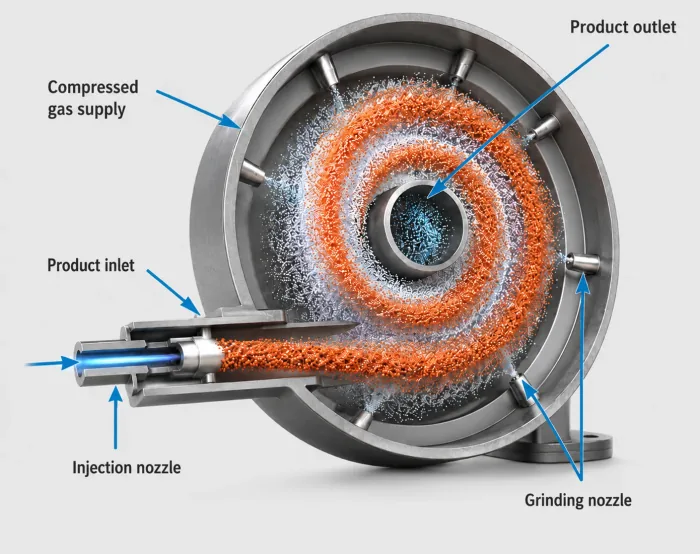
Jet milling is not the primary candidate for precursor activation in this draft. A future dry finishing step would require its own purpose, feed characterization and material-integrity assessment.
Evaluate a planetary or mixer mill for controlled precursor preparation. Research combining mechanical and hydrothermal preparation with later conversion demonstrates why the whole reaction sequence matters, rather than milling time in isolation.
A blend-only preparation can serve as a comparison when investigating the effect of mechanical activation. Keep composition and downstream treatment consistent between the two routes.
A proposed evaluation brief, not a validated processing recipe.
Start by checking whether the intended powder change calls for dry jet milling. Jet milling is not the first route proposed for this preparation task; review the material-specific method discussion before requesting a configuration.
Explore laboratory jet mills Explore pilot and production jet mills
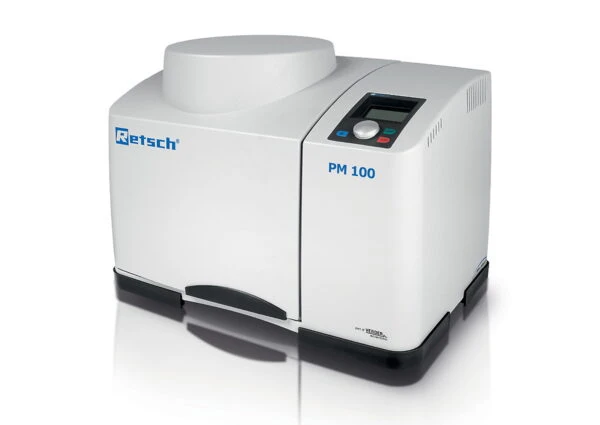
Precursor activation and defined mechanical research
Confirm: Jar and media compatibility, wear, temperature and retained phase.
View RETSCH PM 100 Planetary Ball Mill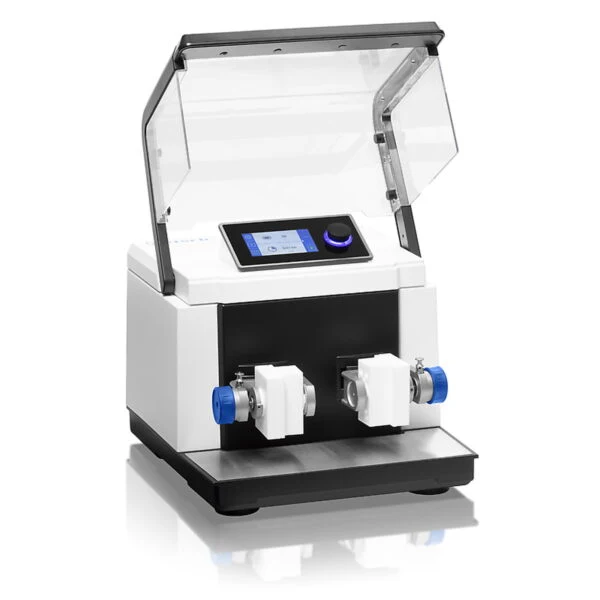
Small-sample grinding and analytical homogenization
Confirm: Representative aliquots, contact-material contamination and sample recovery.
View RETSCH MM 400 Mixer MillThese are candidates for application review. Equipment listings do not establish cathode-specific performance, inert-gas capability or containment. Confirm the exact configuration with Glen Mills.
Verify chemical composition and phase identity after conversion, then assess particle shape and contact-material impurities. Electrochemical evaluation needs an appropriate high-voltage test system and cannot be replaced by powder fineness.
Percentiles depend on the measurement and weighting basis. Report the method, dispersion conditions and complete curve. These labels are definitions, not target sizes or equipment guarantees.
Share the chemistry, processing stage, quantity and current condition.
Confirm suitability, safety information, scope and acceptance measures before shipping.
Evaluate the intended change against morphology, contamination and retained function.
Review feeding, recovery, handling and the additional validation needed.
Free feasibility testing depends on material suitability and an agreed scope. Ask which measurements are available, how much sample is required and which handling arrangements are needed. Do not ship powder before written instructions.
Moving from a laboratory trial to pilot or production work requires review of feeding, collection, cleaning, thermal behavior and throughput. A laboratory result does not establish performance at a larger scale.
Get an equipment recommendationIt is not the primary route proposed here for LiNiPO4 precursor or composite work. A dry finishing trial would require a separate objective and material review.
Specify composition, processing stage, primary and secondary morphology where applicable, and the full particle-size distribution. For LiNiPO4, the first decision is: use mechanical preparation to test a specific precursor-route hypothesis, with phase confirmation at the end of the route.
No. Verify LiNiPO4 after the full specified conversion route. A fine or activated precursor does not establish the target phase.
Consider it when LiNiPO4 precursor activation, analytical preparation or deliberate material modification is the experiment. Confirm the intended change and the measurements that would identify unwanted damage before choosing settings.
No. Use only manufacturer-approved hardware and operating conditions. A mechanically assisted hydrothermal research method does not establish reactor capability for a standard mill jar.
Share the exact composition or a nonconfidential description, SDS, processing stage, starting condition, desired result and quantity. Include atmosphere and impurity limits. Glen Mills must agree on suitability, scope and shipping before receiving the sample.
The cited primary paper studies a mechanically assisted hydrothermal nickel-phosphate precursor and subsequent transformation to LiNiPO4. It does not validate an ordinary ball mill as a complete synthesis installation.
Prepared . Literature and manufacturer references support the discussion; they do not establish a tested Glen Mills recipe for your powder.
Application-selection guidance for discussion with Glen Mills. Equipment and application support since 1980
YOUR MATERIAL. YOUR NEXT STEP.
Tell us which powder you have, what needs to change and what must remain intact.
Start with a jet-milling suitability review. Request free feasibility testing or an equipment recommendation; the team will confirm whether dry jet milling fits the material and agree on scope before arranging a test.
Start with a nonconfidential description. Contact us before sharing proprietary formulations, and wait for written shipping instructions before sending material.