
Why consider wear during ceramic preparation?
Wear can introduce material from the tools. Its significance depends on the ceramic composition and the sensitivity of the intended analysis.
Technical ceramics, also known as advanced ceramics, are a specialized category of ceramic materials designed for high-performance applications across various industries. These materials are distinguished by their superior mechanical, thermal, and electrical properties, making them essential in sectors such as aerospace, automotive, electronics, and medical technology. Technical ceramics are engineered to withstand extreme conditions, outperforming traditional materials and driving innovations in product design and manufacturing processes. Ongoing research continues to enhance their properties and broaden their applications, highlighting their growing relevance in sustainability and efficiency in industrial processes. As industries seek innovative materials to meet modern engineering challenges, technical ceramics are positioned at the forefront of material science, promising significant contributions to future technologies.
Pre-crushing and homogenizing required: Two steps in one go Grinding technical ceramics is crucial because it allows for precise shaping and sizing of these materials, ensuring they meet the specific requirements of various applications. This process enhances the mechanical properties of ceramics, making them suitable for high-performance uses. Additionally, grinding helps achieve tight tolerances and smooth surface finishes, which are essential for the functionality and reliability of ceramic components. Many of the ceramics are quite hard, thus not as easy to grind. Abrasion also plays a
significant role when choosing most suitable grinders and milling systems. Pre-crushing can be done best in Jaw Crushers, with are available also with breaking jaws made of zirconium oxide or tungsten carbide – both abrasion resistant materials and technical ceramics themselves. Fine grinding steps follow in Planetary ball Mills or Disc Mills for example, depending on the sample amount and the required final particle size and distribution. Numerous reports from Retsch detail the fine grinding of materials such as zirconium oxide and aluminium oxide in ball mills, achieving nano-sized particles through wet grinding processes. This article, however, focuses on the pre-grinding stage and introduces RETSCH new combination unit, which integrates a jaw crusher with a disc mill and a cyclone.
Case study Silicon Carbide
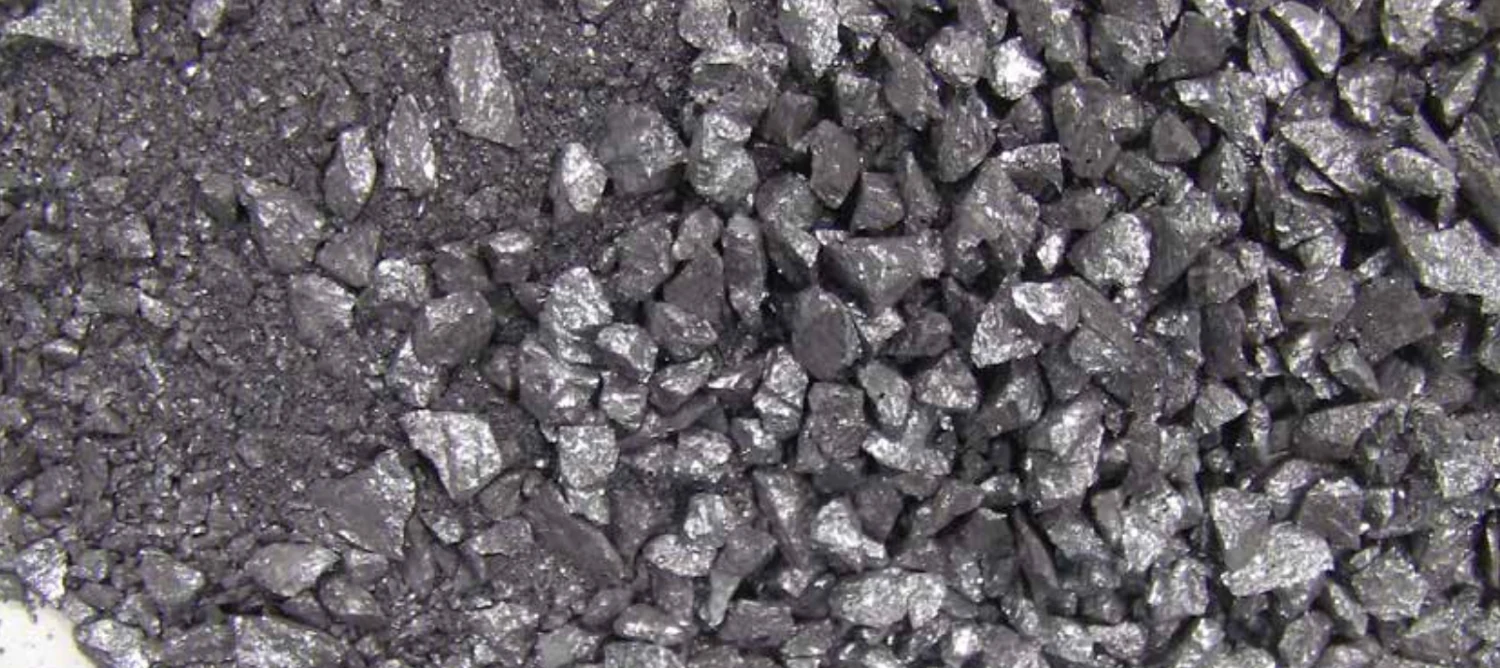
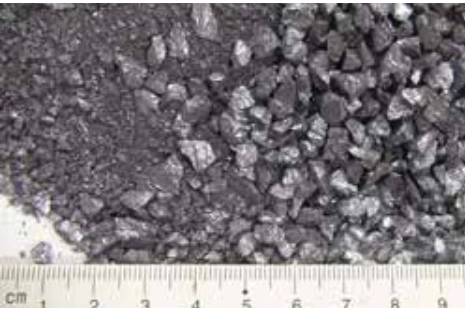
About 500 g silicon carbide were crushed in the new combination unit. Initial feed size was 100 mm, and the gap of the BB 250 was set to 2 mm. The feed rate has to be adapted to the fine grinding step in the Disc Mill DM 200 of the combination unit. The sample material breaks as plates, so that bigger particles less than 10 mm were fed in the fine grinding step. In this case, the sample was processed in about 10 min. The gap of the Disc Mill was set to 300 µm, so that in the end around 700 µm particles were obtained. To avoid material wear, the Jaw Crusher can be equipped with tungsten carbide jaws or with NiHard4, the disc mill with plates of tungsten carbide. For demonstration reasons, the intermediate fraction is also shown.
Hard task: Large sample quantities of silicon carbide Larger sample quantities of such hard sample like silicon carbide are better crushes in two separate units. First step pre-crushing, followed by sample division step and fine-grinding of a part sample. The Jaw Crusher BB 500 is the ideal instrument to grind larger sample pieces and quantities of such hard samples like silicon carbide. 6 kg (about 10 pieces) of the sample with size 120 mm were crushed in just 2 min in the BB 500 with a gap setting of zero. The sample can be divided into 10 equal sub-samples using Retsch´s PT 300, each of 600 g sample. If required, a second sample division step can be added to get part samples of 60 g sample for further grinding steps.
Plan the configuration for your material.
Review the interfaces between crushing, grinding, discharge and analysis. Tool wear can matter where small compositional changes are relevant. Define the required prepared form and contamination limits for each material rather than applying one broad ceramics setting to all components.
| Consideration | Information to provide |
|---|---|
| Ceramic composition | Constituents and wear sensitivity |
| Stage interfaces | Crushing through collection |
| Analytical limits | Fineness and permitted contamination |
How should the application examples be used?
The results describe the materials and configurations discussed here. Confirm equipment options, contact materials and operating conditions for your own sample before adopting a method. A demonstrated endpoint does not guarantee the same outcome for a different material.
Discuss material testing with Glen Mills or request further information or a quote.
Explore the equipment discussed
- RETSCH BB 500 Jaw Crusher
- RETSCH PT 300 Rotating Sample Divider
- RETSCH DM 200 Disc Mill
- RETSCH BB 250 Jaw Crusher