
Can sample weight alone determine cutting-mill suitability?
No. Feed shape, bulk and breaking behavior also affect preparation. A low-weight sample can still need an appropriate feeding and cutting arrangement.
For the grinding of singular children's toys for analytics of hazardous substances, a feather sample with a low weight or a small batch of herbs, the existing range of cutting mills does not yet offer a satisfactory solution. The lossy sample recovery of larger machines as well as the difficulties of smaller machines to take up large samples or milling power to provide the necessary performance for effective processing define the problems.
The solution is the SM 50 Cutting Mill with its pioneering new development: the Total Access Concept consisting of EasyInspect, Push-fit and EasyClean. The device combines the compactness of bench-top models with the power performance of floor-standing mills and therefore has all the features needed to become an indispensable classic in laboratory technology.
The (technical) design of the SM 50
is space-saving, time saving and makes cleaning uncompromisingly easy impresses with its universality thanks to its unique, modular design (push-fit) can be seamlessly integrated into any laboratory environment.
By this SM 50 increases the number of possible grinding processes, when processing a variety of sample materials in series. Thanks to the Total Access Concept up to 150 percent more grinding processes can be realized. The innovative push-fit milling chamber supports the use of multiple chambers, enabling cleaning and grinding to happen concurrently, which reduces process time by 60 percent. While one chamber is being cleaned, the other can be used for the next grinding process. The newly developed approach ensures efficient, virtually contamination-free, and precise sample preparation.
Sample recovery of up to 100 percent
With almost 100 % sample recovery, the SM 50 sets new benchmarks for working with small sample amounts where maximum material recovery is crucial. The comprehensively improved technical design reduces deposit areas by shortening the distances from the hopper to the collection container. The cyclone integrated directly into the mill housing
reduces the release of dust speeds up the grinding process avoids excessive heat development and allows for the compact design.
The coordinated design of the sample hopper and the integrated cyclone ensure extremely high separation efficiency.
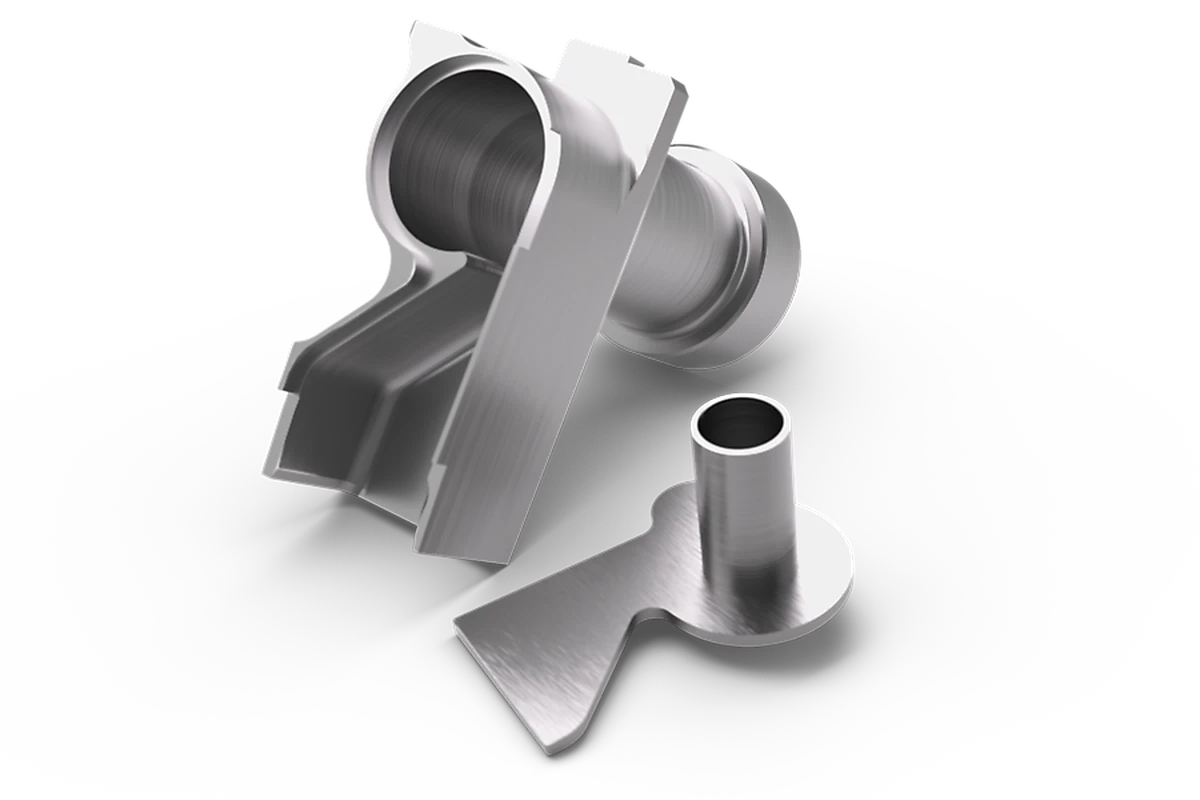
The highlight of the SM 50 is the Total Access Concept, consisting of the EasyInspect hopper and push-fit milling chamber, which has been brought to series maturity for the first time and revolutionizes cleaning processes, thus enabling contamination-free milling. The EasyInspect hopper easily opens completely so that even the smallest residues can be recognised and removed. The unique push-fit milling chamber can be completely removed without tools and can be cleaned thoroughly under water. This results in extreme advantages when processing small sample amounts, as quick and thorough cleaning prevents cross-contamination. Another factor for cross-contamination is the continuous abrasion of the milling tools. The removable milling chambers of the SM 50 are available in different materials so that a wide variety of initial samples can be processed directly one after the other:
a version for standard applications a version for milling without heavy metal contamination a stainless steel version for corrosion an abrasion-resistant milling
Precise milling performance thanks to a powerful, compact design
Above all, the combination of high sample capacity and small footprint makes the SM 50 a must-have in any laboratory environment. The robust 1.5 kW motor with a high speed of up to 4,000 rpm drives a large rotor with a diameter of 130 mm, which maximizes the cutting speed for maximum milling performance and minimum risk of blockages. Also sample materials that are embrittled with LN2 are milled with power. For large and tough sample pieces, the SM 50 supports the user with a large feed size for grinding monolithic samples up to 50 mm. The advantage: Pre-grinding is no longer necessary, which saves time and reduces the overall process duration. The generous hopper and chamber volume also favours the grinding of voluminous, fluffy materials. It is based on a sluice principle that enables controlled feeding of the sample material and thus ensures maximum performance of the rotor and cyclone.
Equipped for the use of a wide variety of samples
Equipped to handle a diverse array of samples, the SM 50 offers exceptional versatility with a wide range of accessories. This includes sieves with aperture sizes from 0.25 mm to 10 mm, allowing precise control over particle sizes. The rotor speed is infinitely adjustable via a touch display and push button, facilitating tuning to meet specific sample types and grinding requirements. With various rotor types, the SM 50 excels in grinding fibrous, hard, brittle, soft and dusty samples such as herbs, bark, and dried vegetables. This flexibility is essential for laboratories dealing with diverse materials to ensure consistent and reproducible results. Its reliable handling of a broad spectrum of sample materials makes the SM 50 a true all-rounder for numerous applications.
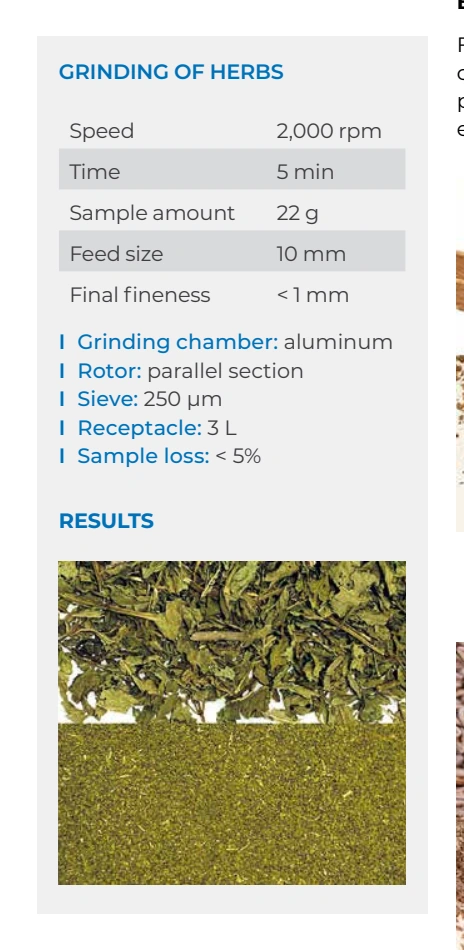
Brittle and dusty samples
For small amounts of material that are easy to grind yet demand full recovery, the compact SM 50 provides an ideal solution. Its batch feeding system allows for rapid processing and the integrated cyclone for near-complete recovery of sample material, even with slightly greasy and sticky substances, like those found in animal feed.
Herb-grinding trial
| Parameter | Trial condition |
|---|---|
| Speed | 2,000 rpm |
| Grinding time | 5 min |
| Sample quantity | 22 g |
| Feed size | 10 mm |
| Final fineness | <1 mm |
| Grinding chamber | Aluminum |
| Rotor | Parallel-section rotor |
| Sieve aperture | 250 µm |
| Receptacle | 3 L |
| Reported sample loss | <5% |
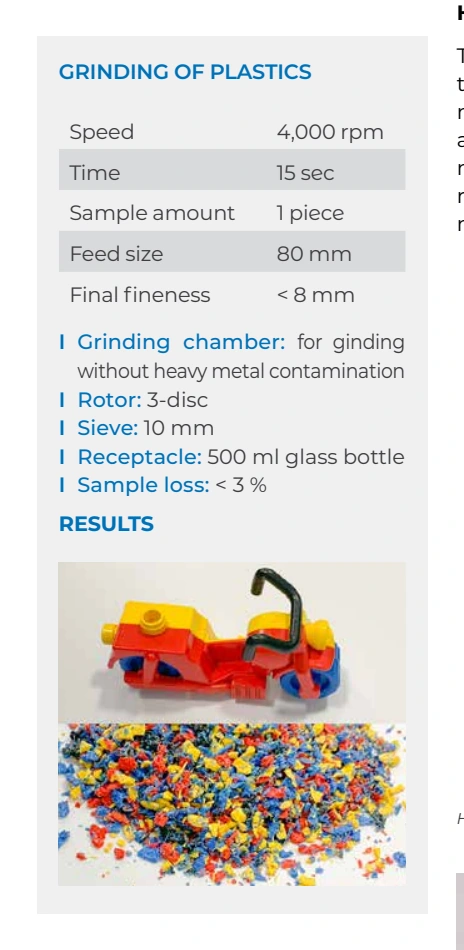
Plastic-grinding trial
| Parameter | Trial condition |
|---|---|
| Speed | 4,000 rpm |
| Grinding time | 15 s |
| Sample quantity | 1 piece |
| Feed size | 80 mm |
| Final fineness | <8 mm |
| Grinding chamber | Configuration for grinding without heavy-metal contamination |
| Rotor | Three-disc rotor |
| Sieve aperture | 10 mm |
| Receptacle | 500 mL glass bottle |
| Reported sample loss | <3% |
Hard and tough samples
The SM 50 grinds large pieces efficiently and easily. The large feed hopper fills a gap in the market for benchtop grinding solutions. Its cyclone technology transports sample material to the collector, making it ideal for hard and temperature-sensitive samples such as plastic parts, wood chips and dry food such as dog chews. With a powerful 1.5 kW motor and speeds up to 4,000 rpm, the SM 50 maximizes cutting speed and reduces the risk of blockage. Liquid nitrogen can be used for cooling or embrittlement of softer materials.
] s / m [ y t i
Feather-grinding trial
| Parameter | Trial condition |
|---|---|
| Speed | 2,000 rpm |
| Grinding times | 1 min and 1 min 30 s |
| Sample quantity | 1 L / 6 g |
| Feed size | 60 mm |
| Final fineness | <2 mm |
| Grinding chamber | Aluminum |
| Rotor | Parallel-section rotor |
| Sieve apertures | 6 mm and 750 µm |
| Receptacle | 3 L |
| Reported sample loss | <5% |
Light and voluminous samples
Light and voluminous samples such as feathers, textiles, paper and hay are effectively transferred via the milling chamber using a special flap in the hopper. Cyclone technology aids in transporting these samples through the sieve to the collection container.
Conclusion: A Lab Essential for the daily work
The SM 50 cutting mill is a versatile and powerful tool for laboratories focusing on grinding small sample quantities. Its globally unique design ensures contamination-free grinding, easy cleaning and high sample recovery, making it an indispensable laboratory tool for achieving precise and reliable results. With its advanced features and flexibility, the SM 50 sets a new standard in laboratory grinding and fulfills even the most precise requirements when processing small samples.
Plan the configuration for your material.
A sample may be bulky while still having a low total mass. Describe those properties separately when discussing a cutting setup. Assess whether the preparation preserves the relevant mixture and leaves enough material for the analytical work, including any repeat or reserve portions.
| Consideration | Information to provide |
|---|---|
| Feed geometry | Largest piece and shape |
| Available mass | Analytical and reserve needs |
| Recovery objective | Usable output after collection |
How should the application examples be used?
The results describe the materials and configurations discussed here. Confirm equipment options, contact materials and operating conditions for your own sample before adopting a method. A demonstrated endpoint does not guarantee the same outcome for a different material.
Discuss material testing with Glen Mills or request further information or a quote.