
Should a powder be milled before measuring its original distribution?
Not when the original distribution is the required measurement. Preparation that changes particles must be distinguished from separation and testing.
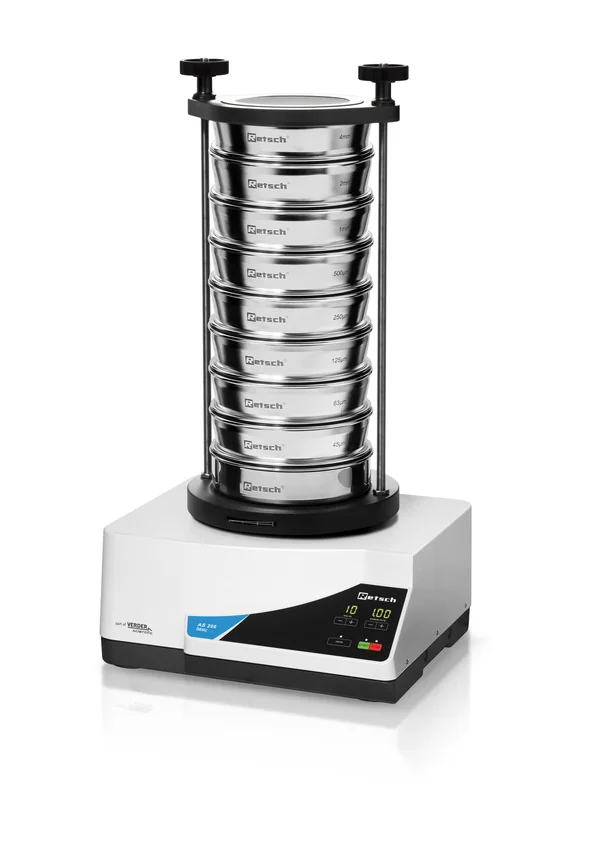
Concept Laser uses the sieve shaker AS 200 basic to separate unused metal powders after the 3D printing process
Sieving and Pulverization of Metal Powders
Re-using raw materials is an important factor in powder metallurgical processes. RETSCH offers a range of instruments which are suitable for sieving powders and pulverizing metal parts both of which are re-introduced into the production process. The following examples demonstrate the suitability of RETSCH instruments for these applications.
Separation of size fractions by sieving to recover metal powder residues after 3D printing using laser technology
RETSCH sieve shakers, like the Vibratory Sieve Shaker AS 200 basic, are well suited to sieve agglomerated metal powder before it is used for 3D printing, or to separate the unused metal powder after the printing process into fractions with the objective to recover the fi ne particles for re-use. Concept Laser, a manufacturer of machines for 3D printing of metal components, uses the AS 200 basic for this purpose. It is the economical model of the AS 200 series with familiar RETSCH quality and reliability. 1 to 17 fractions may be obtained after short sieving times. The shaker features digital setting and display of performance and time ensuring comfortable sieving of ferrous and non-ferrous metals like gold, tungsten carbide, or precious metals.
The most common test sieves used for this application are RETSCH test sieves with 200 or 203 mm diameter and a height of 25 mm or 50 mm according to ISO 3310-1 or ASTM E11. Aperture sizes of 32 µm – 150 µm are best suited to separate the non-agglomerated metal powder after the printing process for recovery. Very common is the use of the following aperture sizes: 32 µm, 40 µm, 50 µm, 63 µm, 100 µm and 150 µm.
The well-proven RETSCH sieves consist of a high-stability stainless steel frame to ensure reliable sieving results. Paying close attention to mesh-specifi c requirements, the sieve fabric is precisely joined into the frame and tautened. The individual laser engraving of each RETSCH test sieve provides a clear and accurate labeling with full traceability.
Vibratory Sieve Shaker AS 200 basic and test sieves
Recycling of green bodies or hard metal parts produced by Metal Injection Molding
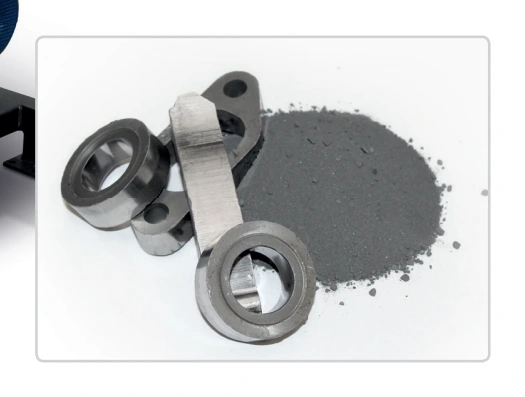
Metal Injection Molding is used to produce metal parts of complex geometrical shapes. Metal powders and binders are mixed to a feedstock and injected into a mold using plastic injection molding machines (MIM) to form so-called green parts in the fi rst step, followed by partial removal of the binder to form fragile brown parts, and fi nally the sintering process to produce stable new metal parts of a defi ned complex shape. At each stage, intermediate parts with undesired properties may be produced. These are crushed and pulverized to recover the raw material for re-use.
Jaw Crushers like RETSCH’s BB 500 XL pulverize defective green parts, brown parts, or hard metal parts within minutes.
Application example: 10 kg of green parts < 100 mm were crushed in two batches with closed gap (i.e. direct contact between fi xed and moving crushing arm) in the Jaw Crusher BB 500 XL. Each batch was pulverized to a fi nal fi neness of 85 % < 250 µm after only 1 minute.
Jaw Crusher BB 500 XL
Plan the configuration for your material.
If the original distribution is the subject of the test, grinding would change what is being measured. If chemical preparation is required, tool contributions and representativeness become central. Explain the alloy, process history and final test before choosing sieving or pulverization equipment.
| Consideration | Information to provide |
|---|---|
| Preparation objective | Measure or change the powder |
| Alloy context | Composition and process history |
| Tool compatibility | Contact materials and analytical limits |
How should the application examples be used?
The results describe the materials and configurations discussed here. Confirm equipment options, contact materials and operating conditions for your own sample before adopting a method. A demonstrated endpoint does not guarantee the same outcome for a different material.
Discuss material testing with Glen Mills or request further information or a quote.