
Does a matching particle distribution prove mortar compatibility?
No. Distribution is one consideration. The material's composition and the requirements of the restoration application also need evaluation.
Technical article.
The Cologne Cathedral is a venerable old building whose historic substance is preserved by continuing restoration works. Mortar is one of the construction materials that the conservators use for preservation and restoration of the ancient stones. To obtain mortar with optimum quality, the conservators at the cathedral workshop in Cologne use a RETSCH sieve shaker to determine the particle size distribution of the material.
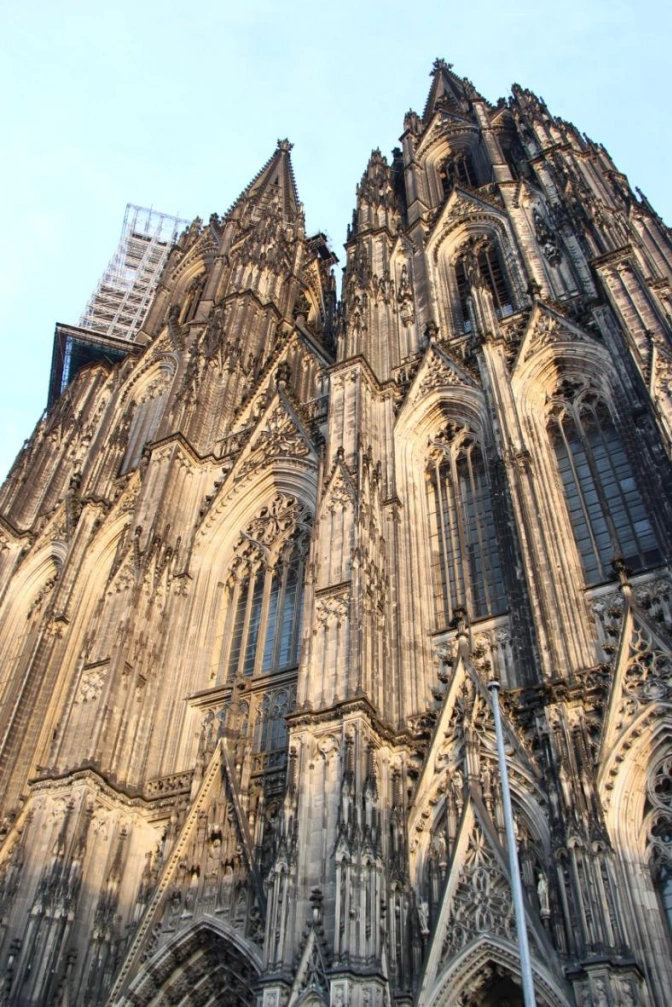
It is a landmark not only for Cologne but also for the whole of Germany - the Cologne Cathedral. Majestically and awe-inspiring it towers over the heart of the city and is part of the UNESCO World Heritage since 1996. The Cathedral gained in importance when the Archbishop brought the relics of the three Magi to Cologne in 1164. As a
consequence, huge
numbers of pilgrims poured into the city which made the construction of a bigger building
inevitable. Roughly
300,000 tons of stone were used to build the cathedral; in the Middle Ages it was mainly
trachyte
from
the
German “Siebengebirge”, in the 19th century mostly sandstone. With the help of the medieval building plans the cathedral was finished in 1880 after more than 600 years construction time.
But time has taken its toll on the cathedral and the consequences are quite obvious: some part of the Cologne Cathedral is always covered in scaffolding. The influence of acid rain and the permanent weathering of the stone surfaces have brought about a variety of damages. The foremost task of the cathedral
Technical article.
workshop is therefore to preserve the historic edifice from decay. To conserve the original structures is very challenging as the different stone types used show different degrees of weathering. The cathedral workshop tests various media to preserve the façade. Surprisingly, it is the very small particles which are ideally suited to protect the cathedral from water and help to create a façade as historically correct as possible.
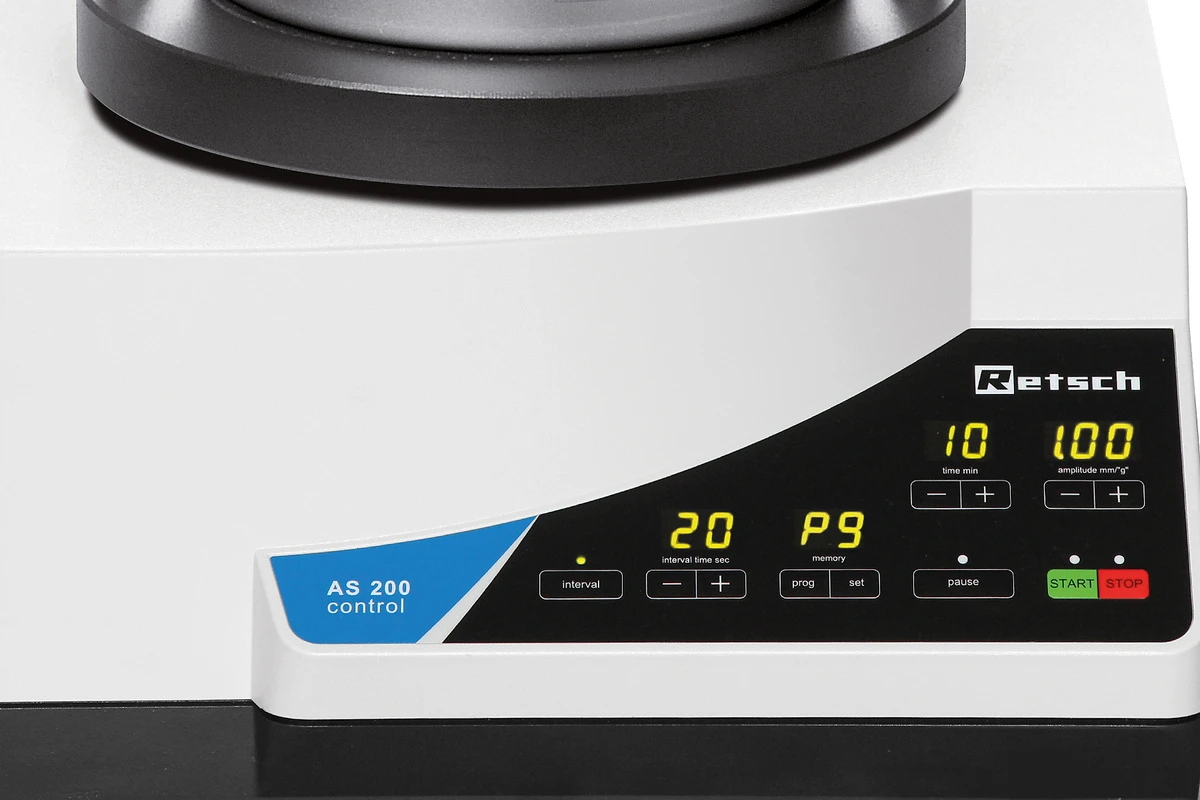
Sieve Shaker AS 200 control in the cathedral workshop
Conservation of stones and facades with mortar
In the summer of 2013 three young stone restorers joined the Cologne cathedral workshop. The stone mason Jasper Voelkert, M. A., is specialized in mortar. “The conservation of the stone surfaces will gain more importance in the future to protect the historic substance and fill cracks”, explains the specialist. The newly equipped workshop tests different types of mortar to find the type which is best suited to imitate the structure and color of the original stones. In the Middle Ages mostly trachyte was used which has a tendency to crack. The breaking edges need to be stabilized, to avoid, for example, the intrusion of water.
Mortar consists of an aggregate which significantly influences the granulation and color, binding agents such as silicic acid, lime or cement and various other additives for adhesion and stabilization. Optimized mortar not only matches the color and structure of the stone in need of restoration but also its physical properties. To keep the pore space as small as possible, particles with a mixed granulation, for example sand and quartz, are used. This mixture not only hinders the intrusion of water but it also reduces the amount of binding agent and increases stability. A particle size distribution which closely follows the Fuller
Technical article.
particle size distribution curve is ideal to reduce the space between the particles. The comparison shows the Fuller particle size distribution with a maximum particle size of 4 mm. To fill the spaces between the particles in the best possible way, 70 % of the grains should be smaller than 2 mm, 50 % smaller than 1 mm and the fine fraction below 63 µm should still amount to 12.5 %.
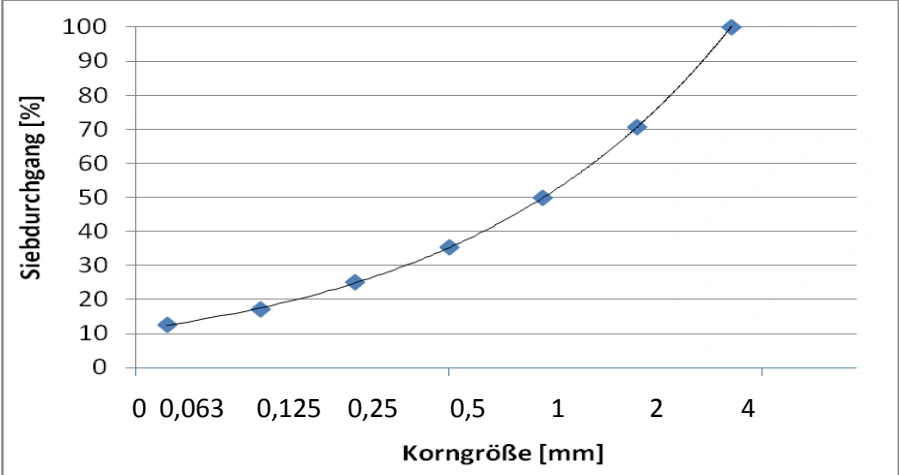
Ideal particle size distribution (Fuller curve) with a maximum particle size of 4 mm. The hollow space between the particles should be as small as possible.
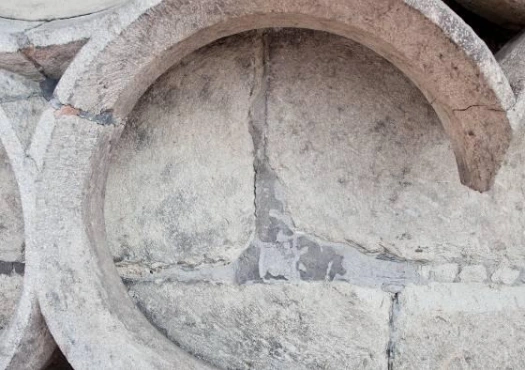
Cologne, Cathedral, Window S 3, wall area in tracery, before (left) and after (right) restoration © Dombauhütte Köln / photo: M. Unkelbach
Sieve Shaker AS 200 control used in mortar production
How can mortar be optimized with regards to its structure, color and particle size distribution? On the one hand, different fractions of sand and other aggregates are required which are newly combined to obtain the correct mortar. Moreover,
Technical article.
mortar is usually supplied in large bags which contain too much of the coarse fraction, whereas only a small part of the finer particles is required. When the restorers joined the team at the cathedral workshop, a RETSCH sieve shaker AS 200 control was purchased. “The use of the AS 200 control makes our work a lot easier and mortar production reproducible. Without it we would need to sieve the fractions by hand which would lead to rather empirical test runs”, explains Jasper Voelkert. The AS 200 control helps to obtain an optimized mortar which closely follows the Fuller particle size distribution and which is a mixture of different fractions, sieved from various bags.
RETSCH sieve shakers are used in Research & Development, for quality control of raw materials, intermediate and end products as well as for production control. The patented electromagnetic drive allows for optimum adaptation to the sample material. The drive produces a three-dimensional throwing motion which lets the sample move uniformly over the complete sieve surface. The shakers provide high separation efficiency in a size range from 20 µm to 125 mm, even with short sieving times. It is possible to use different sieve diameters (from 100 mm to 450 mm). Sieve stacks up to 450 mm height allow for separation of up to 17 fractions in one analysis. The “control” series provides digital setting of amplitude, time, sieve acceleration and intervals. Once a sieving process has been optimized, it can be easily repeated thanks to the memory for 9 programs. The optional software EasySieve® helps to evaluate and document sieve analyses in accordance with relevant standards
Stone restorer Jasper Voelkert M. A. with sieve shaker AS 200 control
Technical article.
Conclusion
Restoring historical buildings is a challenging task. It is of great importance to use materials which allow for a historically correct preparation of the stones. The team at the cathedral workshop Cologne uses a RETSCH AS 200 control sieve shaker to produce mortar with optimum particle size distribution as it is required for the restoration and visual improvement of the cathedral façade.
Fuller Particle Size Distribution:
The particle size distribution graphically represents the granulation of a material. It is ascertained by using sieves with different aperture sizes which correspond to the particle sizes of standards DIN 1045, DIN 4022 and DIN 18196. The Fuller particle size distribution shows the ideal distribution where the hollow spaces between the particles are minimized.
Plan the configuration for your material.
Choose the fractions relevant to the mortar formulation and keep sample handling consistent. Particle distribution is one material attribute alongside composition, color and other requirements of the restoration work. A laboratory distribution should be interpreted within that complete formulation and application context.
| Consideration | Information to provide |
|---|---|
| Material source | Ingredient and batch identity |
| Sizing method | Relevant sieve fractions |
| Formulation context | Required mortar properties |
How should the application examples be used?
The results describe the materials and configurations discussed here. Confirm equipment options, contact materials and operating conditions for your own sample before adopting a method. A demonstrated endpoint does not guarantee the same outcome for a different material.
Discuss material testing with Glen Mills or request further information or a quote.