
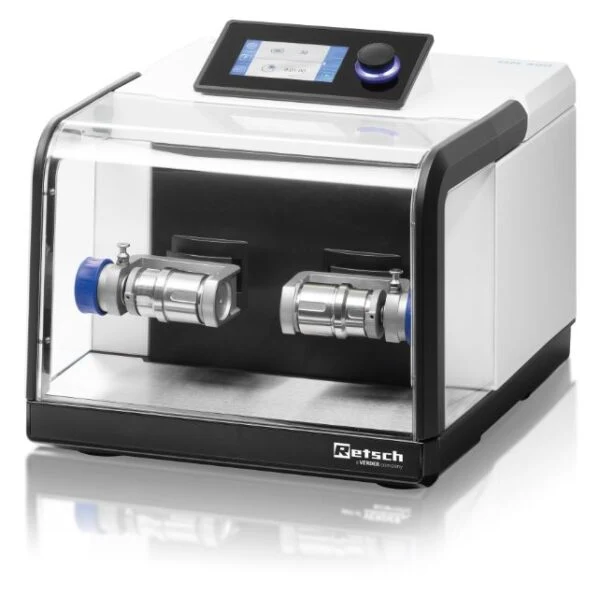
Can the same MM 400 setup serve every application?
No. Match the vessels, media and treatment to the material and endpoint. The mill's range of applications does not remove the need for configuration selection.
One of the most widely used laboratory mills, the Mixer Mill MM 400, is known for its ease of use and speed when homogenizing small sample volumes up to 2 x 20 ml within 1-2 minutes. The compact bench-top unit is one of the most versatile instruments for sample preparation for quality control or research applications. It is well recognized in the biological field for extraction of nucleic acids and proteins.
Whether the sample material is hard-brittle, like ores or teeth, fibrous, like dried plants or hair, soft and sticky, like chewing gum or raisins, or whether it is biological cells like yeast and bacteria – the MM 400 is suitable for all.
Furthermore, it is well established in the mechanochemistry community as a suitable tool for conducting chemical reactions in the grinding jars via kinetic energy input. To make this extremely versatile mill even better, it has received a fresh design as well as new features and accessories.
Improved settings and operation
The easily accessible touch screen on the top of the mill facilitates intuitive operation. The maximum grinding time has been extended from 99 min to 99 h, which is especially beneficial for mechanochemistry applications, where long process times are required.
The MM 400 offers the option to program 12 SOPs. It is also possible to store up to 6 cycle programs which include grinding time and, for example, break times, or the number of repetitions, e. g. for intermediate cooling. The machine calculates the total process time, so the user knows exactly when the process is finished.
The clamping mechanism for the grinding jars has been revised in a way to improve operation of the hand wheel. This also results in a significant noise reduction compared to the previous model.
Calibration ensures reproducibility
It is a well-known fact that the degree of homogenization of an analysis sample influences the standard deviations of analytical results. One factor which impairs the reproducibility of the homogenization process is the variation of time and frequency after a prolonged period of usage.
The MM 400 is the first mill which enables calibration of frequency and time, thus providing a reliability and consistency of homogenization processes which is indispensable in sectors like the pharmaceutical industry. The mill will be delivered with frequency and time initially calibrated by Retsch. Periodical calibrations performed by the Retsch service team ensure consistent reproducibility and best comparability of results obtained at different locations / laboratories.
This special feature for quality control is particularly interesting for: I Quality control of pharmaceutical products I Testing laboratories I Laboratories at different locations which need to obtain reproducible results I All accredited laboratories applying ISO/IEC 17025 or ISO 9000ff
Ready for in-situ RAMAN Spectroscopy
A new feature of the MM 400 has been developed with mechanochemical applications in mind: transparent grinding jars are the basis for RAMAN in-situ spectroscopy, allowing for observation of the chemical reactions taking place inside. The best way to do this is to place the RAMAN spectrometer underneath the jars.
The cover below the grinding jars can be easily removed by loosening the three screws. The bottom plate of the machine has two openings through which the RAMAN spectrometer points towards the bottom of the grinding jars. Thanks to this special setup, the MM 400 is perfectly equipped for mechanochemical purposes.
New accessories, more options
Thanks to a wide range of accessories, the Mixer Mill MM 400 is suitable for a wealth of applications, including cell disruption in disposable vials such as up to eight 50 ml Falcon tubes or various Eppendorf tubes (20 vials max. at a time). Typical sample materials include plants, insects, feathers, bones, tissue, tablets, wood, soil, minerals, chemicals, plastics, food – the MM 400 is a true allrounder in sample homogenization. It generates grind sizes down to 5 microns and is suitable for hard, medium-hard and brittle as well as soft, elastic and fibrous sample materials. When used with stainless steel grinding jars, it can also be employed for cryogenic grinding. The optional CryoKit allows for cooling of the filled jars in liquid nitrogen. Three new accessories make the MM 400 even more versatile than before.
10 ml transparent PMMA jars: I Mechanochemical applications, especially spectroscopy
in combination with RAMAN
in-situ
Inducing chemical reactions via light energy in so-called photochemical reactions
Adapter for four four 5 ml steel grinding jars: I Up to 8 x 2 ml sample material can be homogenized in one batch I Suitable for applications which require smallest sample volumes and a high sample throughput I For hard sample materials which cannot be easily pulverized in disposable plastic vials I Homogenization of sample pieces sized up to 4 mm, which is not possible in disposable 2 ml or 5 ml tubes
2 ml steel jars for PTFE adapter with 10 slots I Alternative to 2 ml disposable tubes, mainly for biological samples which may require cryogenic grinding. The plastic tubes tend to break when cooled to -196°C. I Up to 20 samples with a maximum grain size of around 2 mm can be pulverized easily, also cryogenically. I Mechanochemical purposes requiring a high sample throughput.
Application Examples
Quality control of materials like soil, plastic, food, minerals, wood, plants, quartz sand, coal
The MM 400 offers grinding jars in 7 materials and in volumes from 1.5 ml to 50 ml. With its two grinding stations it homogenizes sample volumes up to 2 x 20 ml in one step, usually in 30 seconds to 2 min at 30 Hz. Stainless steel jars are typically used for standard applications. Depending on the subsequent analysis, other materials may be required – for example, if the heavy metal content of the homogenized sample is to be examined, abrasion from the steel jars could falsify the results. In this case, the use of zirconium oxide jars is recommended. To homogenize plastic samples, but also some food or plant samples, cryogenic processing in steel grinding jars is the best suited method. Pre-cooling in a liquid nitrogen bath for some minutes embrittles the samples inside the jars before approx. 2 min of homogenization at 30 Hz. If the sample is not yet fine enough, the jars are reimmersed in the LN2 bath, and the grinding step is repeated.
With the adapter that accommodates four 50 ml disposable tubes, it is also possible to grind 8 medium-hard samples like soil (without stones) or fibrous samples like dried plants in one step. For the soil sample, each tube is filled with 50 g sample and three 20 ml agate balls. Grinding for a few minutes at 25 Hz fully homogenizes the samples. For the (pre-frozen) plant materials it is beneficial to fill the tubes half with sample and add two 15 mm steel balls. Grinding is done for 2-4 min at 25-30 Hz. As the tubes are made of plastic, it is recommended to fill enough sample material in the tubes to reduce the impact energy. The tubes should not be frozen or used for more than one grinding process. Cleaning steps are not required which makes the process very efficient.
RETSCH also offers adapters for four 30 ml wide mouth bottles, which are durable enough to pulverize samples like quartz sand. Filled to one third with sample and 10 ml stainless steel grinding balls sized 5 mm, the sample is typically homogenized within a few minutes at 25-30 Hz. Just like the Falcon Tubes, the wide mouth bottles should be used only once and require no cleaning.
The new adapter for four 5 ml stainless steel jars enables grinding up to 8 hard and brittle samples, like quartz or coal, in one step. Each jar can be filled with up to 1.5 ml sample (max. size 3 mm) and one 10 mm grinding ball. After a few seconds at 30 Hz, these samples are pulverized to less than 100 µm.
Forensic samples like bones, teeth, hair, fingernails, tumor tissue, sputum
Forensic materials such as bones and teeth are mostly brittle and therefore usually don’t require cooling prior to pulverization. Depending on the required analytical fineness the samples may have to be submitted to preliminary crushing in a jaw crusher or cutting mill to produce particle sizes small enough for further processing in the MM 400 (< 8 mm). Grinding of teeth or bones is done with balls > 5 mm made of steel, zirconium oxide or tungsten carbide. The big grinding balls have enough crushing power to pulverize the very hard samples. 1 g of sample is filled into a 35 ml grinding jar of zirconium oxide and finely ground using a 20 mm zirconium oxide grinding ball. After 2 minutes at 30 Hz, the sample is pulverized to < 200 µm, ready for extraction of nucleic acids. For very tough samples, embrittlement with liquid nitrogen improves the breaking behaviour.
In contrast to the more compact bones or teeth, hair or fingernails are best pulverized using smaller grinding balls, as friction rather than impact is required for fibrous materials. Attention needs to be paid to the grinding time – it should be kept as short as possible, as the samples tend to get burnt. 1 g of hair is put into a 25 ml grinding jar of stainless steel including 6 x 10 mm stainless steel balls. After milling for 2 min at 25 Hz, the sample is pulverized to < 150 µm and is now suitable for analysis like drug control. Very tough hair or fingernail samples require cryogenic grinding.
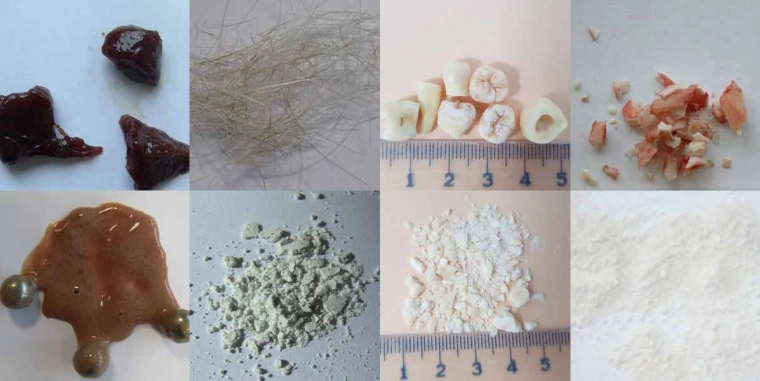
Homogenization of soft and tough forensic samples like sputum of cystic fibrosis patients or tumor tissue require larger sample volumes than 600 µl to represent the initial sample. The 5 ml single-use tubes are the perfect solution for this application. The MM 400 offers an adapter for five 5 ml tubes, thus permitting simultaneous preparation of 10 samples. In each vial, 3 ml sputum is homogenized with three 5 mm zirconium oxide grinding balls at 30 Hz within 2 min. Tissue samples such as liver can be homogenized as well in the 5 ml tubes.
Here, up to 3 g sample are filled in each tube, together with three 10 mm stainless steel grinding balls (better results than using several smaller ones). The vials must be filled with a buffer to enable homogenization (5 min at 30 Hz). The same grade of homogenization can be achieved in 50 ml conical centrifuge tubes with the following parameters: 4 balls stainless steel (20 mm), 15 g sample, buffer, 30 Hz, 3 min. Due to the weight of sample/grinding ball/buffer, only 2 x 2 samples can be processed at a time with centrifugation tubes. The temperature increase is in both cases negligible.
Is cryogenic grinding of small volumes of tissue samples required, then the new 2 ml steel tubes are the best choice, as the disposable plastic tubes usually break under cryogenic conditions, even after short grinding times with moderate frequency. Small sample pieces up to 4 mm can be pre-frozen in LN2 and transferred to the pre-frozen tubes (including the grinding balls). The frozen steel tubes are placed in the 10-slot PTFE adapter. Thus, up to 20 samples can be pulverized cryogenically within some minutes at 30 Hz.
Biological applications like cell disruption of yeast, bacteria, microalgae or washing off intact cells
Cell disruption of bacteria, yeast, filamentous fungi or microalgae in cell suspension is a standard procedure in basic biological research, applied biotechnology or medical research to get access to DNA, RNA, proteins or metabolites. Various methods can be used on a lab scale which can be roughly divided into methods using chemicals to destroy the cell membranes and structures, and mechanical methods.
With mechanical methods it is possible to crack the thick walls of cells such as Bacillus spores and Mycobacterium cells which are difficult to lyse. The addition of chemicals – which might be affecting the subsequent extraction steps – is not required. Bead beating with glass beads is a widely used easy and effective mechanical method for cell disruption. The beads and the cell suspension are thoroughly mixed and the shearing forces resulting from the large surface area of the glass beads crack the cell walls. Bead beating is often used for small scale cell disruption in 2 ml single-use vials, but can also be transferred to larger vials such as the 50 ml disposable centrifugation tubes. Advantages over other mechanical methods such as ultrasonification include the ease of use, the possibility to process several samples in one step without the risk of cross contamination and the better yield of cellular components. The MM 400 in combination with different adapters makes the process reproducible, fast and efficient. For the isolation of DNA or RNA usually less than 1 ml of cell material is needed, thus cell disruption is mostly done in 1.5 ml, 2 ml or 5 ml disposable tubes.
RETSCH offers different adapters for these vials, thus allowing to process up to 20 samples in one step. For the extraction of proteins or metabolites, however, larger amounts of cell suspension are required, therefore cell disruption in 50 ml disposable tubes is advisable; with the MM 400, eight samples can be processed simultaneously (8 samples of 30 ml cell suspension or 240 ml cell suspension divided to the 8 conical centrifuge tubes with subsequent pooling of the cell suspension). Usually, for samples like yeast, the tubes are filled half with the beads and half with the cell suspension, cell disruption is completed after 5-7 min at 30 Hz with minor warming effects. For micro algae, the filling level with glass beads is 80 % of the tube (filled up with cell suspension), the glass beads should be smaller than for yeasts and usually the cell disruption requires only 30 s to 3 min.
Washing procedure to obtain intact bacterial cells from human tissue: After artificial replacement of joints, infections may occur, one of the main risks is the so-called prosthetic joint infection caused by bacteria. Since very different microorganisms cause the infections, the classification for qualitative therapies is very complex. Here the Mixer Mill MM 400 comes into play. The procedure is easy: The bacteria on the tissue samples have to be washed off without destroying them, so that they can be cultivated afterwards for diagnostic reasons. The samples are diluted with 20 ml of sterile demineralized water and 5 ml glass beads of 1 mm diameter in a 30 ml disposable wide mouth bottle, then the samples are agitated for 3.5 min at 30 Hz. During this process the microorganisms are washed off the sample without being destroyed so that they can be easily reproduced later on an agar plate. With this method a good documentation rate is achieved (A.-L. Roux et. al 2010).
Conclusion
With the Mixer Mill MM 400 RETSCH has developed a true multipurpose mill which covers a huge range of applications, including classic mixing and homogenization but also more complex tasks like cell disruption via bead beating or mechanochemical processes.
The ease of use of mixer mills in general, combined with a wealth of accessories make the MM 400 the perfect choice for quick, safe and reproducible processing of small sample volumes.
What determines the choice of vessel for a small MM 400 sample?
Begin with the preparation objective and vessel requirements. An arrangement suited to a hard powder may not be the right choice for tissue or a reaction mixture. Confirm the available model configuration and compatible accessories rather than assuming every accessory discussed over the product's history is interchangeable.
| Consideration | Information to provide |
|---|---|
| Preparation task | Grinding, disruption or reaction |
| Vessel choice | Material, volume and compatibility |
| Operating record | Cycle and recovery method |
Discuss material testing with Glen Mills or Contact Glen Mills for information or a quote.