
Does a long grinding run guarantee nanoscale material?
No. The result depends on the material and configuration and must be measured. Time alone is not a particle-size specification.
Mixer mills are true all-rounders which are used in laboratories all over the world. These compact versatile bench-top units for dry, wet and cryogenic grinding of small sample amounts mix and homogenize powders in only a few seconds and are easy to handle.
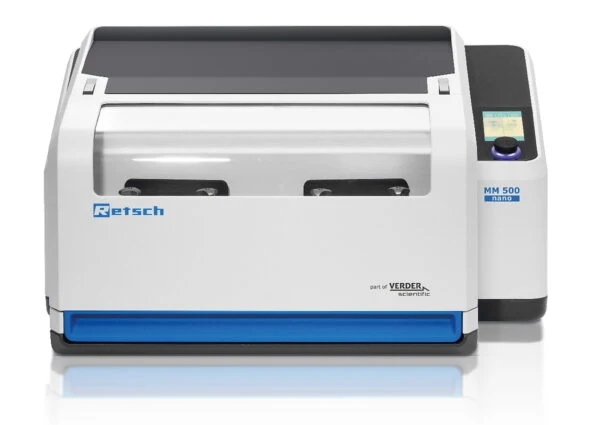
When it comes to long-term grindings of several hours with high energy input to obtain particles sizes <1 µm, e. g. for mechanical alloying or chemical reactions, planetary ball mills have been the instruments of choice so far. Despite their benefits for this type of application, they have the drawback of requiring cooling breaks and are not as easy to handle as Mixer Mills. RETSCH has now introduced the new mixer mill MM 500 nano which features a maximum frequency of 35 Hz and which has therefore as the first Mixer Mill in the market the crushing power to produce particles down to the nanometer range. It accommodates two grinding jars sized 50 ml, 80 ml or 125 ml and with its suitability for long-term grinding processes up to 99 hours, it will become a real alternative to planetary ball mills – with all the benefits a Mixer Mills offers - like comfortable handling and less warming effects.
Safe and easy operation
The MM 500 nano provides maximum operational convenience and safety. The lids on the grinding jars are easily screwed tight for applications like wet grinding and mechanochemical reactions up to 5 bar. The innovative design of the screw-lock jars ensures optimum exploitation of the usable volume. This is an advantage over the jars of classic mixer mills where the lid forms part of the jar volume which makes it difficult to apply ball fillings of 60%, for example, which is required for wet grinding. Moreover,
RETSCH's Mixer Mill MM 500 nano
The innovative screw-lock grinding jars are easy to handle and clamping is a matter of seconds.
it is more convenient for the user to fill in fibrous sample materials when the jar volume is not part of the lid. The clamping system of the MM 500 nano is very user-friendly, particularly when compared to the clamping of Planetary Ball Mills. The jars are easily inserted into the clamping system and may even remain in the system for extraction of a sub-sample or a quick visual check of the sample. Another benefit of the MM 500 nano is the large 4.3-inch touch display enhances operating convenience. By using the RETSCH App, the user can control the mill via smart phone or tablet, create application routines, access the RETSCH application database or get in touch with the RETSCH service team.
Beside these handling advantages, the mill is the perfect work horse for classic mixer mill applications: quick pulverization of hard and brittle samples as well as cryogenic grinding but also for new types of applications, so far not possible with a Mixer Mill, like ultra-fine grinding down to <100 nm or mechanical alloying – usually without requiring cooling breaks. The application examples in this article show impressively that the MM 500 nano achieves better grind sizes than classic mixer mills and even beats planetary ball mills in terms of fineness and total process time.
High energy input results in high final fineness
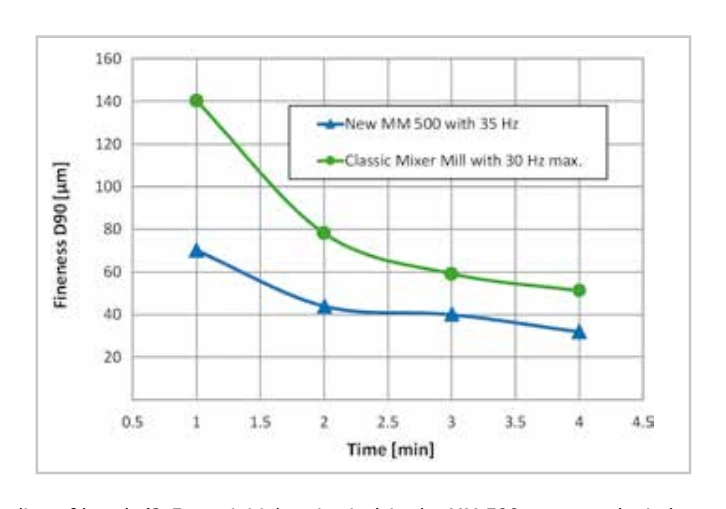
The MM 500 nano achieves extraordinary grind sizes thanks to the increased frequency of 35 Hz, whereas classic mixer mills usually have a maximum frequency of 30 Hz or even less. Thus, those mixer mills are not suitable for applications which require high energy input. The comparison shows the influence of the higher energy input on the final fineness after grinding basalt for a few minutes. The influence of the additional 5 Hz is very impressive in the first 2 minutes where the particles obtained at 35 Hz are factor 2 smaller than at 30 Hz. Additionally, the MM 500 nano accommodates two jars with a maximum usable volume of 45 ml each which is twice the amount a smaller mixer mill can process but comes close to what is possible with Planetary Ball Mills. The following examples demonstrate that the MM 500 nano is perfectly suited for applications which are traditionally performed in planetary ball mills, like ultra-fine grinding down to <100 nm.
Pulverization in the nanometer range without heat build-up
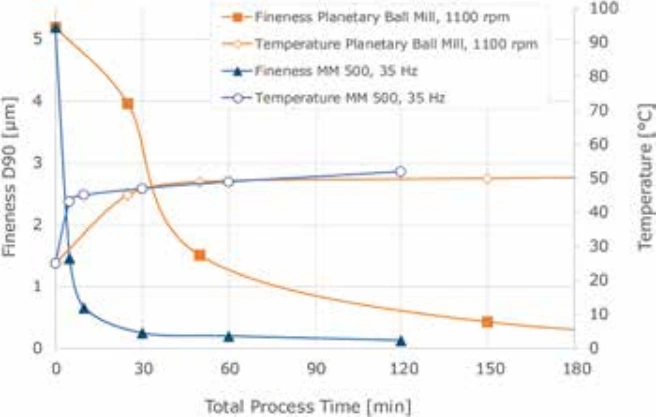
Typical process times for ultra-fine grinding are several hours; in conventional ball mills additional time for grinding breaks to avoid over-heating of the sample must be added. In contrast to planetary ball mills, the MM 500 nano produces particles in the nanometer range without requiring any cooling breaks; the grinding mechanism based on impact rather than friction generates less heat and is more effective than that of a planetary ball mill. The example in The comparison shows that the temperature inside the grinding jars, while grinding aluminum oxide, is very similar in the MM 500 nano and the planetary ball mill – with the difference that the planetary ball mill requires a 4-minute break after each minute of grinding. Otherwise, the temperature inside the jar could rise to 100 °C already in the first few minutes of the grinding process.
The maximum achievable grind size of 0.14 µm of the aluminum oxide sample was achieved much quicker in the MM 500 nano than in the benchmark planetary ball mill (2 h instead of 5 h process time).
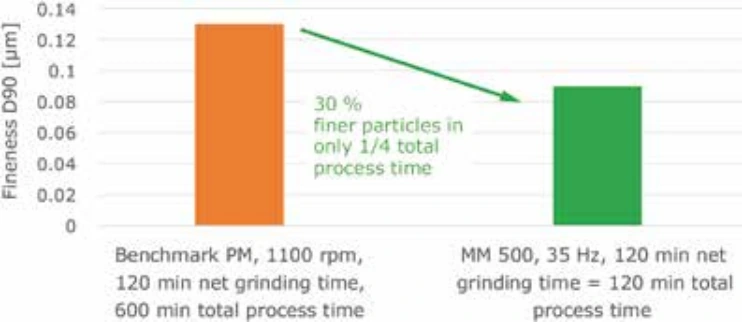
Another example for ultra-fine grinding is shown in figure 5: Grinding of titanium dioxide resulted in much better fineness in the MM 500 nano (90 nm) compared to the benchmark planetary ball mill (130 nm) in only a quarter of the time.
New screw-lock jar design
Grinding of fibrous sample material
Beside the grinding of hard and brittle samples, planetary ball mills are commonly used to pulverize fibrous sample materials like straw or hair. A rule of thumb for effective grinding in ball mills is to fill in 30% of the jar volume with sample. Another 30% is filled with balls (dry grinding). As fibrous samples tend to lose volume during grinding, it is recommended to fill more sample in the jar to decrease wear. The jar design of planetary ball mills as well as the new screw-lock jar design of the MM 500 nano is very convenient to get enough fluffy, fibrous, voluminous samples into the jars – as the lids of those jars are flat. In classic mixer mills, a part of the volume is located
in the lids, so that it becomes a bit difficult to fill in enough fibrous sample material – the part volume in the lid cannot be used effectively. In the following example, animal hair was ground. 1.2 g of the very light sample could be filled in 80 ml grinding jars and ground for 7 min with 30 ball with size 10 mm. The result in the MM 500 nano was much better than in the planetary ball mill .
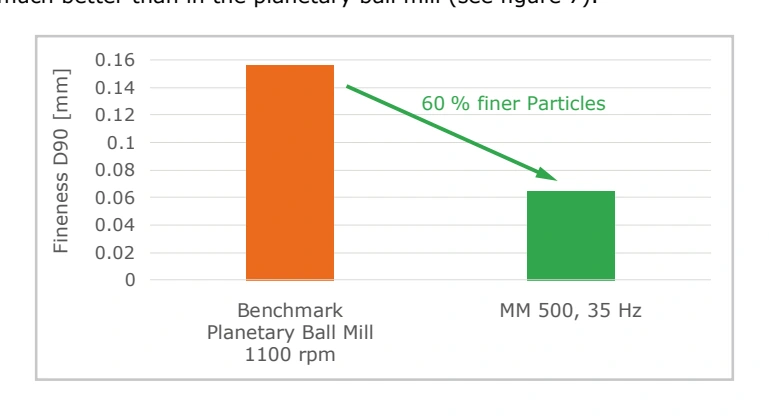
Final fineness after 7 min continuous grinding of animal hair in the MM 500 and the benchmark Planetary Ball Mill with 30 x 10 mm grinding ball stainless steel.
60 % finer Particles
Benchmark Planetary Ball Mill 1100 rpm
MM 500, 35 Hz
At maximum frequency the Mixer Mill MM 500 nano produces finer particles during cryogenic grinding than classic mixer mills. Left: grinding results after 4 x 2 minutes with intermediate cooling of 3 mm polypropylene particles. Right: grinding results after 7 x 2 minutes with intermediate cooling of 2 mm polyamide particles.
Cryogenic grinding of tough, elastic samples materials
Classic mixer mills are the instruments of choice when it comes to pulverization of tough, elastic sample materials like plastics, rubber, elastomers. At room temperature, those sample materials cannot be pulverized as they get only deformed by impact effects. If they are embrittled with liquid nitrogen, the breaking properties are improved, and pulverization is possible. For this reason, the grinding ball(s) and the sample material are filled in the grinding jar, which is closed tightly before it is put in a bath with liquid nitrogen for indirect sample embrittlement. The advantage of the MM 500 nano over classic mixer mills is again the increased crushing power of 35 Hz, as well as larger volume of the grinding jars up to 125 ml. In the application example below, the result of cryogenic grinding of the two sample materials polypropylene and polyamide is given . Again, the increased energy input of 35 Hz instead of 30 Hz results in finer particles obtained in the MM 500 nano.
Conclusion
The MM 500 nano is the perfect combination between a classic mixer mill and a planetary ball mill. On the one hand, it achieves excellent grinding results within a few minutes, on the other hand, it is powerful and robust enough to carry out long-term grindings in the nanometer range or mechanical alloying processes. On top of that, uncomplicated handling ensures safe operation.
Plan the configuration for your material.
Define the fineness measurement and whether the process is dry or uses a liquid phase. Record the jar, media, loading and cycle as a complete setup. Reaching an ultrafine endpoint for one material does not establish the same result for every powder or operating condition.
| Consideration | Information to provide |
|---|---|
| Target size | Distribution and measurement technique |
| Preparation mode | Dry or liquid-assisted |
| Cycle record | Tools, loading and thermal behavior |
How should the application examples be used?
The results describe the materials and configurations discussed here. Confirm equipment options, contact materials and operating conditions for your own sample before adopting a method. A demonstrated endpoint does not guarantee the same outcome for a different material.
Discuss material testing with Glen Mills or request further information or a quote.