
Does longer milling always produce a finer measured distribution?
No. The material and preparation conditions determine the result, and agglomeration can influence what is measured. Evaluate the distribution rather than time alone.
Nanotechnology is one of the most innovative developments of our time which revolutionizes industries such as materials science, pharmaceutics, food, pigments or semi-conductor technology. Nanotechnology deals with particles in a range from 1 to 100 nm. These particles possess special properties due to their size, as their surface is greatly enlarged in relation to their volume (so-called “size-induced functionalities”). Ultrafine particles are, for example, harder and more break-resistant than larger particles. Nanotechnology brings effects which occur in nature to a commercial scale, such as, for example, the lotus effect: nanocoated fabrics or paints are water- and dirt-repellent just like the lotus flower.
| Industry | Application |
|---|---|
| Alternative fuels | Improved cleaning of solar cells |
| Automobile | Densification of tyre material; improved color properties of paint |
| Cosmetics | Protection against UV radiation |
| Textiles | Protection against water or dirt (lotus effect) |
| Medicine | Controlled release of drugs, for example in tumor cells |
| Food | Non-stick coating of food packaging |
| Sports | Reinforcing materials, for example for tennis rackets |
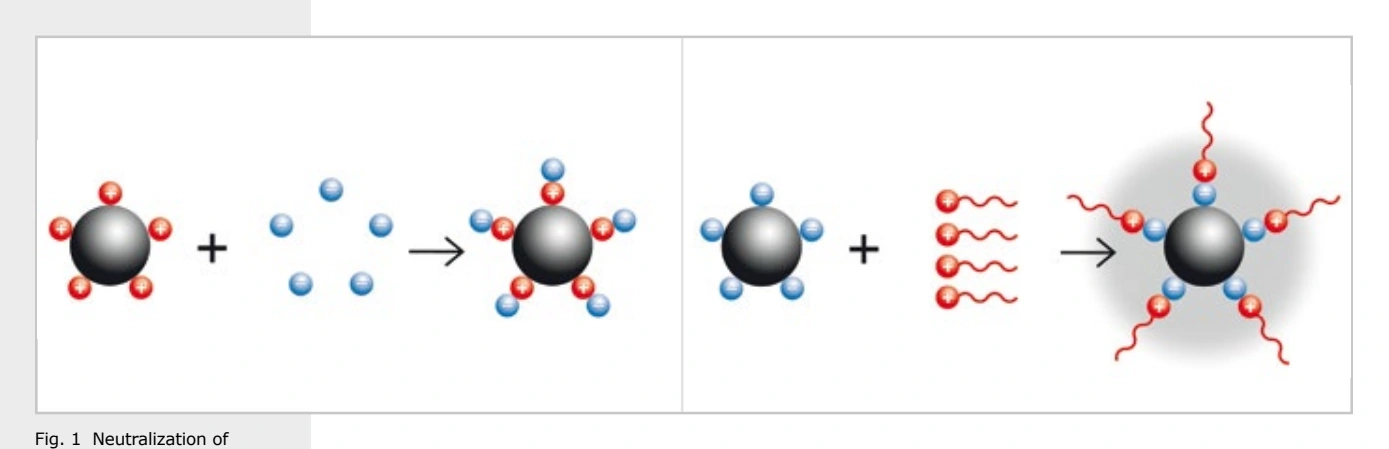
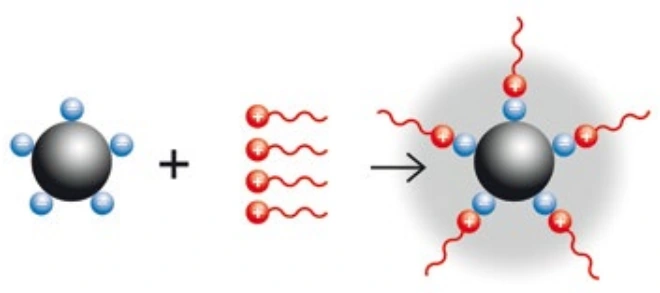
How are nano particles produced? The “Bottom-Up” method synthesizes particles from atoms or molecules. The “Top-Down” method involves reducing the size of larger particles to nanoscale, for example with laboratory mills. Due to their significantly enlarged surface in relation to the volume, small particles are drawn to each other by their electrostatic charges. Nano particles are produced by colloidal grinding which involves dispersion of the particles in liquid to neutralize the surface charges. Both water and alcohol can be used as dispersion medium, depending on the
sample material. In some cases the neutralization of surface charges is only possible by adding a buffer such as sodium phosphate or molecules with longer uncharged tails such as diaminopimelic acid (electrostatic or steric stabilization).
Factors such as energy input and size reduction principle make ball mills the best choice for the production of nanoparticles. The most important criteria for selecting a mill and appropriate accessories are:
Top-Down Method: Production of nanoparticles with ball mills
Nanoparticles are created with the Top-Down method by colloidal grinding using a suitable dispersant to keep the particles from agglomerating. To reduce small particles with mechanical force to even smaller sizes, a high energy input is required. The choice of suitable grinding tools and the correct grinding jar filling are further aspects to be considered.
The steps of colloidal grinding
Preliminary grinding Depending on the size of the initial sample material and desired final fineness, a preliminary size reduction step can be useful. A dry grinding process with grinding balls of >3 mm Ø is usually carried out by filling one third of the jar with grinding balls and one third with sample material. The obtained sample is then used for the actual colloidal process.
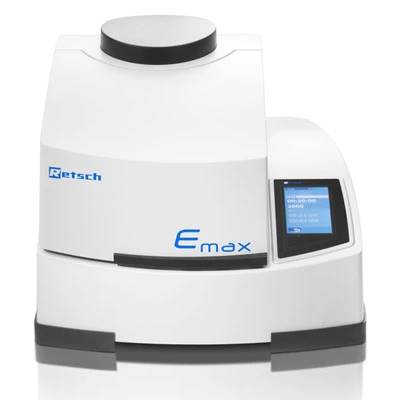
Colloidal grinding With the planetary ball mills, the high energy ball mill Emax and the mixer mill MM 500 nano, RETSCH offers three types of ball mills which provide the required energy input for colloidal grinding down to the nanometer range. Grinding jars and balls made of an abrasion-resistant material such as zirconium oxide are best suited for this type of application. 60 % of the grinding jar volume is filled with grinding balls of 0.5 to 3 mm Ø, providing a large number of frictional points. The actual sample fills about one third of the jar volume. By adding a suitable dispersant (e. g. water, isopropanol, buffer), the consistency of the sample should become pasty thus providing ideal preconditions for colloidal grinding. If a very high final fineness is required, it is recommended to proceed with a second colloidal grinding with 0.1 to 0.5 mm Ø grinding balls, particularly if 2 to 3 mm balls were used in the first process (the balls need to be 3 x bigger than the particle size of the initial material). To separate the sample from the grinding balls, both are put on a sieve (with aperture sizes 20 to 50 % smaller than the balls) with a collecting pan. For the subsequent colloidal grinding 60 % of the jar is filled with small beads. The suspension from the previous grinding is carefully mixed with the grinding beads until a pasty consistency is obtained.
Consistency Some materials tend to become too pasty during grinding which prevents the grinding balls from moving around in the suspension, thus making further size reduction almost impossible. Therefore it is recommended to check the consistency of unknown sample materials during the grinding process. If needed, the sample/ball mixture can be further diluted by adding more dispersant. If a sample is known to swell easily, the sample/dispersant ratio should be adapted accordingly. Another option is the addition of surfactant to stabilize the consistency.
Removal of grinding jars Care must be taken when removing the grinding jar from the planetary ball mill as it can have a temperature of up to 150 °C due to the heat generated during the grinding process. Moreover, pressure builds up inside the grinding jar. Therefore, it is recommendable to use the optional safety closure for the “comfort” grinding jars of the PM series which allows for safe removal of the jar. After the grinding process the jar should cool down for a while. The Emax jar already has an integrated safety closure just like the MM 500 jars. Moreover, the effective cooling system of the Emax prevents the jars from heating up too much. All jars can be equipped with optional ventilation lids which allow working under inert atmosphere.
In the planetary ball mill, centrifugal and Coriolis forces permit grindings down to the submicron range.
Suitable ball mills for the production of nanoparticles
With the planetary ball mills, the high energy ball mill Emax and the mixer mill MM 500 nano, RETSCH possesses suitable mills and the required knowhow for the production of nano particles.
Planetary Ball Mills In the planetary ball mill, every grinding jar represents a “planet”. This planet is located on a circular platform, the so-called sun wheel. When the sun wheel turns, every grinding jar rotates around its own axis, but in the opposite direction. Thus, centrifugal and Coriolis forces are activated, leading to a rapid acceleration of the grinding balls . The result is very high pulverization energy allowing for the production of very fine particles. The enormous acceleration of the grinding balls from one wall of the jar to the other produces a strong impact effect on the sample material and leads to additional grinding effects through friction. For colloidal grinding and most other applications, the ratio between the speed of the sun wheel and the speed of the grinding jar is 1: -2. This means that during one rotation of the sun wheel, the grinding jars rotate twice in the opposite direction.
Planetary ball mills from RETSCH
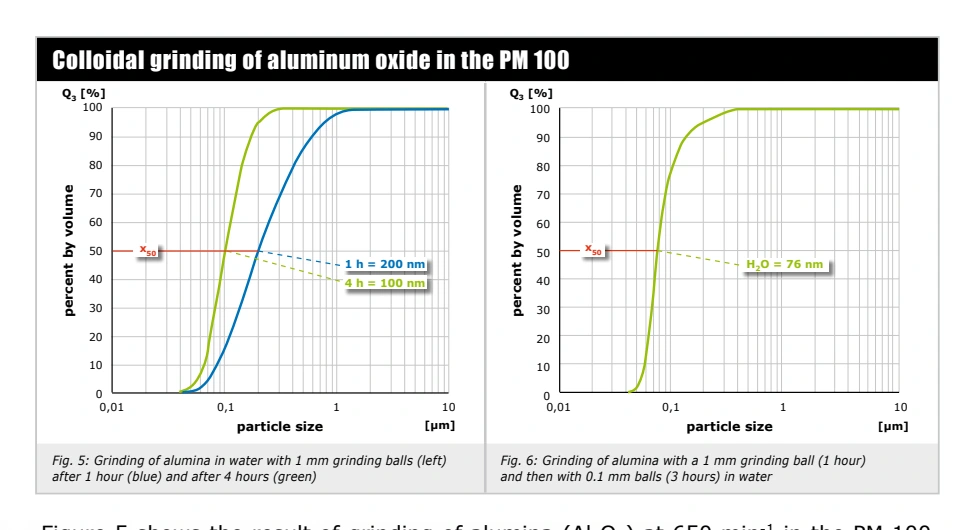
Colloidal grinding of aluminum oxide in the PM 100
Grinding of alumina with a 1 mm grinding ball (1 hour) and then with 0.1 mm balls (3 hours) in water
The comparison shows the result of grinding of alumina (Al2O3) at 650 min-1 in the PM 100. After 1 hour of size reduction in water with 1 mm grinding balls, the mean value of the particle size distribution is 200 nm; after 4 hours it is 100 nm. In a further trial, the material was initially ground for 1 hour with 1 mm grinding balls and then for 3 hours with 0.1 mm grinding balls . In this case, an average value of 76 nm was achieved. The grinding results show that planetary ball mills can produce particle sizes in the nanometer range.
High Energy Ball Mill Emax The Emax is an entirely new type of ball mill which was specifically designed for high energy milling. The impressive speed of 2,000 min-1, so far unrivaled in a ball mill, in combination with the special grinding jar design generates a vast amount of size reduction energy. The unique combination of impact, friction and circulating grinding jar movement results in ultrafine particle sizes in the shortest amount of time. Thanks to the new liquid cooling system, excess thermal energy is quickly discharged preventing the sample from overheating, even after long grinding times.
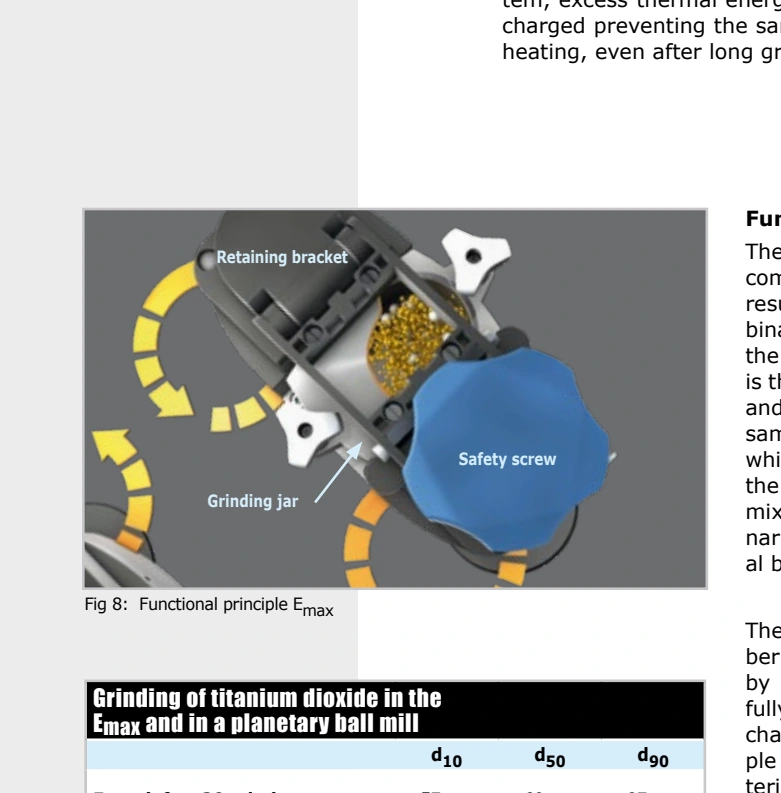
Retaining bracket
Grinding jar
Safety screw
Functional principle Emax
The Emax pulverizes the sample not only faster and to a finer size, it also produces a significantly narrower particle size distribution
Emax
Functional principle
The novel size reduction mechanism of the Emax is based on a combination of high-frequency impact and intensive friction, resulting in unrivaled grinding performance. This unique combination is generated by the oval shape and the movement of the grinding jars which do not rotate around their own axis as is the case in planetary ball mills. The interplay of jar geometry and movement causes strong friction between grinding balls, sample material and jar walls as well as rapid acceleration which lets the balls impact with great force on the sample at the rounded ends of the jars. This significantly improves the mixing of the particles resulting in smaller grind sizes and a narrower particle size distribution than achieved in conventional ball mills.
The grinding energy resulting from the friction of a large number of small grinding balls is extended even further in the Emax by the high speed of 2,000 min-1. The high energy input is fully exploited as the unique liquid cooling system quickly discharges the frictional heat. Without effective cooling both sample and mill would overheat. Depending on the sample characteristics and grinding mode, cooling breaks of approx. 60 % of the total grinding time are recommended for conventional planetary ball mills to prevent overheating. The Emax, on the other hand, is suitable for continuous grinding without breaks thanks to its efficient liquid cooling system.
| Mill / condition | d10 | d50 | d90 |
|---|---|---|---|
| Emax | 57 nm | 69 nm | 87 nm |
| Planetary ball mill / cooling breaks excluded | 66 nm | 105 nm | 476 nm |
In a comparative trial, the pigment titanium dioxide was pulverized in the most powerful planetary ball mill and in the Emax (50 ml grinding jar of zircomium oxide, 110 g matching grinding balls 0.1 mm Ø, 10 g sample, 15 ml 1 % sodium phosphate). After 30 minutes the d90 value of the Emax sample was 87 nm. The planetary ball mill achieved a grind size of only 476 nm after this time (excl. cooling breaks). Consequently, the Emax provided a 5 times higher final fineness than the planetary ball mill .
Pulverization of graphite. The water-cooled Emax is highly superior to the planetary ball mill without cooling system both in speed and achieved final fineness.
The comparison shows the results of grinding graphite in the Emax at 2,000 min-1 (50 ml grinding jar of zirconium oxide, 110 g matching grinding balls 0.1 mm Ø, 5 g sample, 13 ml isopropanol) and in the most powerful planetary ball mill. Graphite is a lubricant and therefore requires a particularly high energy input for size reduction. After only 1 hour of grinding 90 % of the Emax sample possessed a fineness of 13 microns. This grind size was achieved by the planetary ball mill only after 8 hours of grinding (excl. cooling breaks). Regarding the final fineness achieved in the Emax after 8 hours of grinding, its superior performance again is quite apparent: With a d90 value of 1.7 μm the grind size is 7 times finer than the one achieved in the planetary ball mill (12.6 μm).
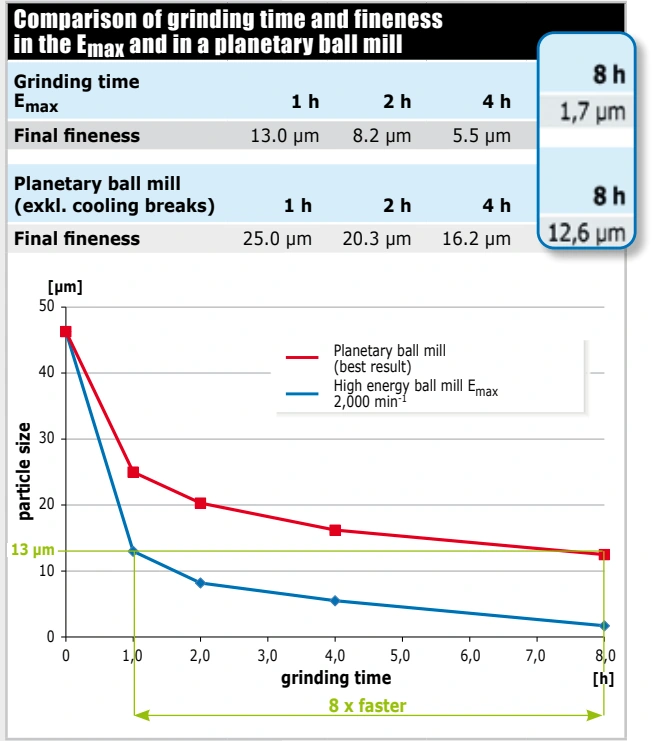
| Net grinding time | Emax fineness | Planetary ball mill fineness |
|---|---|---|
| 1 h | 13.0 µm | 25.0 µm |
| 2 h | 8.2 µm | 20.3 µm |
| 4 h | 5.5 µm | 16.2 µm |
| 8 h | 1.7 µm | 12.6 µm |
Highly efficient liquid cooling
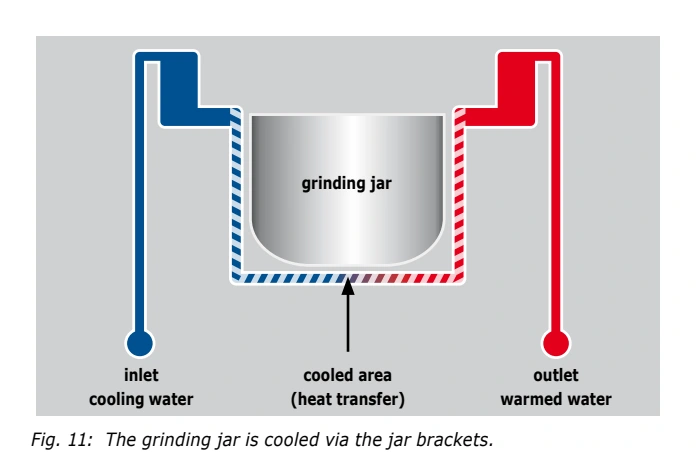
The grinding jars of the Emax are cooled by an integrated water cooling system. To further reduce the temperature, the mill can be connected to a heat exchanger or the tap. The comparison shows the cooling circuit of the Emax. The grinding jars are cooled via the jar. The cooling system is very effective because heat is more easily discharged into water than into air. The Emax software allows the user to carry out the grinding process within a defined temperature range, i. e. he can set a minimum and a maximum temperature. When the maximum temperature is exceeded, the mill automatically stops and starts again upon reaching the minimum temperature.
grinding jar
inlet cooling water
cooled area (heat transfer)
outlet warmed water
Mixer Mill MM 500 nano When it comes to long-term grindings of several hours with high energy input to obtain particles sizes <1 µm, e. g. for mechanical alloying or chemical reactions, planetary ball mills have been the instruments of choice so far. Despite the benefits of planetary ball mills for this application, they have the drawback of requiring cooling breaks and are not as easy to handle as mixer mills. RETSCH has developed the new mixer mill MM 500 nano which features a maximum frequency of 35 Hz, making it the first mixer mill in the market with enough crushing power to produce particles in the nanometer range. It accommodates two grinding jars sized 50 ml, 80 ml or 125 ml and with its suitability for long-term grinding processes up to 99 hours, it has become a real alternative to planetary ball mills – with all the benefits a mixer mill offers - like comfortable handling and less warming effects.
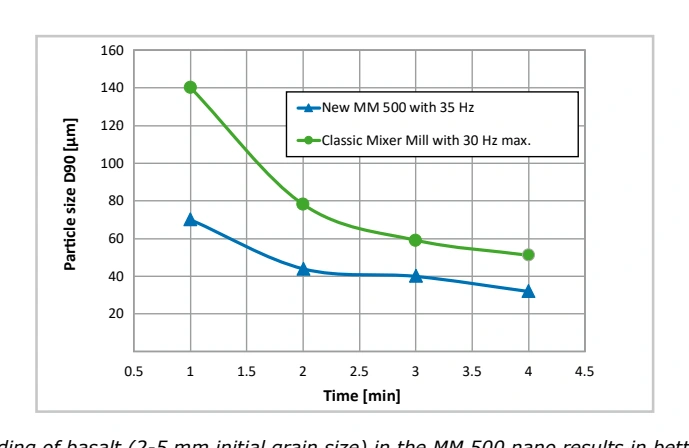
MM 500 nano
Time [min]
High energy input results in high final fineness The MM 500 nano achieves extraordinary grind sizes thanks to the increased frequency of 35 Hz, whereas classic mixer mills usually have a maximum frequency of 30 Hz or even less. Thus, those mixer mills are not suitable for applications which require high energy input. The comparison shows the influence of the higher energy input on the final fineness after grinding basalt for a few minutes. The influence of the additional 5 Hz is very impressive in the first 2 minutes where the particles obtained at 35 Hz are factor 2 smaller than at 30 Hz. Additionally, the MM 500 nano accommodates two jars with a maximum usable volume of 45 ml each which is twice the amount a smaller mixer mill can process but comes close to what is possible with Planetary Ball Mills. The following examples demonstrate that the MM 500 nano is perfectly suited for applications which are traditionally performed in planetary ball mills, like ultra-fine grinding down to <100 nm.
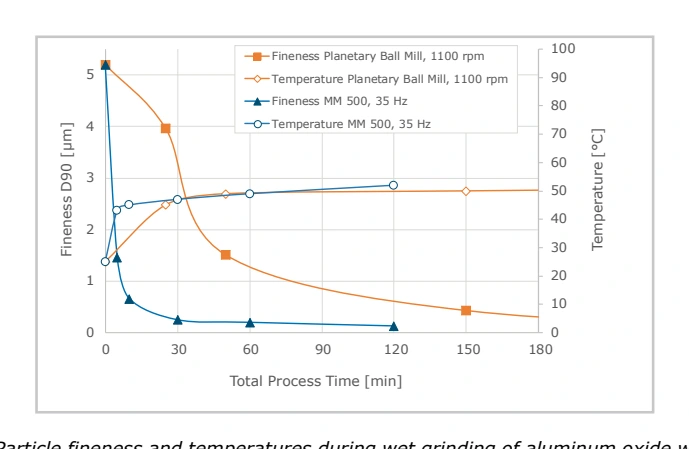
Pulverization in the nanometer range without heat build-up Typical process times for ultra-fine grinding are several hours; in conventional ball mills additional time for grinding breaks to avoid over-heating of the sample must be added. In contrast to planetary ball mills, the MM 500 nano produces particles in the nanometer range without requiring any cooling breaks; the grinding mechanism based on impact rather than friction generates less heat and is more effective than that of a planetary ball mill. The example in The comparison shows that the temperature inside the grinding jars, while grinding aluminum oxide, is very similar in the MM 500 nano and the planetary ball mill – with the difference that the planetary ball mill requires a 4-minute break after each minute of grinding. Otherwise, the temperature inside the jar could rise to 100 °C already in the first few minutes of the grinding process.
Conclusion
Nanoparticles, i. e. particles with a diameter of less than 100 nm, have been the object of scientific research for many years now. There are various techniques to produce nanoparticles. The “Top-Down” method involves size reduction of larger particles to the nanometer range. This is best achieved with ball mills which provide the required energy input. With the widest range of ball mills worldwide, RETSCH offers various suitable instruments. Apart from the planetary ball mills such as PM 100, PM 200 and PM 400, and the high energy ball mill Emax, the new mixer mill MM 500 nano is especially suitable for colloidal grindings down to the nanometer range thanks to the high speed and easy handling.
Plan the configuration for your material.
Define how the target distribution will be measured and how the prepared material should be handled afterward. Jar material, media size, loading and liquid choice all need to fit the sample and equipment. Agglomeration can complicate interpretation, so apparent fineness should be checked using a consistent measurement method.
| Consideration | Information to provide |
|---|---|
| Target distribution | Required size and measurement basis |
| Milling system | Media, vessel and liquid compatibility |
| After grinding | Dispersion and recovery needs |
How should the application examples be used?
The results describe the materials and configurations discussed here. Confirm equipment options, contact materials and operating conditions for your own sample before adopting a method. A demonstrated endpoint does not guarantee the same outcome for a different material.
Discuss material testing with Glen Mills or request further information or a quote.