
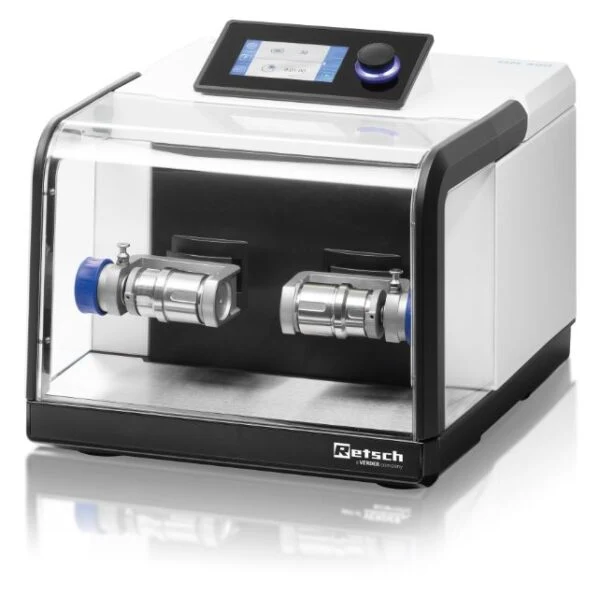
Can any small vessel be used in a ball mill?
No. Vessel geometry, clamping, loading and operating limits must match the specific mill. Confirm accessory compatibility before selecting a parallel preparation format.
One of the challenges when using ball mills is the processing of small sample volumes. Food, tissues, pharmaceuticals, and many other samples are often limited to only a few grams in quantity. To homogenize such small amounts for analysis, or for developing new materials, matching jar volumes are required. In addition, small-volume jars allow for simultaneous processing of multiple samples. This leads to high sample throughput and enables effective parameter variation in material development.
RETSCH offers an extended range of accessories for the processing of small sample volumes in mixer mills. It should be taken into account that a simple downscaling from large volume to small volume is not always possible; in small jar volumes, for example, the power of the balls is lower or thermal transport processes are faster. this discussion focuses on the homogenization of different materials in small-volume jars.
Multi-cavity jars for mixer mills MM 500 control and MM 500 nano
Accessories for the models MM 500 control and MM 500 nano include multi-cavity grinding jars that have the same advantages as conventional Screw-Lock grinding jars: easy jar filling thanks to flat jar lid - even in a glove box; simple clamping of the jars; possibility to visually check the status during operation, and easy cleaning.
Two multi-cavity jar types are available: one with four 10 ml and the other with two 25 ml cavities. They are made of stainless steel and are supplied with pouring aids for taking out a sample from one cavity while the others remain plugged.
Models I MM 500 control I MM 500 nano
Multi-cavity jars I 4 x 10 ml I 2 x 25 ml I stainless steel I with pouring aid to plug individual cavities
In a multi-cavity jar, the oval shape of the cavities corresponds to the single-cavity Screw- Lock jars. This shape facilitates effective ball movement for crushing of hard, brittle, fibrous and dry materials, see example of grinding basalt. The multi-cavity jars are also suitable for applications in mechanochemical material development, for example, when dealing with small volumes of, e. g., expensive educts.
Cryogenic grinding is another application for which the jars can be employed. Samples are embrittled with liquid nitrogen in the MM 500 control or by using the CryoKit for MM 500 nano, see example of cryogenic grinding of plants. In addition, the multi-cavity jars are particularly suitable for wet grinding processes to obtain ultra-fine particles. Taking wet grinding of TiO2 as an example, the results are comparable to those achieved with larger jars, see example below.
Cryogenic grinding of fresh plants
| Parameter | 10 mL cavity | 25 mL cavity |
|---|---|---|
| Plant quantity | 1.5 g | 4 g |
| 7 mm grinding balls | 12 balls | 35 balls |
| Frequency | 30 Hz | 30 Hz |
| Temperature | −100 °C | −100 °C |
| Pre-cooling | 15 min | 15 min |
| Grinding program | 9 cycles of 1 min grinding with 1 min intermediate cooling | 9 cycles of 1 min grinding with 1 min intermediate cooling |
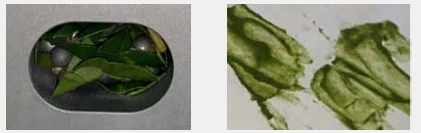
The fresh-plant example achieved good homogenization under cryogenic conditions.
Wet grinding of titanium dioxide
| Parameter | 10 mL cavity | 25 mL cavity |
|---|---|---|
| TiO₂ quantity | 2 g | 5 g |
| 0.1 mm grinding balls | 22 g | 55 g |
| 1% NaPO₄ dispersant | 2 mL | 5 mL |
| Frequency | 30 Hz | 30 Hz |
| Grinding times compared | 5, 10, 30 and 60 min | 5, 10, 30 and 60 min |
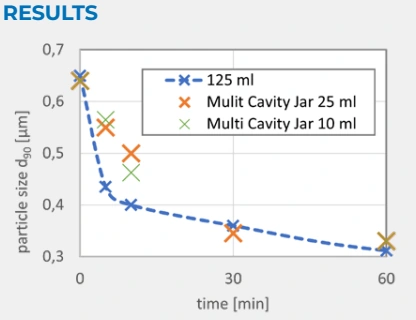
The particle-size comparison shows fineness comparable to preparation in 125 mL jars under the illustrated conditions.
Grinding of basalt
| Parameter | 10 mL cavity | 25 mL cavity |
|---|---|---|
| Basalt split quantity | 17 g | 7 g |
| 12 mm grinding balls | 1 ball | 4 balls |
| Frequency | 30 Hz | 30 Hz |
| Grinding times compared | 1, 2 and 5 min | 1, 2 and 5 min |
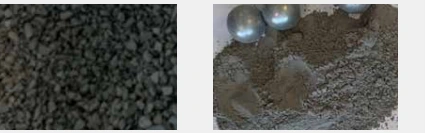
The example reports reproducible results across the cavity stations, with fineness comparable to MM 400 screw-top jars of the same capacity.
2 ml stainless steel reaction vials for MM 500 control and MM 500 nano
For the MM 500 control and MM 500 nano an adapter is available that accommodates nine 2 ml reaction vials made of stainless steel or, alternatively, 18 single use reaction vials of 1.5 or 2 ml.
Models I MM 500 control I MM 500 nano
2 ml reaction vials I 316L steel I adapter for 9 vials (also suited for 18 x 1,5 ml and 18 x 2 ml single-use vials)
Homogenization of biological samples as well as cell disruption are often performed with small volumes, for example, in disposable reaction vials. The MM 500 nano allows high-energy grinding with a frequency of up to 35 Hz. With the MM 500 control, temperature-controlled processing is executed by connecting the mill to a chiller and cooling the sample during grinding. In both mills cryogenic grinding at very low temperatures is also an option, for example, to homogenize tissue. The MM 500 control provides an automated and convenient handling process to freeze the sample down to -100 °C. For cryogenic grinding in the MM 500 nano the CryoKit is available for manual pre-cooling of the fully loaded adapter in a liquid nitrogen bath prior to homo genization. As polymeric reaction vials may not withstand the impact of the balls and may break when frozen, the use of stainless-steel vials is recommended for cryogenic applications.
2 ml stainless-steel reaction vials for MM 400, MM 500 vario and cryomill
PTFE adapters are available for the MM 400 and MM 500 vario and a steel adapter is available for the CryoMill. The adapters accommodate 1.5 ml and 2 ml single-use reaction vials or 2 ml stainless-steel reaction vials.
These adapters enable simultaneous preparation of up to 6 samples in the CryoMill, up to 20 samples in the MM 400 and up to 50 samples in the MM 500 vario. This is beneficial for sample preparation, cell disruption and mechanochemical processes alike, see example of grinding of tablets.
The CryoKit is used for cryogenic grinding in the MM 400 and MM 500 vario. Generally, as polymeric reaction vials may break when frozen, the use of 2 ml stainless-steel reaction vials is recommended for this application, see cryogenic grinding of tissue. If very cold temperatures are required, for example when grinding polymers, the CryoMill offers maximum cooling down to -196 °C, see example of cryogenic grinding of polyamid.
The images on the left show mixer mill types with corresponding adapters for 2 ml vials.
Models I CryoMill I MM 400 I MM 500 vario
2 ml reaction vials I 316L steel I PTFE adapter for 5 & 10 vials (MM 400 and MM 500 vario) I 4 x 10 & 2 x 5 PTFE adapter (MM 500 vario) I 6 vials steel adapter (CryoMill)
Grinding of tablets
| Parameter | Configuration |
|---|---|
| Mill | RETSCH MM 500 vario |
| Sample | 1 tablet cut into 4 mm pieces |
| Grinding ball | One 7 mm stainless steel ball |
| Frequency | 30 Hz |
| Grinding time | 1.5 min |
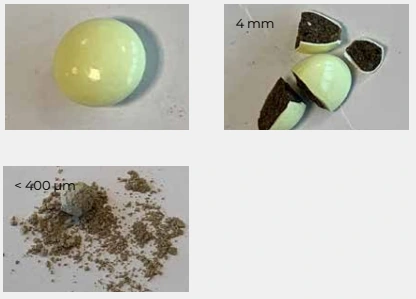
The tablet was manually pre-crushed before grinding. The illustrated prepared sample is labeled below 400 µm.
Cryogenic grinding of tissue
| Parameter | Configuration |
|---|---|
| Mill | RETSCH MM 400 |
| Sample | Three 4 mm tissue pieces, pre-cooled |
| Grinding balls | Four 5 mm tungsten carbide balls, pre-cooled |
| Adapter | Adapter for ten PTFE vials |
| Adapter pre-cooling | 10 min in CryoKit with the adapter fully loaded |
| Frequency | 30 Hz |
| Grinding time | 30 s |
| Grinding program | 3 cycles with 5 min intermediate cooling in CryoKit |
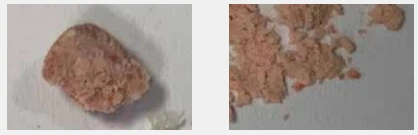
The dense tungsten carbide balls provide high impact forces. Pre-cooling the adapter and sample helps prevent the sample from adhering to the walls.
Cryogenic grinding of polyamide
| Parameter | Configuration |
|---|---|
| Mill | RETSCH CryoMill |
| Sample | 3 g polyamide pellets |
| Grinding ball | One 7 mm tungsten carbide ball |
| Pre-cooling | 15 min |
| Frequency | 30 Hz |
| Grinding time | 30 s |
| Grinding program | 9 cycles with 1 min intermediate cooling |
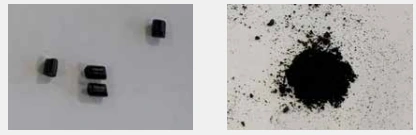
The temperature and impact forces required depend on the polymer. Larger balls and jar volumes may be needed to increase impact forces.
Models I MM 400 I MM 500 vario
5 ml stainless steel jars for MM 400 and MM 500 vario
In addition to 2 ml reaction vials, 5 ml stainless steel jars are available for use in the MM 400 and MM 500 vario. The adapter holds 4 jars, so that 8 samples can be processed simultaneously in the MM 400 and up to 24 samples in the MM 500 vario. The 5 ml jars are suitable to grind plants, pharmaceuticals, tissues, harder materials like basalt, as describes for the above-mentioned examples.
The images on the left show mixer mill types with corresponding adapter.
5 ml grinding jars I stainless steel adapter I for 2 or 4 grinding jars
Plan the configuration for your material.
Multi-cavity vessels can support parallel preparation, while individual tubes serve other sample-handling needs. Confirm the exact RETSCH mill and accessory combination. Capacity, sealing and the amount recovered after processing are separate considerations, particularly when comparing screening conditions across several small samples.
| Consideration | Information to provide |
|---|---|
| Sample availability | Mass per preparation and retained reserve |
| Accessory fit | Exact mill and vessel combination |
| Recovery | Transfer method and acceptable residual material |
How should the application examples be used?
The results describe the materials and configurations discussed here. Confirm equipment options, contact materials and operating conditions for your own sample before adopting a method. A demonstrated endpoint does not guarantee the same outcome for a different material.
Discuss material testing with Glen Mills or request further information or a quote.