
Is increasing the number of balls always beneficial?
No. The full filling arrangement influences motion and treatment. Use the supported setup for the vessel and evaluate it against the sample's preparation endpoint.
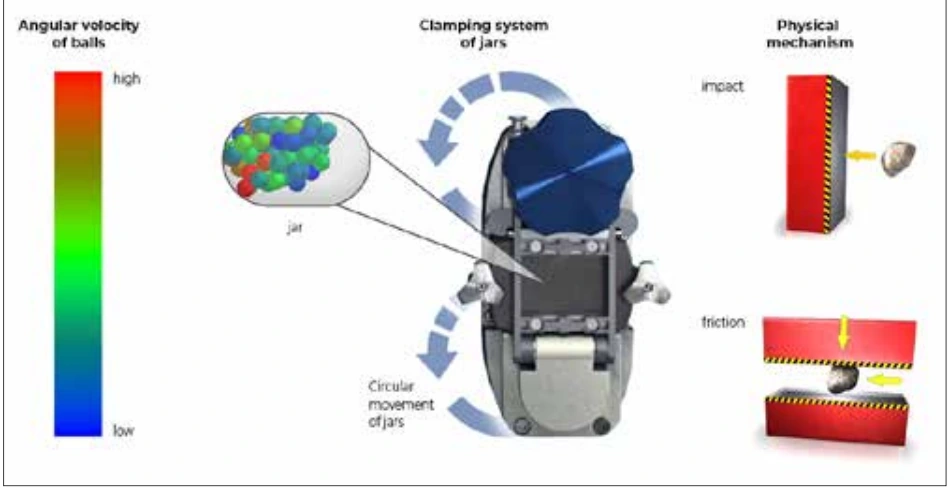
The success of a ball milling application depends on the correct selection of accessories and process parameters. This includes jar sizes, jar materials, ball sizes, number of balls, particle size, material fill level, speed and time or cycle programs. Finding the optimum setup is a challenging task because the result depends on the motion of the balls inside the jar, which is inherently statistical and chaotic in nature. A simple calculation of their movement is not possible and also computational simulations are not yet ready to do the job (see Figure).
However, a basic understanding, combined with experience and experimentation, helps to find the optimum accessories and milling parameters. Retsch calls this knowledge the "art of milling". A well-functioning ball milling process can be established by following three basic rules:
Rule 1: Select an appropriate grinding tool material Grinding tools are generally offered in a variety of materials. The material of the grinding tools ideally should be harder than the sample material and the abrasion of grinding tools should not affect the sample or analytical results.
Rule 2: Follow the advice for optimal jar filling The jar filling situation describes the number and size of balls and the amount and particle size of sample material. This optimum situation depends on what the mill is used for.
Dry grinding:
In a dry grinding process, the balls should be at least a factor of 3 larger than the largest particle of the sample material. The jar filling situation should follow the 1/3 rule, to protect the grinding equipment and allow for an effective particle size reduction: I first 1/3 of the jar volume should be filled with balls. I then 1/3 of the jar volume should be filled with material. I 1/3 of the jar volume is left free space to allow for movement and possible material expansion.
Mechanochemistry:
In mechanochemistry, the jar filling ratio is very individual and closely related to the reaction achieved. Here, the ball to material weight ratio is often greater than 1, with the consequent increase in wear of the grinding tools.
Mixing / Coating:
For final sizes < 30 μm wet grinding is the only option, also called colloidal grinding. In these wet grinding processes, a liquid, e.g. water, alcohol or buffer, is added to the sample to neutralize the surface charges and reduce the attraction of the particles to each other to prevent agglomeration effects. The size of the balls should be at least a factor of five to ten larger than the largest particle of the sample material and a fineness of 1/ 1000 times of ball size can be obtained. For wet grinding I first 60 - 70 % of the jar volume should be filled with the balls. I The dry sample material is then added and dispersed manually. Typically, sample material is added as long as it fills the spaces between the balls. Depending on the particle size of the material, sample volume can be as much as 1/3 of the jar volume.. I Finally, liquid is added and dispersed manually until the mixture´s viscosity is like oil. As the viscosity may increase during the process, the addition of liquid in between may be necessary
Mixing can theoretically be carried out with any jar filling situation. Dry or wet processing is possible. Careful selection of the jar filling situation is essential to account for the particle size reduction that may occur. Also, no balls can be used, and only the materials can be added to the jar.
Rule 3: Select speed and process-time carefully In general, high speeds imply high energy input and result in effective mixing effects and particle size reduction. In particular, impact effects, as found in mixer mills, result in rapid particle size reduction. Longer grinding times usually result in finer particles, but the smallest particle size isn't always achieved at maximum speed due to potential material caking or excessive heat generation at high energy input. To control heat generation, speed can be reduced, pauses can be introduced or temperature control can be used.
Plan the configuration for your material.
Compare tool hardness and wear with the analytical requirements. Then define the ball and sample loading so that the intended motion can occur in the selected vessel. Copying a number of balls into a differently sized jar does not preserve the same physical preparation setup.
| Consideration | Information to provide |
|---|---|
| Tool material | Sample compatibility and wear |
| Media arrangement | Ball size and quantity |
| Jar filling | Sample and any liquid phase |
How should the application examples be used?
The results describe the materials and configurations discussed here. Confirm equipment options, contact materials and operating conditions for your own sample before adopting a method. A demonstrated endpoint does not guarantee the same outcome for a different material.
Discuss material testing with Glen Mills or request further information or a quote.