
Why not test one convenient lump of lignite?
It may not represent the full sample. A controlled reduction sequence is needed to relate the laboratory result to the original material.
outline reliable determination of the heating value of lignite, based on representative sample division and sample homogenisation.
b H
Coal is one of the primary sources of electricity in the world. Although there are other sources of energy, such as oil and natural gas, coal offers the advantage of ease of combustion and the high
calorific value associated with it. The heat of combustion is defined as the total energy, which is released when a substance is burnt completely under oxygen. According to standards, such as DIN 51900 and ISO 1928, the heat of combustion for coal is determined in a bomb calorimeter. If the calorimeter is
cooled down to room temperature after burning the sample, the resulting value is the so-called higher calorific value. Especially for coal, wood and secondary fuels, however, the lower calorific value is more important. It takes into account that, during the combustion process, water resulting from moisture and oxidised hydrogen is vapourised in the hot furnace. The enthalpy of vaporisation of water reduces the combustion energy available in a power plant. Depending on the coal used, these two values may differ significantly.
The lower calorific value can be calculated if the hydrogen content in the sample is known. In this article, the authors will discuss the influence of representative sample division and sample homogenisation on the measurement of carbon and hydrogen concentrations in lignite.
Sample preparation of large quantities of lignite
A typical laboratory sample of coal often consists of 10 kg or more. Depending on the type of coal, each sample piece may have djmensions of 150 nun x 70 mm x 70 mm - or even more. When dealing with rather inhomogeneous materials, such as lignite, it is not sufficient to take one of the big lumps and crush it to obtain a few grams, which can then be used for analytical processes, such as the determrnation of the calorific value or carbon content. One piece of coal taken randomly from the laboratory sample
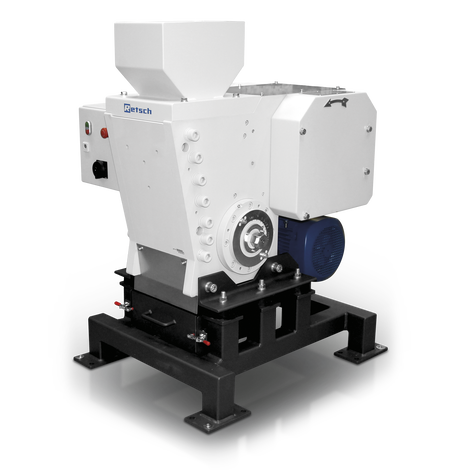
BB 500 XL jaw crusher.
will never entirely represent the original sample; using such a sample for analysis will therefore lead to unreliable results that cannot be reproduced. The German industry standard DIN 51701 stipulates the sample amount required for testing because the reproducibility of analysis results is directly related to the particle size of the sample: the bigger the particles are, the more sample material is required. In the end, however, a small amount needs to represent a large quantity. Consequently, large sample quantities need to be milled with crushers and grinders before analysis to produce homogeneous samples - from which onJy a few grams are extracted for the actual analysis. In this article, the authors will discuss different ways of preparing a coal sample for analysis and the influence the sample preparation process has on the results. A typical s.ize reduction process for coal involves the use of a laboratory jaw crusher to crush the big sample pieces. The subsequent step of fine grinding helps to increase reproducibility, as the sample is further homogenised. The use of a sample divider to produce representative part samples also has a positive effect on the reproducibility of results, as will be demonstrated later. The first step in the sample preparation process is size reduction with a jaw crusher. The RETSCH range of jaw crushers includes various XL models that accept feed sizes ranging from 110 mm to 340 mm. The BB 500 XL jaw crusher accepts feed sizes up to 110 mm and produces particle sizes down to 0.5 mm, depending on the sample properties . In the BB 500 XL, the feed material passes through the no-rebound hopper
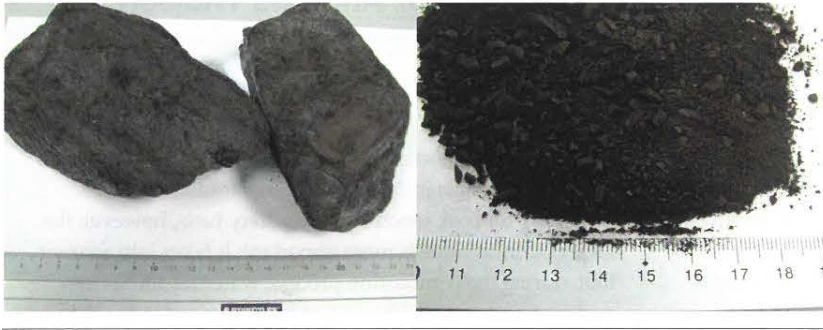
Figures 2 and 3. Lignite before (left) and after crushing in the BB 500 XL (right). With a gap width setting close to zero, the greater part of the sample showed a particle size below 1 mm.
and enters the crushing chamber. Size reduction takes place in the area between the fixed crushing arm and one oscillating arm with rugh frequency. As soon as the sample is smaller than the discharge gap width, it falls into a removable collector. The continuous gap width setting with scale ensures optimum size reduction in accordance with the set gap width. To examine the influence of sample division and sample homogenisation on the reproducibility of analysis results, three different analysis samples were produced:
- Sample A: crushed in a jaw crusher; no sample division; no further pulverisation. ■ Sample B: crushed in a jaw crusher; no sample division; further pulverisation in a rotor mill. ■ Sample C: crushed in a jaw crusher; representative sample division; further pulverisation in a rotor mill.
Production of sample A
5 kg of lignite with particle sizes up to 150 mm x 70 mm x 70 mm were crushed in Lhe BB 500 XL for 6 min. (Figw·es 2 and 3). The gap between the jaws was almost closed and the obtained particle sizes were mostly below 1 mm. Only a few larger particles (approXllllately 10 mm maximum) remained in the sample.
Production of sample B
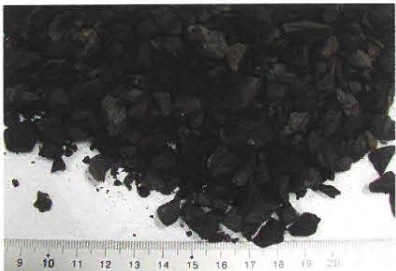
Another 5 kg of lignite were pre-crushed in the BB 500 XL with a gap width of 6 mm in 2.5 min., resulting in particles ranging from 5 mm - 20 mm . In the next step, five part samples were randomly extracted from the pre-crushed sample B and further pulverised using RETSCH's SR 300 rotor beater mill . With its variable speed of 3000 - 10 000 rpm and various accessories, such as rotors and ring sieves, this rotor mill is suitable for preliminary and fine size reduction, either in batches or continuously. The large hopper opening accepts sample feed sizes up to 25 mm. The material passes from the hopper into the centre of the grinding chamber, where it is crushed between the rotor, sieve and grinding inserts. As soon as the material is smaller than the aperture size of the
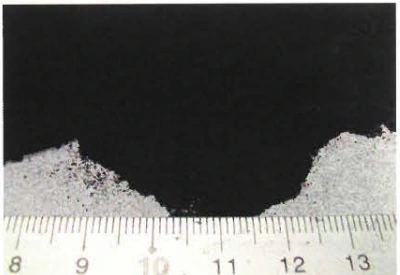
sieve, it enters the collecting receptacle. Thus, the sample remains in the grinding chamber only for a short time, which means that characteristic properties - for example, the moisture content - are not altered. The lignite sample was processed in the SR 300 using a ring sieve with 0.5 mm aperture size at a speed of 10 000 rpm. Each part sample was pulverised to a D90 value ( = 90% of the sample) of 400 µm after only 20 sec. .
Production of sample C
For sample C, the pre-crushed lignite was divided into eight representative fractions by the PT 100 sample divider from RETSCH. Rotating sample dividers are used to divide a bulk sample into representative part samples; scientific research has shown that the rotation principle is the most exact method. Five of the part samples obtained this way were then used for pulverisation in the rotor mill SR 300 with a 0.5 mm ring sieve and at maximum speed of 10 000 rpm. Again, the D90 value is approximately 400 µm.
Elemental analysis
to determine the carbon and hydrogen content The heating value of the lignite is influenced by its carbon and hydrogen content. Combustion analysers are commonly used for the measurement of element concentrations in samples, such as coal, coke or oil. They offer the benefit of simple and fast analysis with high sample weights up to several grams. The only sample preparation required is size reduction and homogenisation of the sample. From the pulverised lignite sample A, five part samples were taken randomly and analysed for its carbon and hydrogen content using the CHS-580 combustion analyser from ELTRA. The same was
done with the more homogeneous, pulverised samples B and C and the results were then compared (Table 1). ELTRA's CHS-580 is designed for the measurement of carbon, hydrogen and sulfur concentrations in organic samples. It accepts sample weights of up to 500 mg and features a resistance furnace with ceramic tube, which provides a maximum temperature of 1550°C. The measurement results for carbon and hydrogen show that the standard deviation decreases with increasing degree of pulverisation. Representative sample division provides a further improvement of the reproducibility. For those applications where a certain standard deviation is tolerable, RETSCH now offers a crusher - the BB 500 XL which accepts large feed sizes and frequently achieves a final fineness <0.5 mm in one go so that no further processing is required. For those applications, however, where a high degree of reproducibility is necessary for example, due to industry-specific standards - the sample preparation procedure involving preliminary crushing, sample division and pulverisation is the best way to ensure minimum standard deviations.
Conclusion Correct sample preparation is an important step in the quality control process, which is often neglected. It directly influences the quality of the analysis results, which can only be meaningful and reproducible if the analysis sample is homogeneous and fully represents the initial sample material. RETSCH provides a number of crushers and mills suitable for the processing of coal and coke samples. ELTRA develops and manufactures combustion analysers, which rapidly and accurately determine concentrations of C, H, 0, N, Sin a variety of solid sample materials. 'f.
SR 300 rotor beater mill with cyclone and DR 1 00 vibratory feeder.
Carbon and hydrogen content of differently prepared lignite samples (mean value of five samples)
\ Sample A: particle size mostly <l mm with a few particles! 10 mm
Sample B: pulverised, fully homogenised, partice size mostly <400 µm, random sampling Sample C: pulverised, fully homogenised, particle size mostly <400 µm, i. divided with sample divider
Carbon 44.08% ± 0.75% 44.58% ± 0.75% 43.91% ± 0.63%
Hydrogen 7.08% ±0.33% 6.95% ±0.11%
Plan the configuration for your material.
Plan reduction and division together as the sample quantity becomes smaller. The measured portion should reflect the starting material rather than the piece most convenient to process. Define handling conditions around the intended test, including properties that may change during storage or preparation.
| Consideration | Information to provide |
|---|---|
| Initial sample | Total quantity and lump variation |
| Reduction plan | Crushing and division stages |
| Test requirements | Properties that must be preserved |
How should the application examples be used?
The results describe the materials and configurations discussed here. Confirm equipment options, contact materials and operating conditions for your own sample before adopting a method. A demonstrated endpoint does not guarantee the same outcome for a different material.
Discuss material testing with Glen Mills or request further information or a quote.